 Germany · 17th century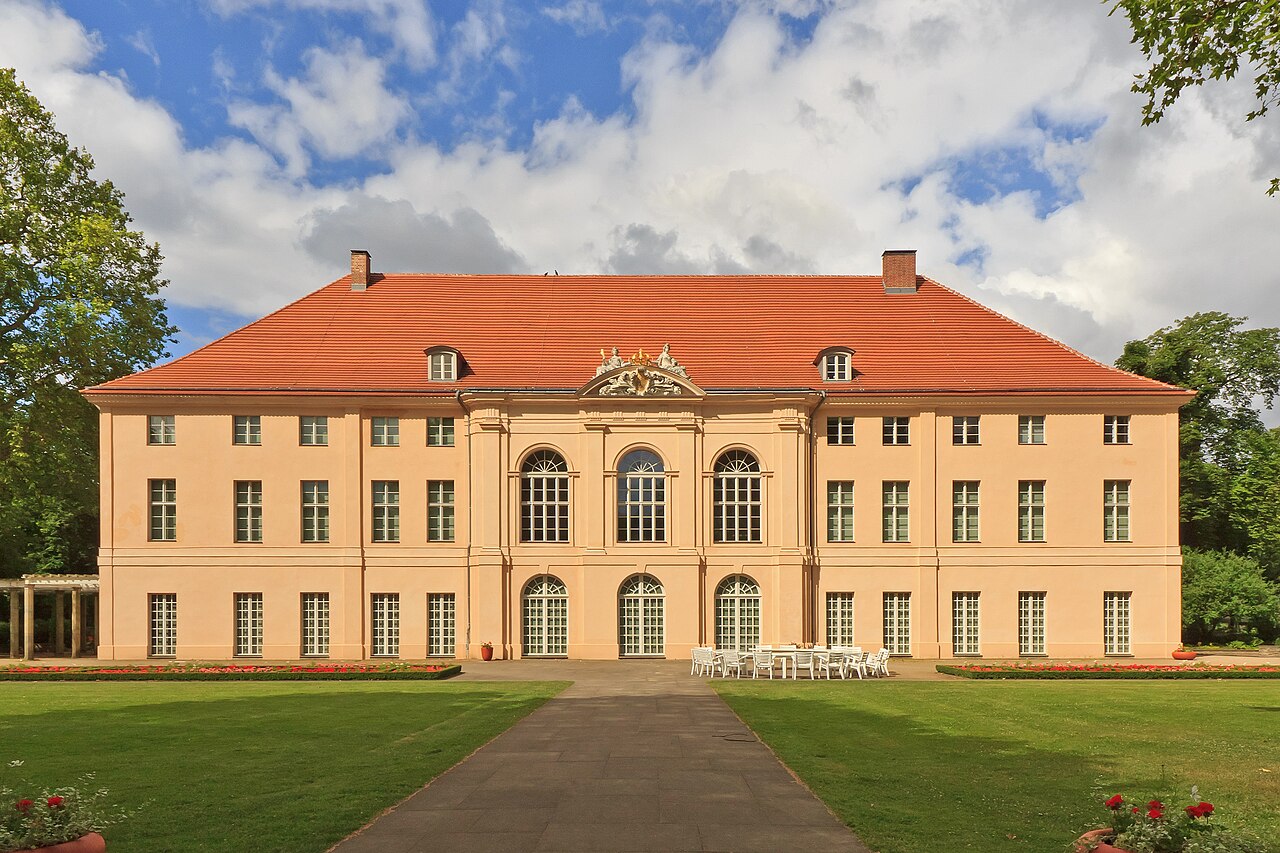
Schönhausen Palace (German: Schloss Schönhausen, pronounced [ˈʃlɔs ʃøːnˈhaʊzn̩]) is a Baroque palace at Niederschönhausen, in the borough of Pankow, Berlin, Germany. It is surrounded by gardens through which the Panke river runs. The palace is maintained by the Prussian Palaces and Gardens Foundation Berlin-Brandenburg and reopened to the public in 2009 after extensive restoration.
In 1662 Countess Sophie Theodore, a scion of the Holland-Brederode family and wife of the Brandenburg general Christian Albert of Dohna, acquired the lands Niederschönhausen and Pankow, then far north of the Berlin city gates. In 1664 she built a manor at Niederschönhausen in "Dutch" style. Minister Joachim Ernst von Grumbkow acquired it in 1680 and, in 1691, his widow sold it for 16,000 Thalers to the Hohenzollern elector Frederick III of Brandenburg, who had fallen in love with the property earlier.
Frederick put the manor under the care of the Amt Niederschönhausen and had it remodeled into a palace from 1691 to 1693 based on plans designed by Johann Arnold Nering. In August 1700 the Prince-elector prepared and planned his coronation as King in Prussia at Schönhausen Palace. In 1704 the now King Frederick I in Prussia contracted Eosander von Göthe to again enlarge the palace and its gardens. However, after the king's death in 1713, his son and successor Frederick William I did not care much for the place. As a result, civil servants, such as Minister Friedrich Wilhelm von Grumbkow, moved in to use it as office space, part of the land was leased and both the palace and the park slowly became dilapidated in the ensuing years.
Under King Frederick II of Prussia, also known as "Frederick the Great", the palace was once again turned into a royal residence for his wife, Elisabeth Christine of Brunswick-Bevern, who used it as her regular summer residence from 1740 to 1790. Artist Johann Michael Graff most probably contributed the lavish stucco decorations executed during this time. As Frederick's relations with his wife were strained, he never visited Niederschönhausen and spent his summers at Sanssouci in Potsdam.
During the Seven Years' War in 1760, while the queen retreated to the Magdeburg fortress, Russian troops pushed deep into Prussia, occupied Berlin and devastated Niederschönhausen Palace.
Text adapted from “Schönhausen Palace” on Wikipedia, CC BY-SA 4.0.
Schönhausen Palace ranks #819 of 9,079 worldwide in the atlas's castle fame ranking, and #65 of the 711 mapped in Germany. Founded 1664, it is older than 24% of the atlas's dated landmarks — one of 721 atlas entries founded in the 17th century. Its Wikipedia articles were opened 6,073 times in the last 60 days, more than 89% of the atlas. 18 more atlas landmarks stand within 25 km. The nearest day-trip guide is Berlin, 7 km away. See how Germany compares in the castle statistics.
View on the interactive castle map →