 Romania · 14th century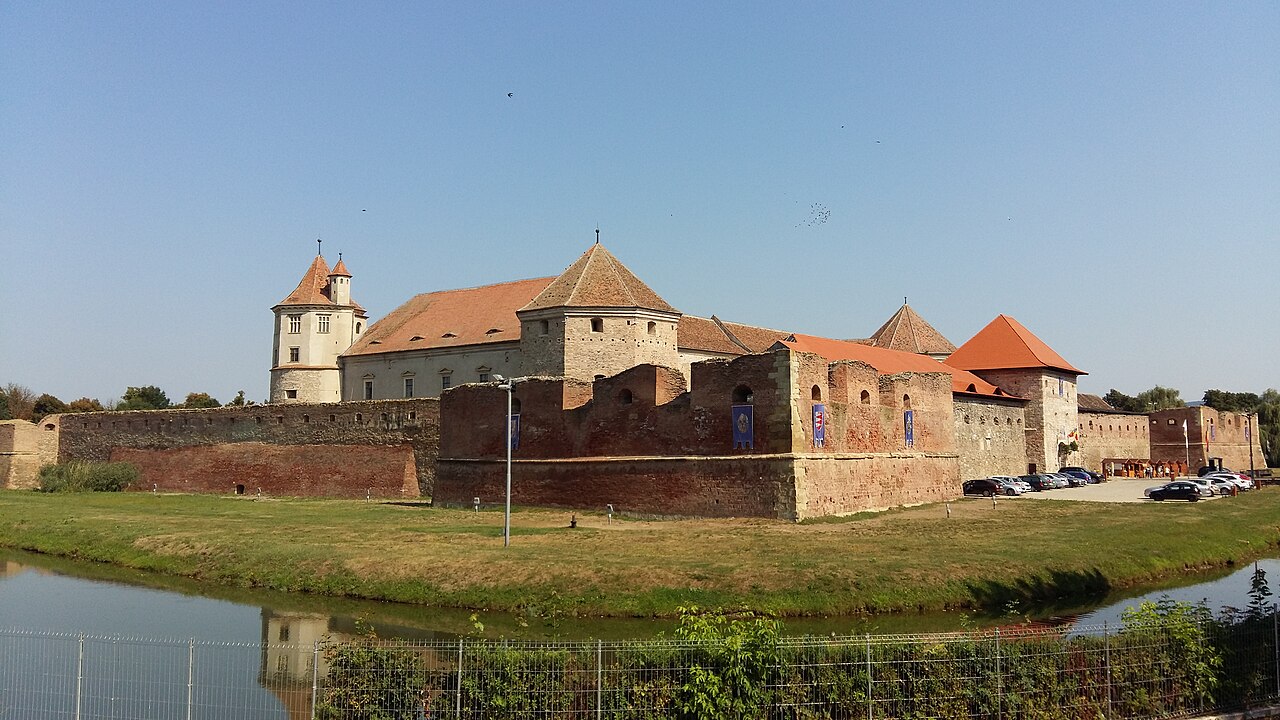
Făgăraș Citadel (Romanian: Cetatea Făgărașului pronunciation: [fəɡəˈraʃ], Hungarian: Fogarasi vár, German: Fogarascher Burg) is a historic monument in Făgăraș, Brașov County, Romania.
The construction of the fortress started in 1310, on the site of a wooden fortification with earth ramparts from the 12th century. Archeological research shows that the old fortification was violently destroyed around the middle of the 13th century, presumably in connection with the Mongol invasion of 1241. Located halfway between Brașov and Sibiu and close to Wallachia, the Făgăraș Citadel provided a defensive position against possible incursions into south-eastern Transylvania.
In 1526, István Majláth consolidated the citadel, doubling the thickness of the walls. In 1541, the Ottomans attacked the fortress and captured Mailat, who died in captivity at Yedikule Fortress in Istanbul. Gáspár Bekes, owner of the citadel between 1567 and 1573, constructed the moat around the fortress, the excavated earth being used to strengthen the inner part of the walls. During the time of Stephen VIII Báthory (voivode of Transylvania from 1571 to 1586) and Balthasar Báthory (lord of the fortress from 1588 to 1594), the first bastion was constructed in the south-eastern corner of the outer defensive ring.
In 1599, Michael the Brave occupied Făgăraș Citadel and sheltered there his family and the royal treasure. In the 17th century, Prince Gabriel Bethlen gave it priority over Alba Iulia in modernizing the fortifications, while Michael I Apafi transformed it, due to its strengthened position, into a princely residence. It functioned as a garrison from 1689, preserving its military function after the union of Transylvania with Romania.
In 1950, the citadel was converted into a prison for political detainees. It was ideally suited for this purpose: the surrounding moat, high walls two to three meters thick, barred windows and geometric shape allowing sentinels to guard the interior and exterior all combined to make escape practically impossible. The exterior fortifications were used by the Securitate secret police as an operational base in their struggle against the anti-communist resistance fighters in the Făgăraș Mountains. The prison housed former cadres of the Siguranța and the Police. In early 1950, the citadel held 101 common criminals.
Text adapted from “Făgăraș Citadel” on Wikipedia, CC BY-SA 4.0.
Făgăraș Citadel ranks #1,719 of 9,035 worldwide in the atlas's castle fame ranking, and #20 of the 125 mapped in Romania. Founded 1310, it is older than 60% of the atlas's dated landmarks, one of 757 atlas entries founded in the 14th century. Its Wikipedia articles were opened 3,523 times in the last 60 days, more than 81% of the atlas. 2 more atlas landmarks stand within 25 km. The nearest day-trip guide is Brașov, 54 km away. It is one of the 78 landmarks on the atlas's regional map of Transylvania. It is stop 10 of 26 on the Transylvania castle route, Bran to Cluj-Napoca. See how Romania compares in the castle statistics.
View on the interactive castle map →