 China · 19th century
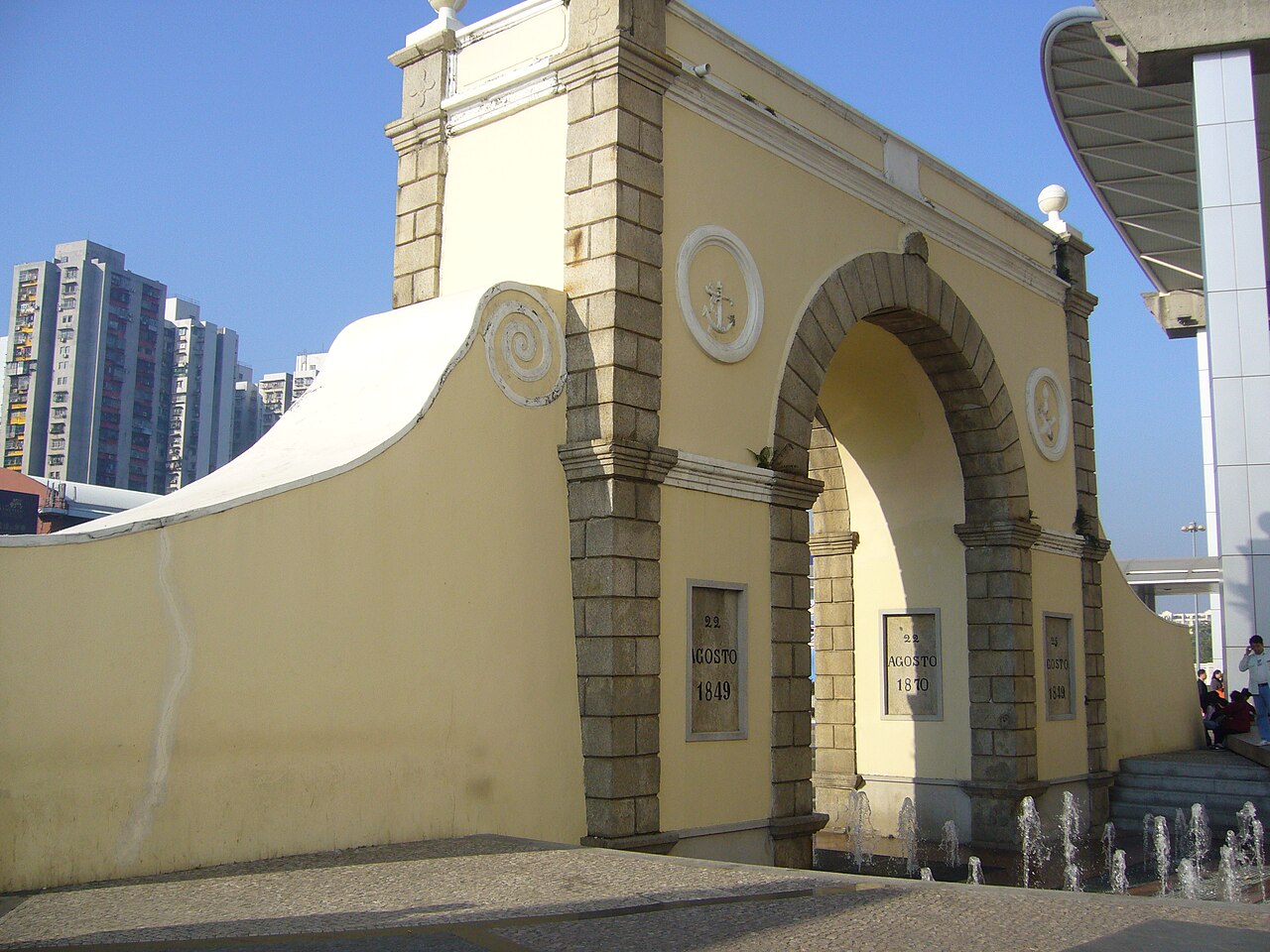
Portas do Cerco ranks #2,196 of 9,040 worldwide in the atlas's castle fame ranking, and #40 of the 103 mapped in China. Founded 1849, it is older than 8% of the atlas's dated landmarks, one of 705 atlas entries founded in the 19th century. Its Wikipedia articles were opened 3,160 times in the last 60 days, more than 79% of the atlas. 8 more atlas landmarks stand within 25 km. The nearest day-trip guide is Zhuhai, 7 km away. See how China compares in the castle statistics.
The Portas do Cerco is an area in Nossa Senhora de Fátima, Macau, China. Located on the northern tip of the Macau Peninsula, it is known by the Barrier Gate separating Macau from mainland China. The Portuguese built the gate in 1849 to replace a crumbling wall that the Chinese erected during the Ming dynasty in 1573. The Chinese built a garrisoned wall to control the flow of people and goods. It was the site of the Passaleão incident, a clash between the Qing dynasty and the Kingdom of Portugal in 1849 over the death of Macau's governor Ferreira do Amaral. Led by Colonel Mesquita, Portugal won the small battle which led to the extension of Macau's border northwards.
At the limit of said expansion, the Portas do Cerco was built with the inscription "A pátria honrai, que a pátria vos contempla" (Portuguese for "Honor your fatherland, for your fatherland looks over you") on the façade on its inner arch in 1849. The Barrier Gate served as a de facto boundary, but the precise limits of Macau's border has never been formally demarcated.
Macau, now a special administrative region of China, still has an official border with Zhuhai in mainland China a few meters behind the old barrier gate. The new Posto Fronteiriço das Portas do Cerco (Barrier Gate Border Post) was opened on 15 January 2004.
Text adapted from “Portas do Cerco” on Wikipedia, CC BY-SA 4.0.
View on the interactive castle map →