 China
China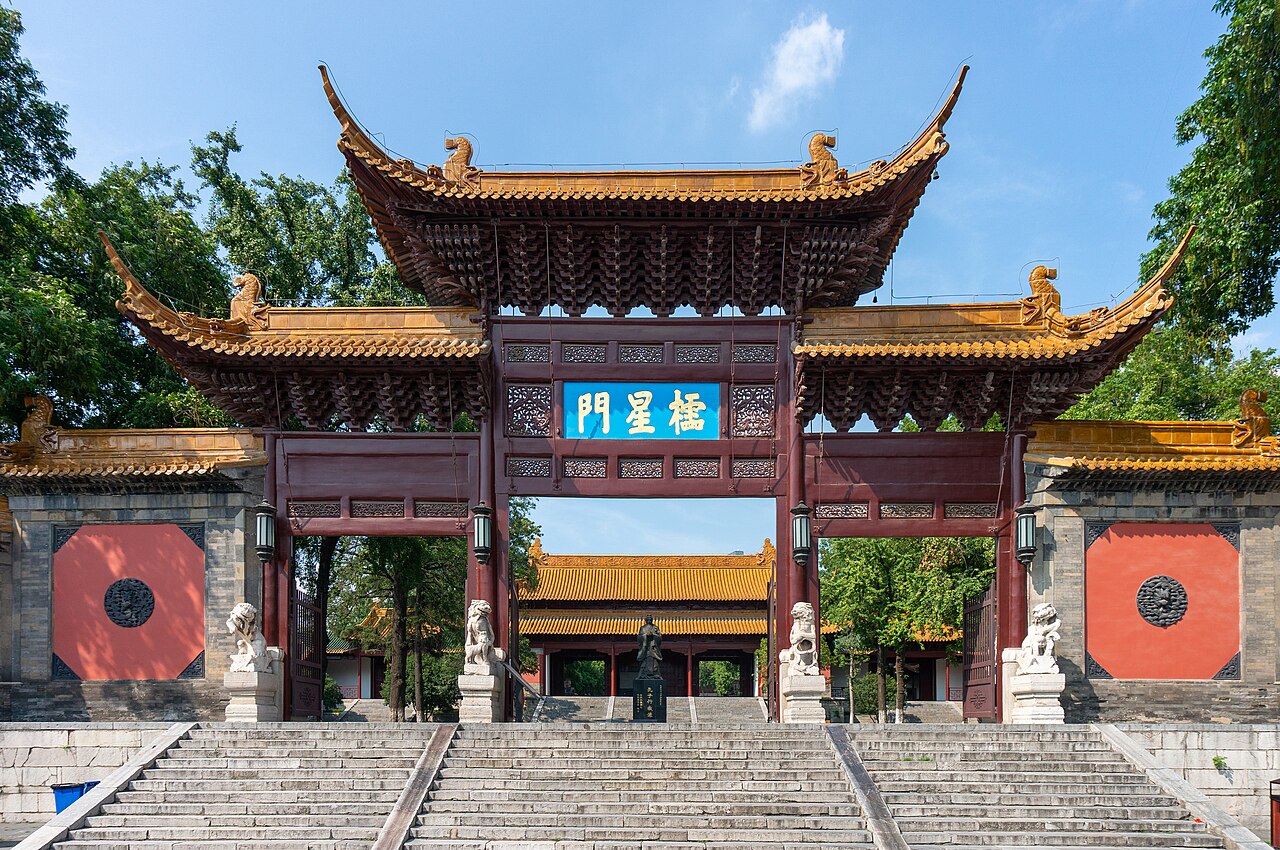
The Chaotian Palace (Chinese: 朝天宫; pinyin: Cháotiān Gōng, lit. "Palace of Heaven Veneration") is located in Nanjing, China. It was built as an imperial palace in the Ming dynasty, and today it is known as the Nanjing Municipal Museum. Chaotian Palace area has the largest preserved traditional Chinese architectural complex in Jiangnan.
The palace is a complex of buildings, in the center of which is the Wen Temple, which was built with precious materials, including yellow glazed tile was from Jingdezhen in Jiangxi province. It is a total of 70,000 square meters, consisting of three lines. Within the palace are more than 100,000 cultural relics.
The site of the palace is located on Ye Mountain, once a place for metal casting in the ancient time of State of Wu in Zhou dynasty, named Ye Cheng, literally the city of metallurgy, the first name of the city of Nanjing. The Imperial Central University, at the time called Zongmingguan, was located there in Former Song dynasty. Chaotian Palace, or called Mingtian Palace, as a Taoist temple was originally named Ziji Palace built on the site of Zongmingguan in the era of Southern Wu, the Kingdom of Wu in the ending of Tang dynasty. It was rebuilt as Chaotian Palace by the Hongwu Emperor during the early Ming dynasty (in the late 14th century). In Ming dynasty it was used primarily by members of the royalty for "veneration of ancestors".
The complex was burnt down during the Taiping Rebellion in Qing dynasty, and the present buildings were built from 1866 to 1870 when Nanking Academy (Jiangning Fuxue) moved to the site. During the ROC rule the place became Examination Yuan, Capital High Court, Ministry of Education (once named Tahsueh Yuan), as well as Palace Museum Nanjing Branch. In the PRC it became the Nanjing Municipal Museum.
Chaotian Palace is located in the west gate of Qinhuai District, Nanjing. It is the highest grade, the largest scale and the most complete preservation of ancient buildings in Jiangnan area. Emperor Zhu Yuanzhang of Ming Dynasty named Chaotian Palace, meaning "to worship heaven" and "to see the emperor", is the highest view of Ming Dynasty royal Taoism.
Text adapted from “Chaotian Palace” on Wikipedia, CC BY-SA 4.0.
Chaotian Palace ranks #2,637 of 9,035 worldwide in the atlas's castle fame ranking, and #42 of the 103 mapped in China. Its Wikipedia articles were opened 1,892 times in the last 60 days, more than 68% of the atlas. 3 more atlas landmarks stand within 25 km. See how China compares in the castle statistics.
View on the interactive castle map →