Fortress
Simatai
🇨🇳 China · 6th century
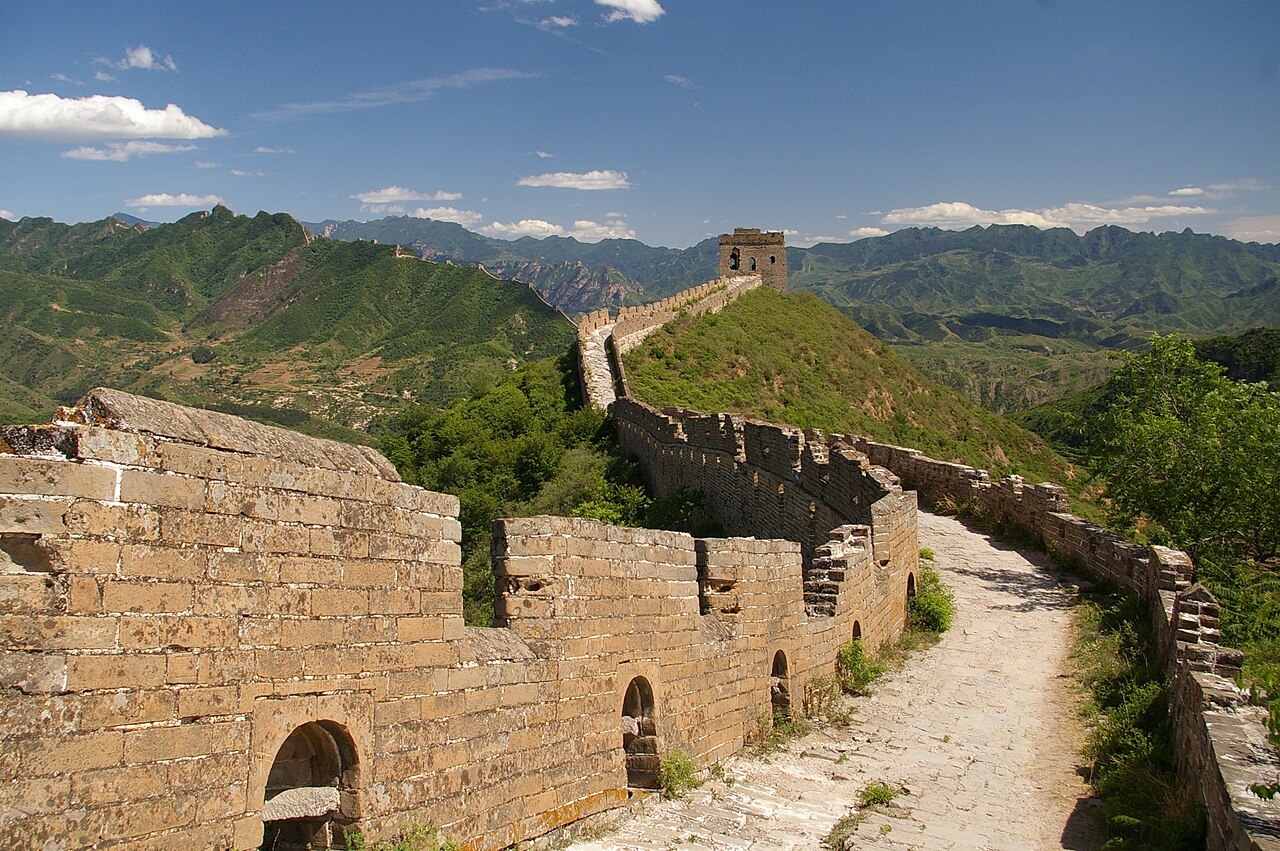
Simatai (Chinese: 司马台; pinyin: Sīmǎtái), a section of the Great Wall of China located in the north of Miyun District, 120 km northeast of the city center of Beijing, holds the access to Gubeikou, a strategic pass in the eastern part of the Great Wall. It was closed in June 2010 but has been reopened to tourists since 2014.
The section was originally built during the Northern Qi dynasty (550–577) and rebuilt during the Hongwu Emperor's reign during the Ming dynasty.
Simatai Great Wall is 5.4 km long with 35 beacon towers. This section of the Great Wall incorporated the different characteristics of each section of the Great Wall. A specialist on the Great Wall, Professor Luo Zhewen, has said that "The Great Wall is the best of the Chinese buildings, and Simatai is the best of the Great Wall." UNESCO has designated Simatai Great Wall as one of the World Cultural Heritage Sites as part of the Great Wall World Heritage Site.
Simatai Great Wall is separated by a valley into eastern and western parts. The western part is gently sloped with 20 well-preserved watchtowers dotting along the wall. The eastern part is much steeper, following more rugged terrain that includes cliff edges and kilometre-high peaks.
Hanging precariously onto the Yan Mountains, Simatai Great Wall is known for its steepness. Open-air gondolas provide a way to ascend partway up the wall. The 17 watchtowers are relatively closely spaced and have views of the surrounding area.
Tower 12- the last accessible tower, generally occupied by a guard preventing access to the more dangerous sections further on.
Tower 14 - 'Cat's Eye Tower' (Maoyan Lou; 猫眼楼) Heavenly Ladder: Climbing the mountainside at a steep 80-degree gradient, the Heavenly Ladder leads to the Fairy Tower. Stretching upward along the abrupt mountain ridges, the narrowest part is just half a meter wide.
Tower 15 - 'Fairy Tower' (Xiannü Lou; 仙女楼): With a sculpture of twin lotus flowers above the arched doors, it is considered by many to be the most beautiful of all towers and is known for its architecture. Legend has it that it was the dwelling place for an antelope reincarnated in the form of an angel who fell in love with a shepherd.
Sky Bridge: As little as 40 centimeters wide in places, this 100-meter-long segment of the wall connects the Fairy Tower to Watching Beijing Tower.
Text adapted from “Simatai” on Wikipedia, CC BY-SA 4.0.
Simatai ranks #1,840 of 8,134 worldwide in the atlas's castle fame ranking, and #38 of the 119 mapped in China. Founded c. 564, it is older than 96% of the atlas's dated landmarks — one of 34 atlas entries founded in the 6th century. Its Wikipedia articles were opened 2,303 times in the last 60 days, more than 70% of the atlas. 1 more atlas landmarks stand within 25 km. See how China compares in the castle statistics.
View on the interactive castle map →Frequently asked questions
Where is Simatai?
Simatai stands in China, at 40.65914°, 117.28176°.
When was Simatai built?
The atlas dates its founding to c. 564. Earlier structures may have stood on the site; this is the earliest documented founding year.
How famous is Simatai?
In this atlas's fame ranking: #1,840 of 8,134 worldwide, and #38 in China. Fame here combines how many Wikipedia language editions cover a landmark with how many people read them.
What is the nearest castle to Simatai?
Jinshanling, about 3 km away.
More castles in China
- Andingmen China
- Wanping Fortress China · 17th century
- Hushan Great Wall China · 15th century
- Yungbulakang Palace China · 7th century
More fortresses
- Puerta de Elvira Spain · 11th century
- James Joyce Tower and Museum Ireland · 19th century
- Castra Pinnata Scotland
- Castrum Segontium Wales