 Bosnia and Herzegovina · 14th century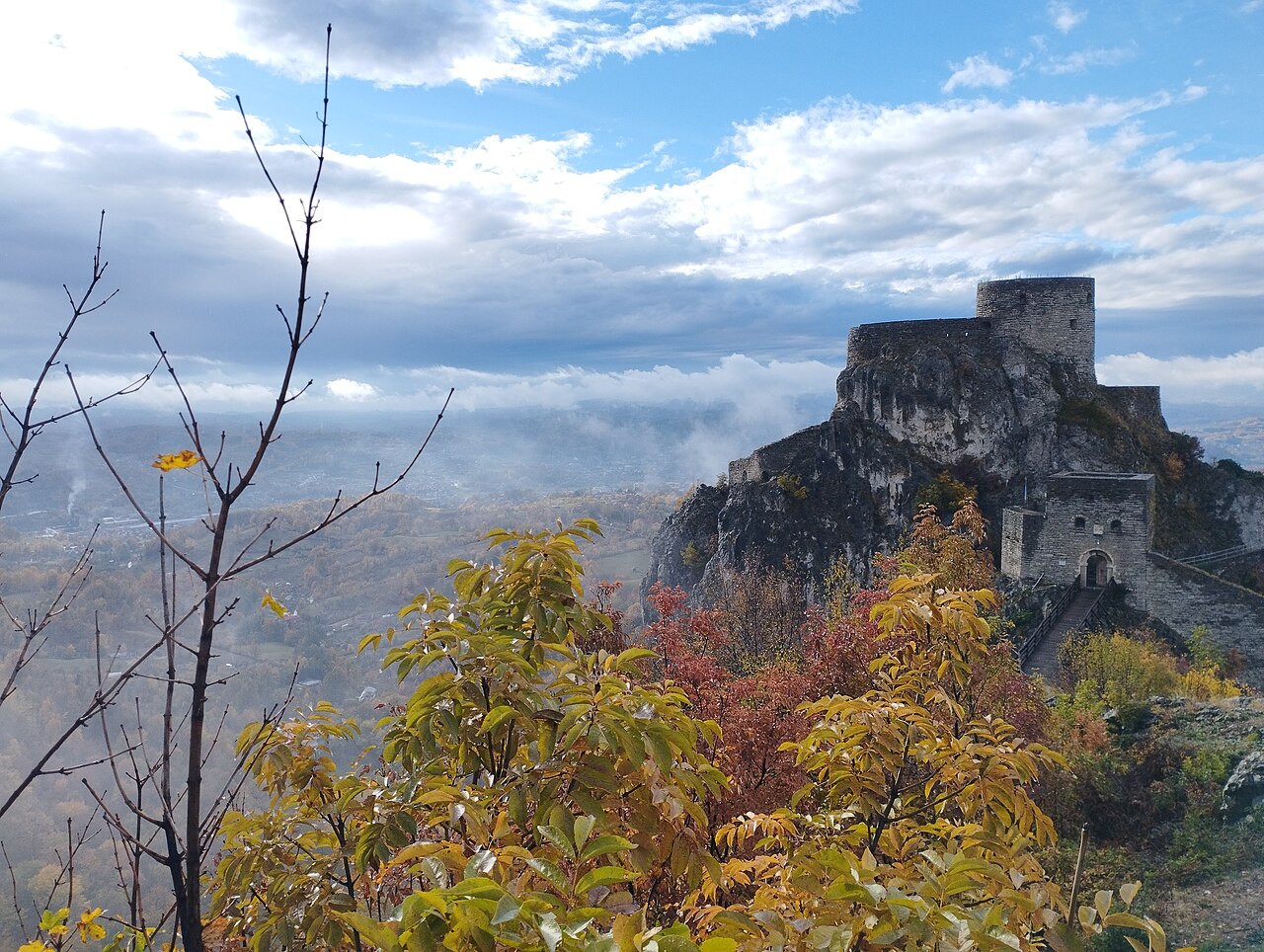
Srebrenik Fortress (Bosnian, Croatian and Serbian: Tvrđava Srebrenik / Тврђава Сребреник; also known as: Gradina / Градина) is a fortress located near the city of Srebrenik in Bosnia and Herzegovina. It has been a national monument of Bosnia and Herzegovina since 2 November 2004.
The fortress is located on the northeastern slopes of Majevica mountain in the village of Gornji Srebrenik, about 5 km away from the city centre. It is built on a steep, almost inaccessible rock, with a deep trench dug underneath, with the only entrance being a small bridge.
No current historical sources identify the exact year of its construction or who its constructor was. Earliest records date back to edicts of Stephen II to Ragusa from 1333.
It was located on, at the time, important military roads which made it an important strategic stronghold. Already in 1363, king Louis I of Hungary sent an army to Bosnia, led by his palatine Nicholas Kont, which suffered significant losses under Srebrenik.
In 1393 it was captured by Hungarian king Sigismund of Luxembourg and within the next decades it changed rulers several times, with Hungarians recapturing it in 1405, 1408 and 1410 respectively. It was then granted as a gift to Serbian despot Stefan Lazarević, but remained in use by the Hungarians as a garrison. King Thomas of Bosnia managed to recapture it by 1433, but already in 1452 it was seized by Đurađ Branković, nephew of Stefan Lazarević, who gave it to Hungarians.
By 1462 the entire župa Usora was under Ottoman control, including Srebrenik. Due to failures in logistics and an epidemic, the Ottoman army had to retreat and Matthias Corvinus managed to seize back Srebrenik. In order to further improve defense against future Ottoman attacks, Matthias created Banate of Srebrenik in 1464 and granted it to Nicholas of Ilok who later became the titular king of Bosnia.
It is not known when the Ottomans recaptured it, but sometime between 1510 and 1519 is the most likely date.
Ever since the Battle of Mohács and up to Treaty of Karlowitz, due to expansion of Ottoman borders, the fortress saw very little military activity. Because of that, it was either completely abandoned or left with only a small garrison.
The Srebrenik Castle belonged to the Smoluća Nahija, the prince was Vlatko, son of Vladimir. He had 8 sons of which 3 converted to Islam.
Text adapted from “Srebrenik Castle” on Wikipedia, CC BY-SA 4.0.
Srebrenik Fortress ranks #2,205 of 9,079 worldwide in the atlas's castle fame ranking, and #6 of the 40 mapped in Bosnia and Herzegovina. Founded 1333, it is older than 58% of the atlas's dated landmarks — one of 755 atlas entries founded in the 14th century. Its Wikipedia articles were opened 1,705 times in the last 60 days, more than 65% of the atlas. 1 more atlas landmarks stand within 25 km. The nearest day-trip guide is Sarajevo, 95 km away. See how Bosnia and Herzegovina compares in the castle statistics.
View on the interactive castle map →