 China · 16th century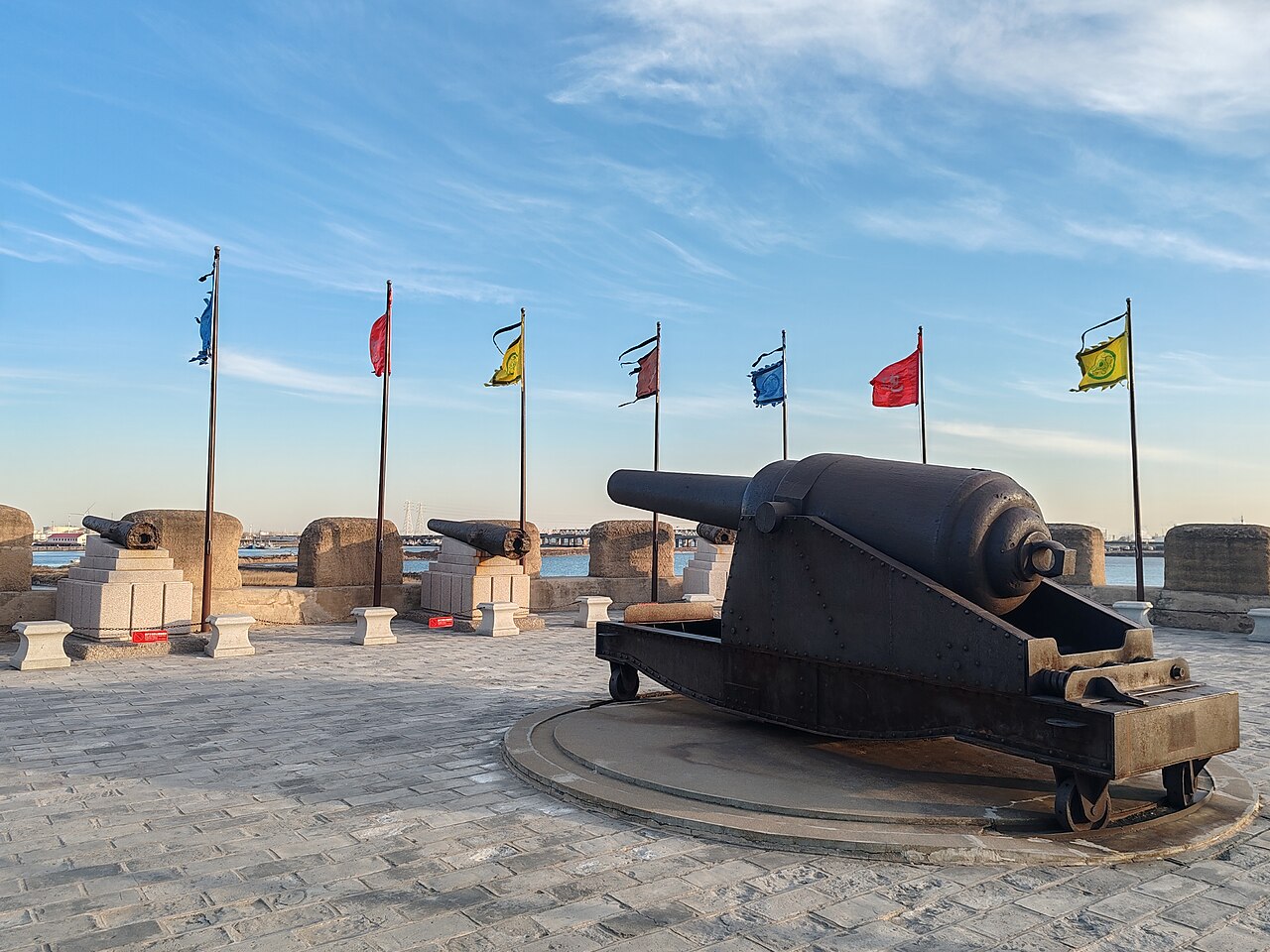
The Taku Forts or Dagukou Forts (大沽口炮台), also called the Peiho Forts are forts located by the Hai River (Peiho River) estuary in the Binhai New Area, Tianjin, in northeastern China. They are located 60 km (37 mi) southeast of the Tianjin urban center.
In 1988 the Dagukou Forts were added to the 3rd Batch of National Priority Protected Sites, and was open to the public in 1997.
The first fort was built during the reign of the Ming Jiajing Emperor between 1522 and 1527 by the local military governor Qi Jiguang. Its purpose was to protect Tianjin from attack by wokou sea raiders.
Later, in 1816, the Qing government built the first two forts on both sides of the Haihe estuary in response to increased concerns about seaborne threats from the West. By 1841, in response to the First Opium War, the defensive system in Dagukou was reinforced into a system of five big forts, 13 earthen batteries, and 13 earthworks. In 1851, Imperial Commissioner Sengge Rinchen carried out a comprehensive renovation of the forts, building 6 large forts: two on the south of the estuary, called "Wēi" (威-Might) and "Zhèn" (震-Thunder, Tremor, Quake), three to the north, "Hǎi" (海-sea), "Mén" (门-gate) "Gāo" (高-high), and the sixth, the "Shitoufeng" (石头缝-Stone Seam) Fort, was built on a small ridge on the northern shore.
Each fort had three large guns and 20 small caliber guns. Forts were constructed of wood and brick with an external curtain of two feet of concrete, the layering designed to avoid spalling and minimize penetration by artillery rounds. The forts were around 10 to 15 meters (33 to 49 ft) high, which located as they were in an exceedingly flat landscape, provided a critical vantage point.
In 1856, Chinese soldiers boarded The Arrow, a Chinese-owned ship registered in Hong Kong flying the British flag and suspected of piracy, smuggling and of being engaged in the opium trade. They captured 12 men and imprisoned them. Though the certificate allowing the ship to fly a British flag had expired, there was still an armed response. The British and French sent gunboats under the command of Admiral Sir Michael Seymour to capture the Taku Forts in May 1858. In June 1858, at the end of the first part of the Second Opium War, the Treaties of Tianjin were signed, which opened Tianjin to foreign trade.
Text adapted from “Taku Forts” on Wikipedia, CC BY-SA 4.0.
Taku Forts ranks #898 of 9,079 worldwide in the atlas's castle fame ranking, and #23 of the 107 mapped in China. Founded 1522, it is older than 42% of the atlas's dated landmarks — one of 891 atlas entries founded in the 16th century. Its Wikipedia articles were opened 5,323 times in the last 60 days, more than 87% of the atlas. See how China compares in the castle statistics.
View on the interactive castle map →