 England · 13th century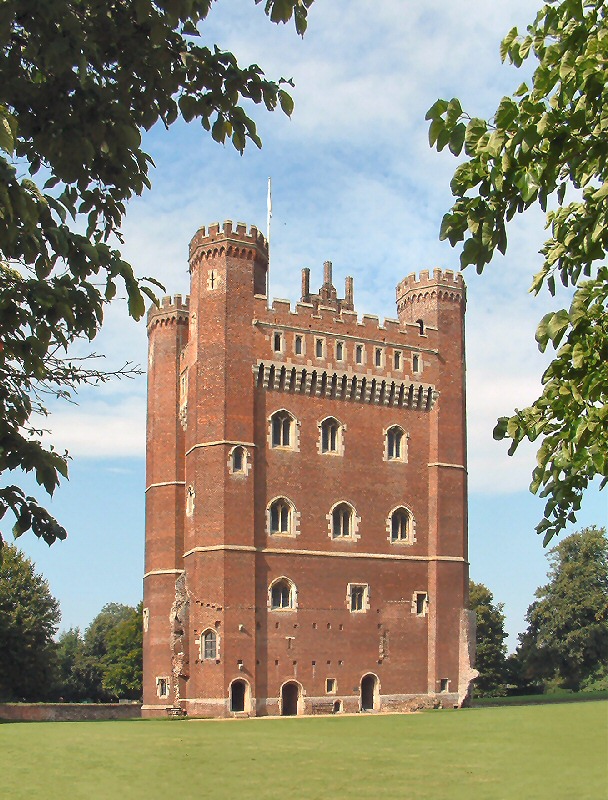
Tattershall Castle is a castle in Tattershall, Lincolnshire, England. Since 1925 it has been in the care of the National Trust.
Tattershall Castle has its origins in either a stone castle or a fortified manor house, built by Robert de Tattershall in 1231. This was largely rebuilt in brick, and greatly expanded, by Ralph Cromwell, 3rd Baron Cromwell, Treasurer of England, in the 15th century. Tree ring dating indicates that construction was underway between 1406 and 1431.
Brick castles are less common in England than stone or earth and timber constructions; when brick was chosen as a building material it was often for its aesthetic appeal or because it was fashionable. The trend for using bricks was introduced by Flemish weavers. There was plenty of stone available nearby, but Cromwell chose to use brick. About 700,000 bricks were used to build the castle, which has been described as "the finest piece of medieval brick-work in England".
Of Lord Cromwell's castle, the 130 ft (40 m) high Great Tower and moat still remain. It is thought that the castle's three state rooms were once splendidly fitted out and the chambers were heated by immense Gothic fireplaces with decorated chimney pieces and tapestries. It has been said that the castle was an early domestic country mansion masquerading as a fortress. Cromwell died in 1456, and the castle was initially inherited by his niece, Joan Bouchier, but it was confiscated by the Crown after her husband's demise and remained in royal ownership from king Edward IV to king Henry VIII. Tattershall Castle was recovered in 1560 by Sir Henry Sidney, who sold it to Lord Clinton, later Earl of Lincoln, and it remained with the Earls of Lincoln until 1693. It passed to the Fortesques, but then fell into neglect.
It was put up for sale in 1910. Its greatest treasures, the huge medieval fireplaces, were still intact. When an American bought them they were ripped out and packaged up for shipping. Lord Curzon of Kedleston stepped in at the eleventh hour to buy the castle and was determined to get the fireplaces back. After a nationwide hunt they were found in London and returned. He undertook restorations of the castle between 1911 and 1914. It was gifted to the National Trust, on his death, in 1925 and remains today one of the three most important surviving brick castles of the mid-15th-century in the United Kingdom.
Text adapted from “Tattershall Castle, Lincolnshire” on Wikipedia, CC BY-SA 4.0.
Tattershall Castle ranks #1,482 of 9,079 worldwide in the atlas's castle fame ranking, and #97 of the 360 mapped in England. Founded 1231, it is older than 72% of the atlas's dated landmarks — one of 1080 atlas entries founded in the 13th century. Its Wikipedia articles were opened 2,350 times in the last 60 days, more than 73% of the atlas. 1 more atlas landmarks stand within 25 km. The nearest day-trip guide is Sheffield, 91 km away. See how England compares in the castle statistics.
View on the interactive castle map →