 England · 12th century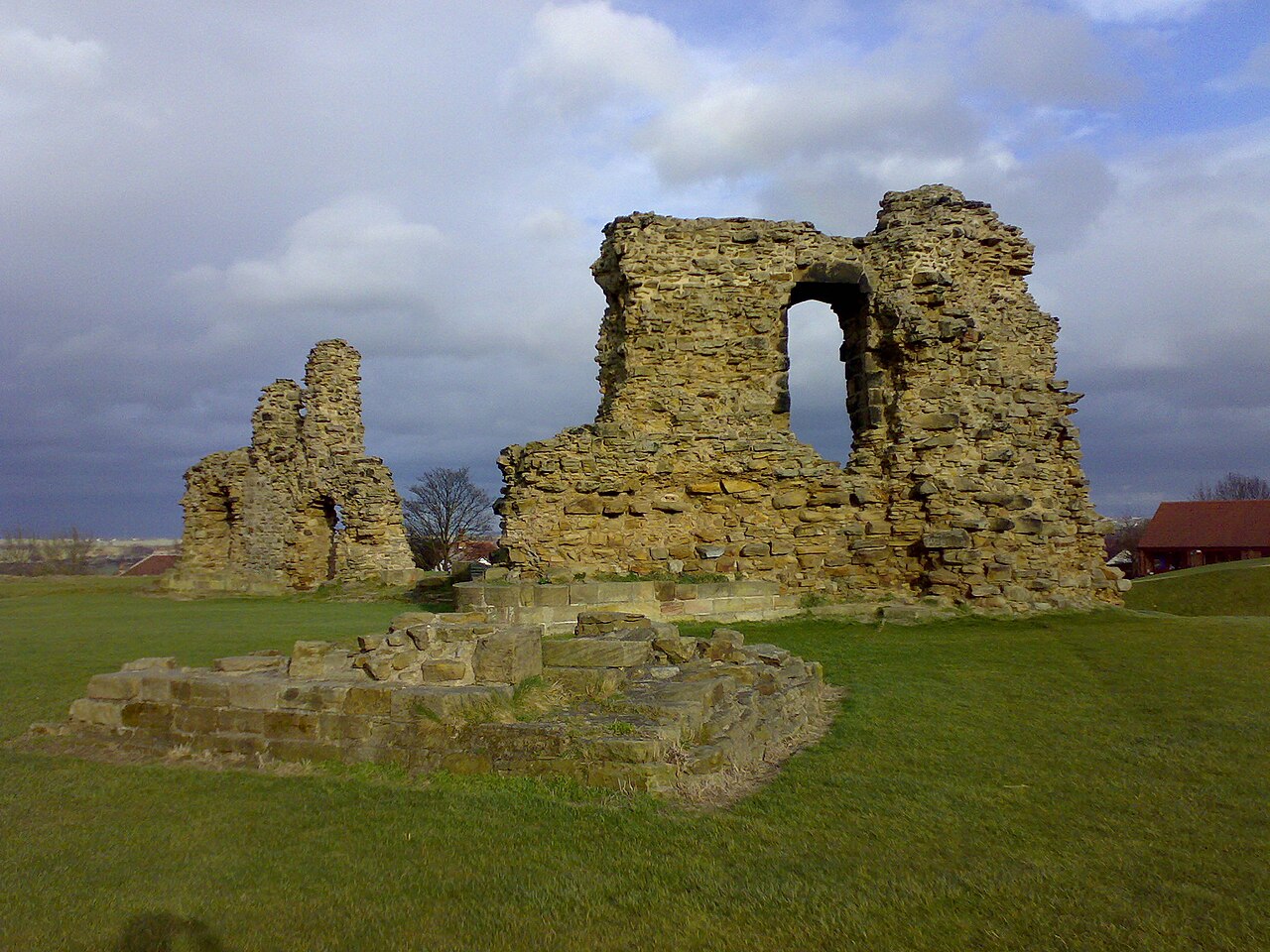
Sandal Castle is a ruined medieval castle in Sandal Magna, a suburb of the city of Wakefield in West Yorkshire, England, overlooking the River Calder. It was the site of royal intrigue and the setting for a scene in one of William Shakespeare's plays.
William de Warenne, 2nd Earl of Surrey (1081–1138) was granted the Sandal estates in 1107. The 2nd earl built the first Sandal Castle of timber. He supported Robert Curthose against Henry I of England and was banished from the kingdom for two years. Later he was given the Wakefield manor. William de Warenne, 3rd Earl of Surrey (1119–1148) spent little time at Sandal, having taken crusading vows and joined the Second Crusade. He had one daughter, Isabel de Warenne (1137–1199), who married William of Blois, son of King Stephen, who became the 4th earl. He died in 1159, leaving no children. Isabel, his widow, next married Hamelin (1129–1202), the 5th earl.
He was the son of Geoffrey of Anjou and assumed the Warrene name on his marriage in 1164. Hamelin is thought to have built the early Norman stone fortifications at Conisbrough Castle and also begun to replace the wooden fortifications at Sandal with stone.
William de Warenne, 5th Earl of Surrey (1166–1240) married Maud Marshal in 1225. He was loyal to his cousin, King John and is one of the four nobles whose name appears in the Magna Carta for John. On King John's death in 1216 he supported Henry III. Maud de Warenne, William's widow, held the Wakefield Manor from 1240 until their son John de Warenne, 6th Earl of Surrey (1231–1304) came of age in 1252. John married Alice de Lusignan in 1247. In 1296 the 6th Earl was appointed warden for Scotland by Edward I and in 1299, the Earl and his royal master were triumphant over the Scots at the Battle of Falkirk.
William de Warrene (1256–1286) was killed at a tournament in Croydon pre-deceasing his father. His son John de Warenne, 7th Earl of Surrey (1286–1347) was born in the year of his death. John married Joan of Bar but lived adulterously with Maud de Nereford from a village near Castle Acre in Norfolk. In 1347, the 7th Earl died. His sons John and Thomas became Knights Hospitaller in the Holy Land, predeceasing their mother. The lands passed to Edward III.
The Warennes had castles at Lewes in Sussex and Reigate in Surrey, Castle Acre Castle in Norfolk and Conisbrough in Yorkshire.
Text adapted from “Sandal Castle” on Wikipedia, CC BY-SA 4.0.
Sandal Castle ranks #1,705 of 9,079 worldwide in the atlas's castle fame ranking, and #109 of the 360 mapped in England. Founded c. 1150, it is older than 80% of the atlas's dated landmarks — one of 756 atlas entries founded in the 12th century. Its Wikipedia articles were opened 1,941 times in the last 60 days, more than 69% of the atlas. 1 more atlas landmarks stand within 25 km. The nearest day-trip guide is Sheffield, 31 km away. See how England compares in the castle statistics.
View on the interactive castle map →