 England · 13th century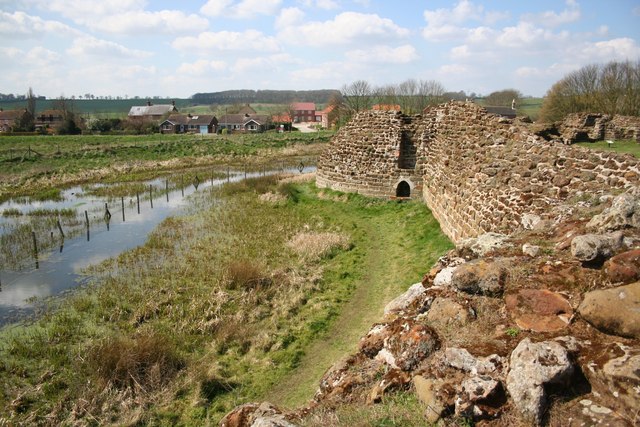
Bolingbroke Castle is a ruined castle in Bolingbroke (now Old Bolingbroke) in Lincolnshire, England.
Most of the castle is built of Spilsby greenstone, as are several nearby churches. The local greenstone is a limestone that proved to be porous, prone to rapid deterioration when exposed to weather and a substandard building material. The castle was constructed as an irregular polygonal enclosure. The castle is one of the earliest examples of a uniform castle designed and built without a keep. It was originally surrounded by a large water-filled moat 31 metres (102 ft) wide. The curtain wall was up to 5 metres (16 ft) thick and defended by five D-shaped towers and a twin-towered gate house.
Similar to another castle built by Ranulf during the same period at Beeston in Cheshire, Bolingbroke had no inner defensive keep. The castle relied instead on thick walls and the five D-shaped defensive corner towers. Some design similarities are noted with the contemporary castle at Boulogne-sur-Mer, France that was also constructed without a central donjon.
The area was first fortified by the Saxons in the 6th or 7th century. In the 12th century the Normans built a Motte-and-bailey on a nearby hill above the settlement of Bolingbroke.
The present structure was founded by Ranulf, Earl of Chester, in 1220 shortly after he returned from the Fifth Crusade.
Ranulf died in 1232 without a male heir, and his titles, lands and castles passed to his sisters. Following the death of Henry of Grosmont, 1st Duke of Lancaster in 1361 Bolingbroke passed through marriage into the ownership of John of Gaunt. His wife Blanche of Lancaster, daughter of Henry of Grosmont, was born at the castle in 1342. John and Blanche's son, Henry (the future Henry IV), was also born at Bolingbroke Castle in 1367 and consequently was known as "Henry Bolingbroke" before he became king in 1399.
By the 15th and 16th century, the castle had fallen into disrepair although repairs were carried out during the Tudor period. The castle was used by auditors of the Duchy of Lancaster. Structures were named after the officials, including the "Receiver's Tower" and the "Feodary's Tower". Lead for the roof of the gatehouse was brought from an abandoned chapel at Trusthorpe. In 1636 a survey found that all of the towers were effectively beyond repair.
Text adapted from “Bolingbroke Castle” on Wikipedia, CC BY-SA 4.0.
Bolingbroke Castle ranks #807 of 9,079 worldwide in the atlas's castle fame ranking, and #59 of the 360 mapped in England. Founded c. 1220, it is older than 74% of the atlas's dated landmarks — one of 1080 atlas entries founded in the 13th century. Its Wikipedia articles were opened 6,207 times in the last 60 days, more than 89% of the atlas. 1 more atlas landmarks stand within 25 km. See how England compares in the castle statistics.
View on the interactive castle map →