 Russia · 18th century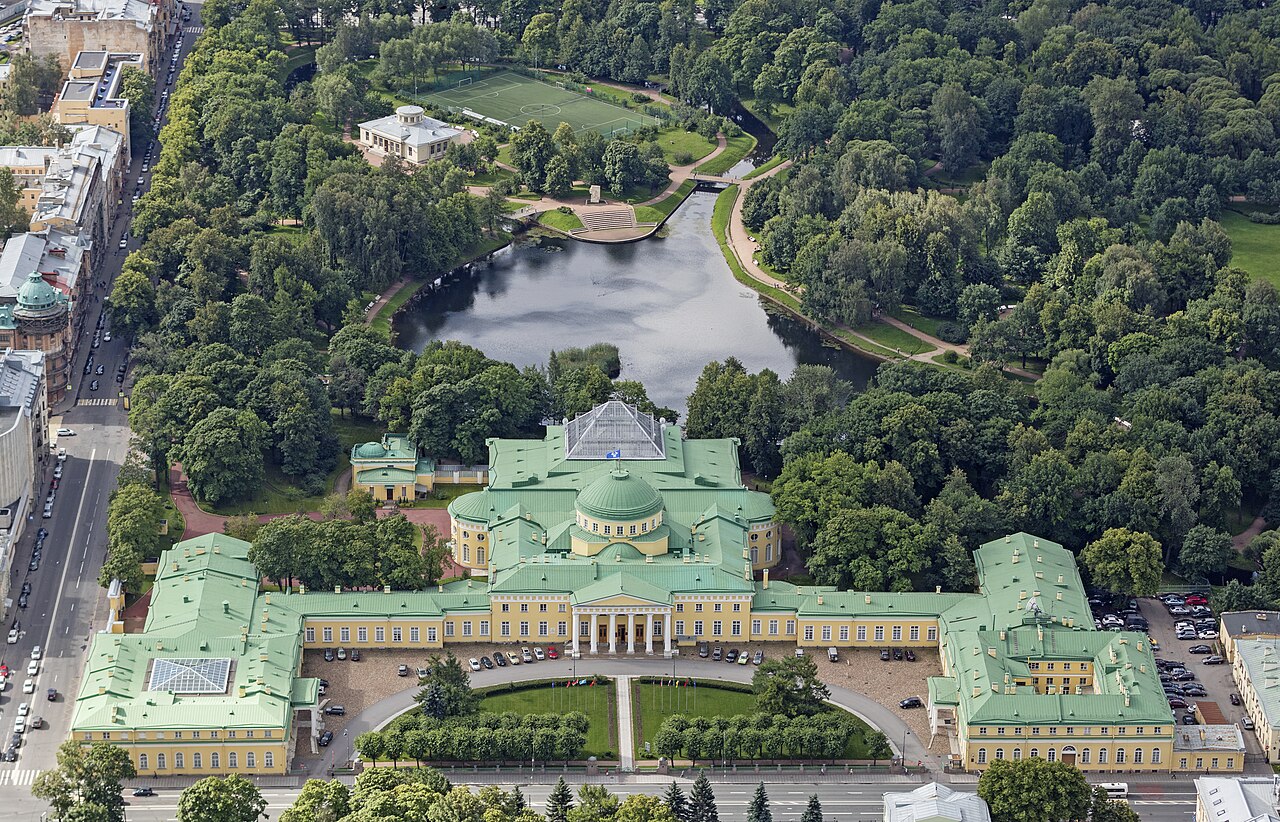
Tauride Palace (Russian: Таврический дворец, romanized: Tavrichesky dvorets) is one of the largest and most historically important palaces in Saint Petersburg, Russia.
Prince Grigory Potemkin of Tauride commissioned his favourite architect, Ivan Starov, to design his city residence in a rigorous Palladian style. Starov's design called for an extensive park, later the Tauride Garden, and harbour in front of the palace, which would be linked with the Neva River by a canal. Building work began in 1783 and lasted for six years. The 13-bay front of the palace has a Tuscan portico and is topped by a shallow dome. A square vestibule leads to an octagonal hall, with the huge "Catherine Hall" beyond. This had eighteen Ionic Greek columns on either side and opens into a large, enclosed winter garden with a central circular colonnade. Considered the grandest nobleman's residence of 18th-century Russia, Tauride Palace served as a model for innumerable manors scattered across the Russian Empire.
Shortly before his death, on 28 April 1791, Potemkin used the palace to host unprecedented festivities and illuminations with the purpose of winning the Empress's waning affections. The ball was described by Gavrila Derzhavin in the longest of his poetry compositions.
Several months after the owner's death, Catherine II purchased his palace and ordered the architect Fyodor Volkov to transform it into her summer townhouse. Volkov was responsible for many improvements in the grounds, including the construction of the theatre in the east wing and the church in the west wing. In the garden, he designed the Admiralty Pavilion, the gardener house, orangery, glass-houses, bridges, and ironwork fences. The sculpture named the Venus Tauride (now in the Hermitage Museum) was kept in the palace from the end of the eighteenth century until the mid-nineteenth, and derives its name from it.
The exterior appearance of the palace was rather plain and contrasted sharply with the riotous luxuriance of its interiors. The domed hall, one of the largest in Russia, was connected by a 75-metre-long (246 ft) columned gallery with a winter garden.
Text adapted from “Tauride Palace” on Wikipedia, CC BY-SA 4.0.
Tauride Palace ranks #309 of 9,079 worldwide in the atlas's castle fame ranking, and #13 of the 146 mapped in Russia. Founded 1783, it is older than 13% of the atlas's dated landmarks — one of 696 atlas entries founded in the 18th century. Its Wikipedia articles were opened 12,287 times in the last 60 days, more than 95% of the atlas. 27 more atlas landmarks stand within 25 km. The nearest day-trip guide is Saint Petersburg, 3 km away. See how Russia compares in the castle statistics.
View on the interactive castle map →