Castle
Tickhill Castle
ENG England · 12th century
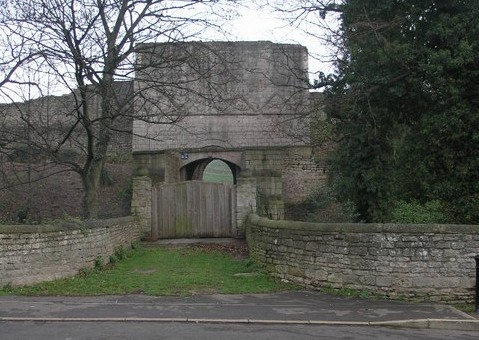
Tickhill Castle is a castle in Tickhill, in South Yorkshire, England and a prominent stronghold during the reign of King John.
The castle started as an 11th-century motte-and-bailey earthwork named Blythe Castle, built by Roger de Busli, a major landholder listed in the Domesday Book of 1086 as holding 174 estates in Nottinghamshire, on land granted to him by the Norman king William the Conqueror. The castle was deliberately built on the Nottingham/Yorkshire border, as Roger held authority in both. After a siege in 1102 Robert Bloet added a curtain wall to the rampart around the bailey; the first part of the castle to be built of stone.
From 1151 to 1153, the castle was held by Ranulf de Gernon, 4th Earl of Chester before his death after being poisoned. In 1180 construction began on an 11-sided or circular keep on top of the motte by Henry II of England; it was completed in 1192 along with a stone bridge and a chapel constructed by his wife Eleanor of Aquitaine.
In 1189, the land around Tickhill was granted to John of England by his brother Richard I of England, although the castle was withheld by Richard, along with Launceston, Rougemont Castle, Exeter, Gloucester and Nottingham, as Richard did not trust John's loyalty while he participated in the Third Crusade. His fears proved well founded after John seized the kingdom in 1191 from William Longchamp, Richard's chosen regent. Along with Windsor Castle, Tickhill was John's main stronghold to protect against a suspected invasion by Philip II of France.
Tickhill and Nottingham became John's last strongholds under the command of Robert de la Mare, and was besieged by Hugh de Puiset in 1194, with defenders holding out until they heard of the return of Richard to England. After gaining permission from Hugh they sent two knights to find out directly if Richard was indeed returned, and the knights immediately offered to restore the castle to Richard. Richard refused, saying he would only accept an unconditional surrender, which the knights negotiated upon their return, surrendering the castle to Hugh de Puiset in exchange for the defenders' lives.
In 1321, the castle was unsuccessfully laid siege by Thomas, 2nd Earl of Lancaster during a rebellion against Edward II.
Text adapted from “Tickhill Castle” on Wikipedia, CC BY-SA 4.0.
Tickhill Castle ranks #3,036 of 8,134 worldwide in the atlas's castle fame ranking, and #199 of the 333 mapped in England. Founded 1192, it is older than 79% of the atlas's dated landmarks — one of 564 atlas entries founded in the 12th century. Its Wikipedia articles were opened 1,975 times in the last 60 days, more than 66% of the atlas. 2 more atlas landmarks stand within 25 km. The nearest day-trip guide is Sheffield, 25 km away. See how England compares in the castle statistics.
View on the interactive castle map →Frequently asked questions
Where is Tickhill Castle?
Tickhill Castle stands in England, at 53.4292°, -1.10844°.
When was Tickhill Castle built?
The atlas dates its founding to 1192. Earlier structures may have stood on the site; this is the earliest documented founding year.
How famous is Tickhill Castle?
In this atlas's fame ranking: #3,036 of 8,134 worldwide, and #199 in England. Fame here combines how many Wikipedia language editions cover a landmark with how many people read them.
What is the nearest castle to Tickhill Castle?
Conisbrough Castle, about 10 km away.
More castles in England
- Rufus Castle England · 12th century
- Eynsford Castle England · 11th century
- Farnham Castle England · 12th century
- Lambton Castle England · 19th century
More castles
- Dundas Castle Scotland · 15th century
- Dunseverick Castle Northern Ireland
- Ewloe Castle Wales · 13th century
- Fa'side Castle Scotland · 15th century