 England · 11th century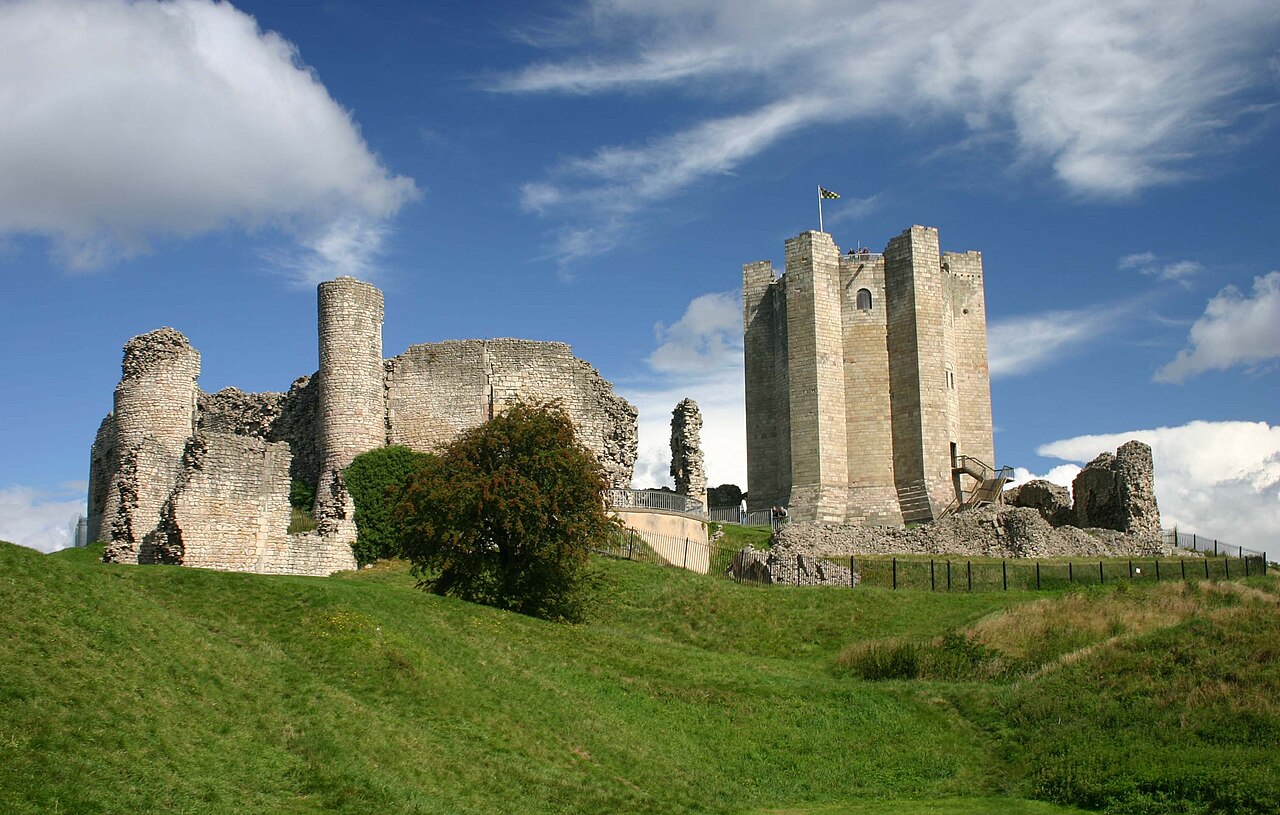
Conisbrough Castle is a medieval fortification in Conisbrough, South Yorkshire, England. The castle was initially built in the 11th century by William de Warenne, the Earl of Surrey, after the Norman Conquest of England in 1066. Hamelin Plantagenet, the illegitimate, parvenu brother of Henry II, acquired the property by marriage in the late 12th century. Hamelin and his son William, Earl of Surrey rebuilt the castle in stone, including its prominent 28-metre (92 ft)-high keep. The castle remained in the family line into the 14th century, despite being seized several times by the Crown. The fortification was then given to Edmund of Langley, passing back into royal ownership in 1461.
Conisbrough Castle fell into ruin, its outer wall badly affected by subsidence, and was given to the Carey family in the 16th century. Its derelict state prevented it from involvement in the English Civil War of the 17th century and the remains were bought by the Duke of Leeds in 1737. Sir Walter Scott used the location for his 1819 novel Ivanhoe and by the end of the 19th century the ruins had become a tourist attraction.
The state took over the management of the property in 1950, but by the 1980s the visitor facilities were felt to be unsuitable, leading to a three-way partnership being created between the local council, the state agency English Heritage and a local charitable trust to develop the castle. The keep was re-roofed and re-floored in the 1990s with the help of European Union funding. English Heritage took over control of the castle in 2008 and continues to operate the property as a tourist attraction.
The castle is made up of an inner and an outer bailey, the former surrounded by a stone curtain wall defended by six mural or fortified towers and the castle keep.
Text adapted from “Conisbrough Castle” on Wikipedia, CC BY-SA 4.0.
Conisbrough Castle ranks #1,334 of 9,079 worldwide in the atlas's castle fame ranking, and #89 of the 360 mapped in England. Founded c. 1100, it is older than 85% of the atlas's dated landmarks — one of 436 atlas entries founded in the 11th century. Its Wikipedia articles were opened 3,009 times in the last 60 days, more than 78% of the atlas. 3 more atlas landmarks stand within 25 km. The nearest day-trip guide is Sheffield, 20 km away. See how England compares in the castle statistics.
View on the interactive castle map →