 Georgia · 9th century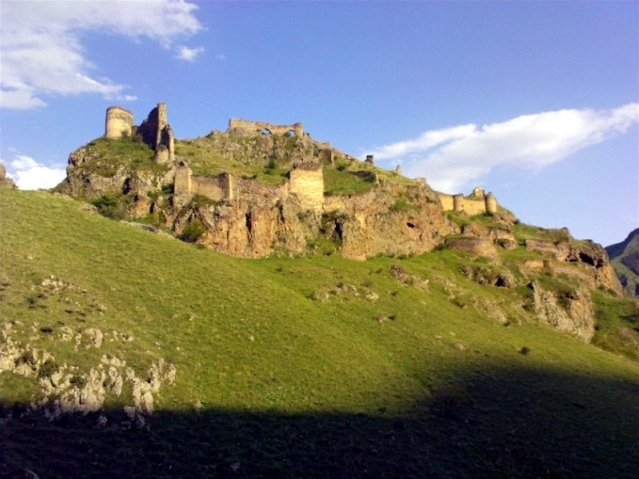
Tmogvi or Tmkaberd (Georgian: თმოგვი, romanized: Tmogvi [tʰmoɡʷi]; Armenian: Թմկաբերդ, romanized: Tʼmkaberd) is a ruined fortress and medieval town in the southern Georgian region of Samtskhe-Javakheti, on the left bank of the Kura River, a few kilometers downstream of the cave city of Vardzia.
The name "Tmogvi" is derived from the Armenian word mog, meaning "pagan priest" or "magus". The fortress is first mentioned in sources from the 9th century. It was built as a defensive work controlling the ancient trade route between the Javakheti plateau and the gorge of Kura, over a gorge formed by the Kura River. It was a crucial military stronghold in the region of Javakheti. The feudal lords of the region were at that time the Bagratids, the Georgian branch. The Georgian chronicles report numerous attempts to take the castle over, but they were rarely successful.
Tmogvi gained importance after the neighboring town and fortress of Tsunda was ruined around 900 AD. In 914 Yusuf ibn Abi'l-Saj approached Tmogvi, but retreated without an attempt to capture it. This was the first mention of the fortress in the chronicles. By the beginning of the 11th century, the fortress had passed under the direct control of the unified Kingdom of Georgia. The second mention is connected with this period, when the country was ruled by Bagrat III. The king imprisoned two rulers of the duchy of Klarjeti, Sumbat III and his brother Gurgen, in the fortress.
In 1073, it was given in apanage to the nobleman Niania Kuabulisdze; his descendants kept it in the following centuries, before it passed to other major feudal families such as the Toreli, the Tmogveli, the Shalikashvili or the Jaqeli. In 1088, the fortress collapsed in the first devastating earthquake, when its ruler Kakhaber and his wife both died. In 1191, the fortress was gifted to Sargis-Mkhargrdzeli by Queen Tamar. Mkhargrdzeli ruled in Tmogvi for a century. The most famous among them, Sargis Tmogveli was also a writer and poet, and philosopher. The town was restored and blossomed, after it was destroyed again in the second earthquake of 1283.
The third earthquake of 1319 destroyed Tmogvi again. It was restored during the rule of Murvan Katkhaidze by architect Theodor. The medieval Georgian writer Sargis Tmogveli was from Tmogvi. Shalikashvili family were the last rulers of the fortress in the 16th century.
Text adapted from “Tmogvi” on Wikipedia, CC BY-SA 4.0.
Tmogvi ranks #1,806 of 9,079 worldwide in the atlas's castle fame ranking, and #10 of the 48 mapped in Georgia. Founded c. 900, it is older than 94% of the atlas's dated landmarks — one of 88 atlas entries founded in the 9th century. Its Wikipedia articles were opened 1,767 times in the last 60 days, more than 66% of the atlas. 1 more atlas landmarks stand within 25 km. The nearest day-trip guide is Gyumri, 81 km away. See how Georgia compares in the castle statistics.
View on the interactive castle map →