 Scotland · 15th century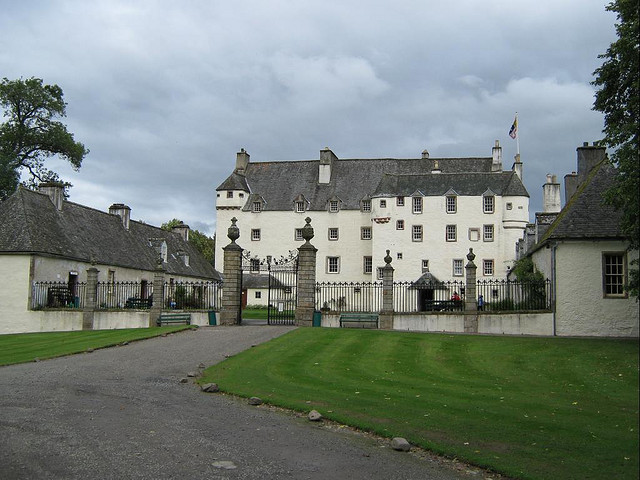
Traquair House, approximately 7 miles southeast of Peebles, is claimed to be the oldest continually inhabited house in Scotland. Whilst not strictly a castle, it is built in the style of a fortified mansion. It pre-dates the Scottish Baronial style of architecture, and may have been one of the influences on this style. The estate contains the famous Traquair Brewery.
The house is built on the site of a hunting seat used by the Scottish kings from the 12th century, though no part of the present building can be dated with certainty before the 15th century. Alexander I was the first Scottish king to stay and hunt at Traquair. At that time it was a remote "castle", surrounded by forest. Upon Alexander III's death in 1286, the peace of the Borders region was shattered and Traquair became a key link in the chain of defence that guarded the Tweed Valley against English invasion.
Over the next two centuries Traquair's ownership changed often, at times coming under the control of the English, and at others, the Scottish throne. In the 1460s James III conferred the estate on Dr William Rogers, an eminent musician, and one of his favourites. After holding the lands for upwards of nine years, Dr Rogers sold them for an insignificant sum in 1478 to the Earl of Buchan. The Earl gifted the estate to his illegitimate son, James Stuart (1480–1513), 1st Laird of Traquair, in 1491. James Stuart obtained letters of legitimation and married the heiress of the Rutherfords, with whom he received the estates of Rutherford and Wells in Roxburghshire.
He was killed at the Battle of Flodden in 1513. His daughter, Jane Stewart, had a daughter Janet with the Earl of Angus born out of wedlock, who married Patrick Ruthven, 3rd Lord Ruthven. Traquair remained the family seat of the Earls of Traquair for the next four centuries.
Mary, Queen of Scots, visited Traquair in August 1566. James VI came to Traquair on 9 March 1602.
In 1875, Traquair passed to a cousin of the Stuarts, Henry Constable Maxwell. He was a direct descendant, but via the female line. The National Portrait Gallery holds a 1992 portrait of Catherine Maxwell Stuart, 21st Lady of Traquair.
Text adapted from “Traquair House” on Wikipedia, CC BY-SA 4.0.
Traquair House ranks #2,627 of 9,079 worldwide in the atlas's castle fame ranking, and #92 of the 226 mapped in Scotland. Founded c. 1450, it is older than 47% of the atlas's dated landmarks — one of 554 atlas entries founded in the 15th century. Its Wikipedia articles were opened 2,737 times in the last 60 days, more than 76% of the atlas. 6 more atlas landmarks stand within 25 km. The nearest day-trip guide is Edinburgh, 39 km away. See how Scotland compares in the castle statistics.
View on the interactive castle map →