 Hungary · 19th century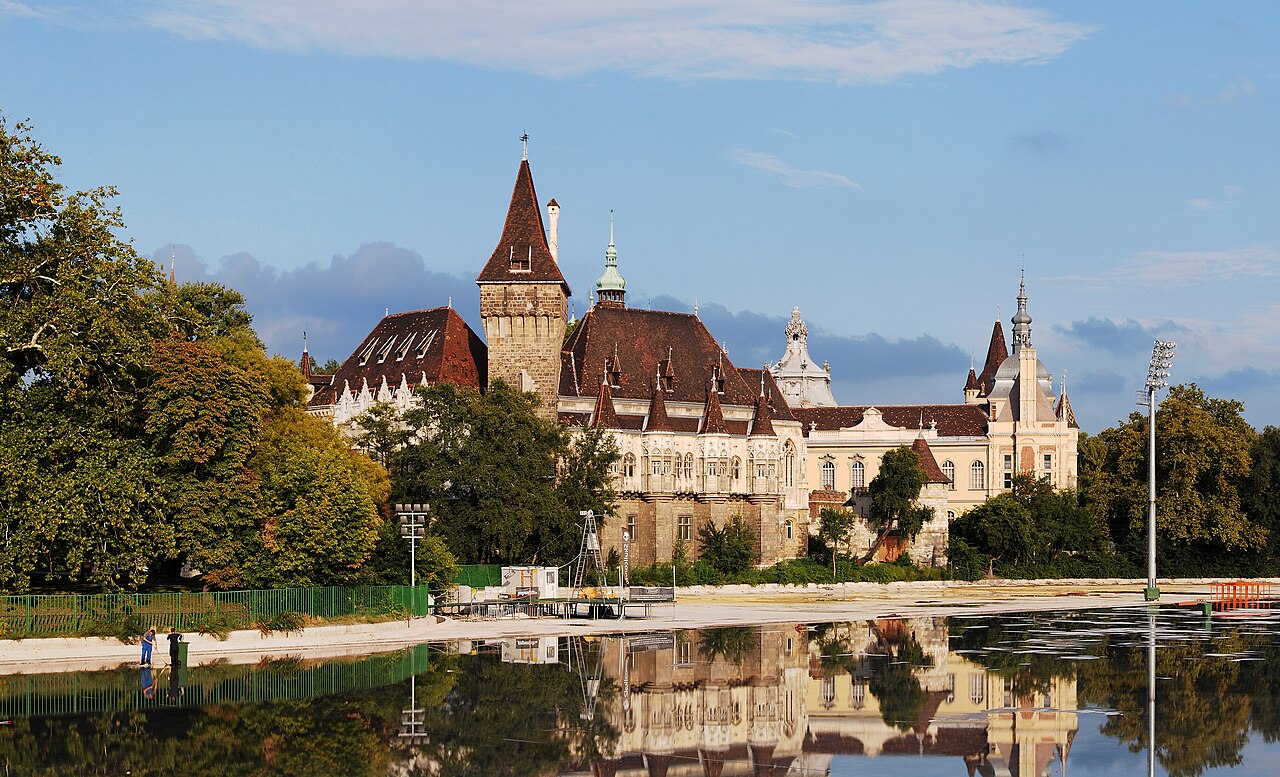
Vajdahunyad Castle (Hungarian: Vajdahunyad vára) is a castle in the City Park of Budapest, Hungary.
The castle was designed by Ignác Alpár and built in 1896 as part of the Millennial Exhibition, which celebrated the 1,000 years of Hungary since the Hungarian Conquest of the Carpathian Basin in 895. Originally, it was made from cardboard and wood, but it became so popular that it was rebuilt from stone and brick between 1904 and 1908.
The "castle" comprises an eclectic collage of multiple landmark buildings from different parts of the Kingdom of Hungary, especially the Hunyad Castle in Hunedoara, Romania. As the castle contains parts of buildings from various time periods, it displays different architectural styles: Romanesque, Gothic, Renaissance, and Baroque. It is sited within Budapest City Park.
The statue by Miklós Ligeti of Anonymus, the unknown chronicler at the court of King Béla III (r 1172–96), known as Anonymous, is in the courtyard of the castle.
The external wall of the castle contains a bust of Béla Lugosi, a Hungarian-American actor famous for portraying Count Dracula in the original 1931 film of the same name.
As of 2015 the castle houses the Museum of Hungarian Agriculture, the biggest agricultural museum in Europe.
Text adapted from “Vajdahunyad Castle” on Wikipedia, CC BY-SA 4.0.
Vajdahunyad Castle ranks #290 of 9,079 worldwide in the atlas's castle fame ranking, and #2 of the 135 mapped in Hungary. Founded 1896 — one of 717 atlas entries founded in the 19th century. Its Wikipedia articles were opened 19,515 times in the last 60 days, more than 97% of the atlas. 17 more atlas landmarks stand within 25 km. The nearest day-trip guide is Budapest, 4 km away. It is stop 11 of 18 on the Danube Bend route, Esztergom to Budapest. See how Hungary compares in the castle statistics.
View on the interactive castle map →