 Hungary · 19th century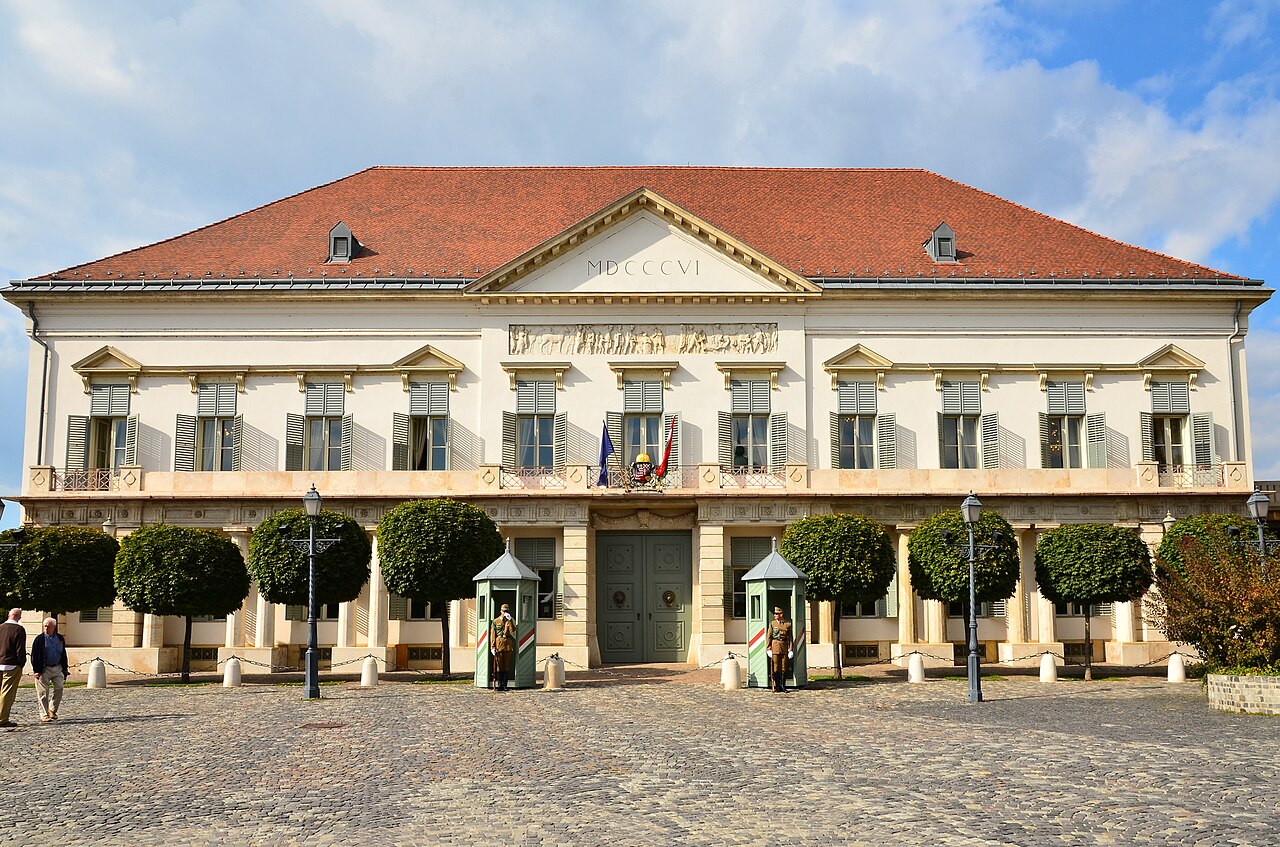
Sándor Palace (Hungarian: Sándor-palota, pronounced [ˈʃaːndor ˈpɒlotɒ]) is a palace in Budapest, Hungary. Located beside the Buda Castle complex in the ancient Castle District, it has served as the official residence and workspace of the President of Hungary since 2003.
Sándor Palace is the 37th largest palace in present-day Hungary.
The original Neoclassical style palace was begun about 1803, and completed about 1806. Count Vincent Sándor commissioned it, and it was named after him. Count Vincent Sándor was a philosopher and aristocrat in the Austrian Empire. His son Count Móric Sándor de Szlavnicza (1805–1878) was better known in Budapest and Vienna, from fame for acrobatic jousts.
The palace then next belonged to Archduke Albrecht, the Imperial Governor of Hungary, until the failed Hungarian Revolution of 1848. After that the palace and its adjacent buildings facing the square were rented as government offices.
Prime ministers The most prestigious tenant was the Hungarian Prime Minister Gyula Andrássy, who in 1867 leased it for the Hungarian government from the Pallavicini family. He would later obtain ownership of the palace following a property swap.
Andrassy renovated the building, which by then was badly in need of repair, with the help of the architect Miklós Ybl. He renovated the ground floor and used it as his offices, while the first floor became his residence.
In all, nineteen Hungarian prime ministers have lived in the palace, each adapting the building to their own tastes.
After the fall of the Hungarian Soviet Republic in 1919, Sándor Palace continued as the Prime Minister's residence until World War II. In 1941, during the war, the grief-stricken Pál Teleki committed suicide in the palace.
Less than four years later, Allied aircraft bombed Sándor Palace, and the building was left in ruins. Anything in the palace that was of value was taken as war booty. Although the ruins did not fall victim to the bulldozer, the palace remained neglected until the Revolutions of 1989.
Following the change from the Communist political system in Hungary in 1989, and thanks to a devoted team of restoration workers, a roof was erected over the ruins and the walls were supported. Over the years, Sándor Palace was gradually restored to its former glory, and the interior renovated in 2002.
Text adapted from “Sándor Palace” on Wikipedia, CC BY-SA 4.0.
Sándor Palace ranks #387 of 9,079 worldwide in the atlas's castle fame ranking, and #3 of the 135 mapped in Hungary. Founded 1806, it is older than 12% of the atlas's dated landmarks — one of 717 atlas entries founded in the 19th century. Its Wikipedia articles were opened 9,317 times in the last 60 days, more than 93% of the atlas. 17 more atlas landmarks stand within 25 km. The nearest day-trip guide is Budapest, 1 km away. It is stop 17 of 18 on the Danube Bend route, Esztergom to Budapest. See how Hungary compares in the castle statistics.
View on the interactive castle map →