 England · 18th century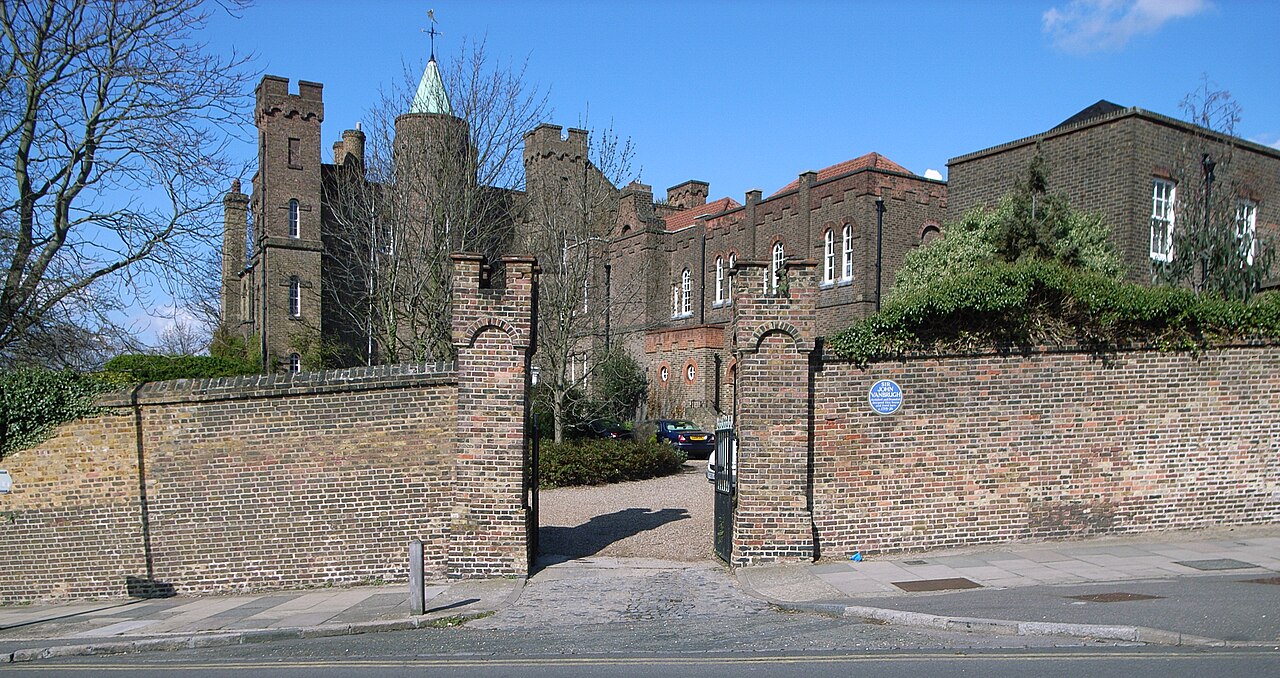
Vanbrugh Castle is a house designed and built by John Vanbrugh around 1719 as a residence for his family.
It is located on Maze Hill on the eastern edge of Greenwich Park in London, to the north of Blackheath, with views to the west past the Old Royal Naval College at Greenwich down to the Thames reaching as far as the Houses of Parliament.
Between 1920 and 1976, it was the site of a school that was funded by the RAF Benevolent Fund for the sons of RAF officers who had been killed in action, and that included several notable musicians amongst its staff during the 1950s.
The castle was designed and built after Vanbrugh had been the architect of the baroque houses at Castle Howard and Blenheim Palace, and shortly after Vanbrugh succeeded his architectural mentor Christopher Wren as Surveyor to the Royal Naval Hospital in 1716. Vanbrugh took a lease of a 12-acre triangular site of the Westcombe estate from Sir Michael Biddulph, 2nd Baronet in 1718, now known as Vanbrugh Fields.
In contrast to the baroque style used for his professional commissions, he chose a more medieval, almost gothic, style for his own house. Built on the southwestern corner of the triangular site, it predates the first clearly Gothic Revival house at Strawberry Hill by 30 years. The main structure was finished in 1719, a three-storey square keep with basement built in brick with tall narrow windows, augmented on the south side square by three four-storey towers: two square flanking towers with battlements and a central projecting circular tower enclosing stairs capped by a conical copper roof. An arched corbel table below the moulded parapet is a feature unique to Vanbrugh at this date, also found at Kings Weston House (1710–1725).
The building's narrow sash windows echo medieval arrowslits or lancets. A garden on the building's lead roof makes the most of the views over the Thames and London.
Aged 55, Vanbrugh married the 26-year-old Henrietta Maria Yarborough in York in January 1719, and he soon added a wing to the east side of the house in a similar style, creating a lopsided, asymmetric construction – said to be the first asymmetric house built in Europe since the Renaissance. It has the "castle air" adopted in Vanbrugh's remodelling of Kimbolton Castle (1708–1719), and also used at Shirburn Castle, both early revivals of a medieval style of architecture.
Text adapted from “Vanbrugh Castle” on Wikipedia, CC BY-SA 4.0.
Vanbrugh Castle ranks #6,564 of 9,035 worldwide in the atlas's castle fame ranking, and #352 of the 360 mapped in England. Founded c. 1719, it is older than 20% of the atlas's dated landmarks, one of 685 atlas entries founded in the 18th century. Its Wikipedia articles were opened 1,085 times in the last 60 days, more than 53% of the atlas. 24 more atlas landmarks stand within 25 km. The nearest day-trip guide is London, 10 km away. See how England compares in the castle statistics.
View on the interactive castle map →