 England · 19th century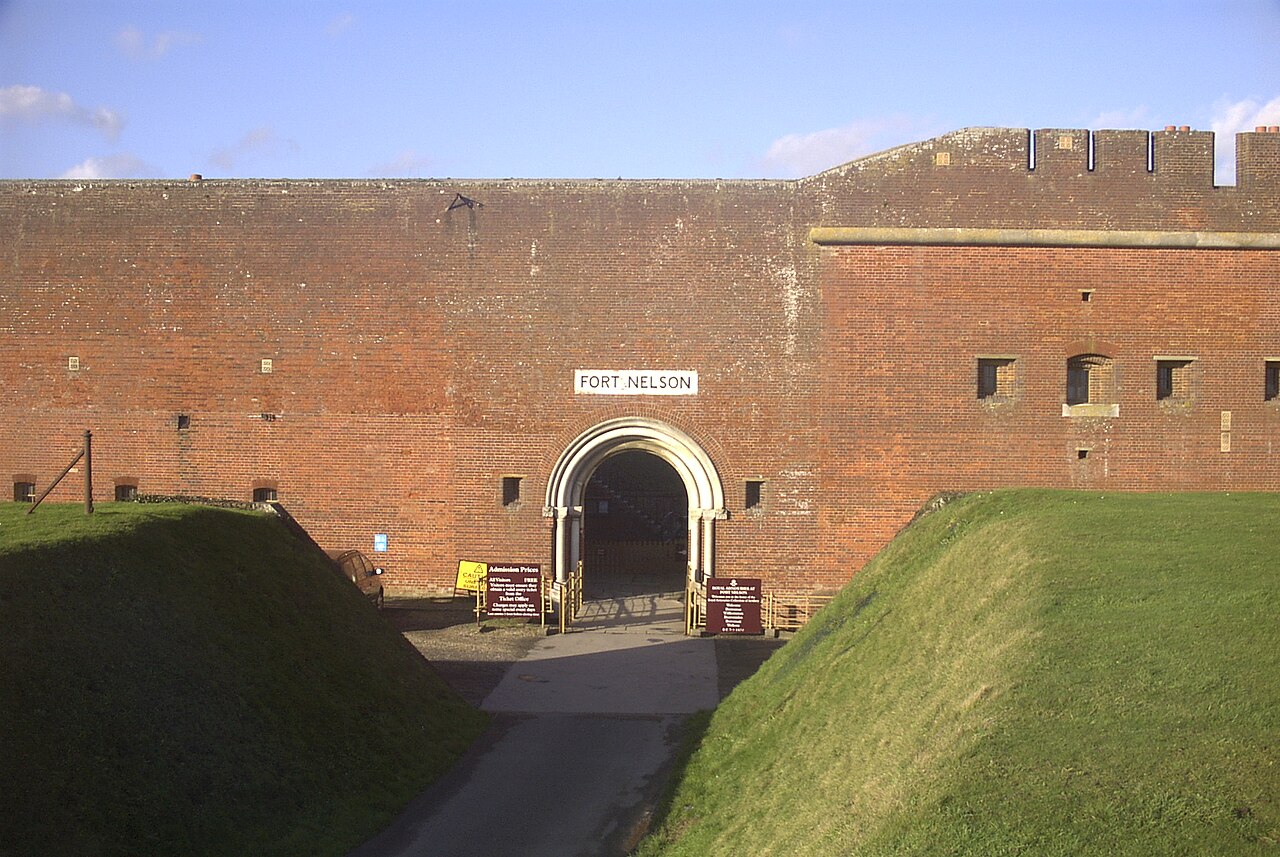
Fort Nelson, in the civil parish of Boarhunt in the English county of Hampshire, is one of five defensive forts built on the summit of Portsdown Hill in the 1860s, overlooking the important naval base of Portsmouth and is a Grade I Listed Building. The current tenant is the Royal Armouries, housing the artillery of the national collection of arms and armour.
Fort Nelson is a typical Polygonal or Palmerston Fort. It is six-sided with a deep ditch protected by three caponiers. Above each caponier is a well-protected emplacement for 13-inch mortars. It was originally entered by two Guthrie rolling bridges and has a barrack block for 172 officers and other ranks, protected by a V-shaped redan. A large open parade ground gives access to the magazines 40 feet underneath it. There are open emplacements on the ramparts for 64 pounder rifled muzzle-loading guns and RML 6.6-inch howitzers. There are also three Haxo casemates for 7 inch rifled breech-loaders.
The Nelson Monument, which gave the fort its name, stands adjacent.
Fort Nelson is one of five Portsdown Forts. Built as a result of the 1859 Royal Commission by Lord Palmerston to prevent a French land attack on the Portsmouth dockyard only 8 kilometres away, because the older Hilsea Lines at the bottom of the ridge were considered insufficient. A series of 6 forts were built along the 7 miles (10 km) of the ridge. From west to east they are forts Fareham, Wallington, Nelson, Southwick, Widley and Purbrook. The line was finished off at the eastern end with Crookhorn Redoubt and Farlington Redoubt. A garrison of around 200 volunteers accompanied by regular army officers would have staffed the fort in time of war.
Construction was protracted and Fort Nelson was not fully armed until the 1890s. The fort was disarmed in 1907 and then used for accommodation. In 1938, it was converted to an area anti-aircraft ammunition store; ten large magazines were built on the parade ground. Fort Nelson was abandoned in the 1950s.
In 1979, after years of neglect and vandalism, it was sold to Hampshire County Council for £50,000. The Council, with assistance of volunteers from the Palmerston Forts Society, restored it at a cost of £3–4 million, and it opened to the public in 1994, becoming part of the Royal Armouries in 1995.
Text adapted from “Fort Nelson, Hampshire” on Wikipedia, CC BY-SA 4.0.
Fort Nelson, Portsmouth ranks #5,953 of 9,035 worldwide in the atlas's castle fame ranking, and #343 of the 360 mapped in England. Founded 1860, it is older than 7% of the atlas's dated landmarks, one of 705 atlas entries founded in the 19th century. Its Wikipedia articles were opened 1,670 times in the last 60 days, more than 65% of the atlas. 12 more atlas landmarks stand within 25 km. The nearest day-trip guide is Portsmouth, 7 km away. See how England compares in the castle statistics.
View on the interactive castle map →