Ruin
Tiverton Castle
ENG England · 11th century
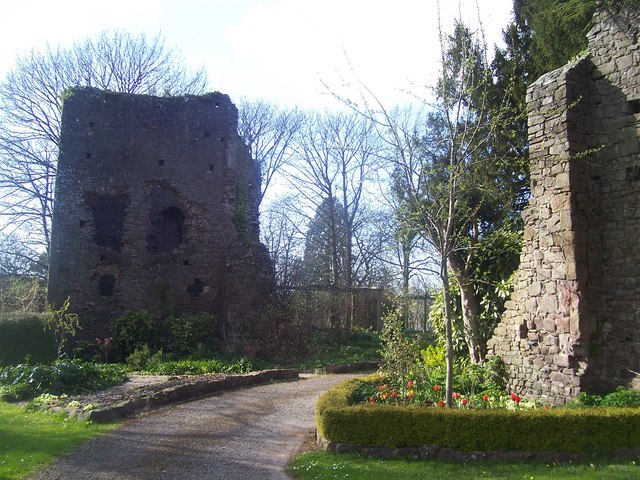
Tiverton Castle is the remains of a medieval castle dismantled after the English Civil War and thereafter converted in the 17th century into a country house. It occupies a defensive position above the banks of the River Exe at Tiverton in Devon.
Once considerably larger, Tiverton Castle now comprises a group of ruined defensive perimeter walls, towers and buildings from various periods. A Norman motte was built in 1106.
During the Civil War the Castle was a Royalist stronghold. Fairfax's Parliamentarian troops laid siege to a troop of Royalists within the Castle and set up his headquarters at Blundell's School and stationed his artillery on Skrink Hills (or "Shrink" Hills) just above him and below Cranmore Castle, about half a mile from Tiverton Castle. The Culverin, the largest artillery piece used by the New Model Army, was capable of firing up to 2,000 yards. Whilst they were still finding their range a lucky shot hit one of the chains holding up the Castle's drawbridge and a small party of roundheads were able swiftly to gain entry and thus put an end to the siege almost before it had started. The bulk of the defensive structure was then demolished by Parliamentarian troops to prevent any military re-use of the structure.
The primary source is the 1645 narrative by John Rushworth (c.1612-1690) dated "Tiverton, Octob. 19. 1645. at nine a clock at night", entitled: The taking of Tiverton, with the castle, church, and fort, by Sir Thomas Fairfax, on the Lords-day last, Octob. 19. 1645. Wherein was taken Colonel Sir Gilbert Talbot, the governour. Major Sadler, major to Col. Talbot. 20. officers of note. 200. common souldiers. Foure peece of ordnance. 500. armes, with store of ammunition, provision, and treasure. Also the severall defeats given to Goring, by his Excellency, and all Gorings forces fled before him. Published according to order". The relevant passage is as follows:
Major Generall Massey did soone possesse himselfe of the Town of Tiverton, the Enemie marched away, onely those who were left in the Castle, and the Church, to keep those places. ... On Friday the 17. instant, our Generall Sir Thomas Fairfax sate downe before Tiverton-Castle and Church, to take them in, and summoned the enemy to deliver them up, of which being denied, we planted our batteries against them, which went forwards that day and the next. On Saturday Octob. 18.
Text adapted from “Tiverton Castle” on Wikipedia, CC BY-SA 4.0.
Tiverton Castle ranks #3,665 of 8,134 worldwide in the atlas's castle fame ranking, and #253 of the 333 mapped in England. Founded 1100, it is older than 86% of the atlas's dated landmarks — one of 325 atlas entries founded in the 11th century. Its Wikipedia articles were opened 1,110 times in the last 60 days, more than 51% of the atlas. 2 more atlas landmarks stand within 25 km. The nearest day-trip guide is Cardiff, 68 km away. See how England compares in the castle statistics.
View on the interactive castle map →Frequently asked questions
Where is Tiverton Castle?
Tiverton Castle stands in England, at 50.9063°, -3.4888°.
When was Tiverton Castle built?
The atlas dates its founding to 1100. Earlier structures may have stood on the site; this is the earliest documented founding year.
How famous is Tiverton Castle?
In this atlas's fame ranking: #3,665 of 8,134 worldwide, and #253 in England. Fame here combines how many Wikipedia language editions cover a landmark with how many people read them.
What is the nearest castle to Tiverton Castle?
Affeton Castle, about 20 km away.
More castles in England
- HM Fort Roughs England · 20th century
- Banna England · 2nd century
- Castrum Anderitum England · 3rd century
- Magna Roman Fort England
More ruins
- Muslim Walls of Madrid Spain · 9th century
- Castriño of Conxo Spain
- Castro of Borneiro Spain
- Aquis Querquennis Spain