 Greece · 5th century BC
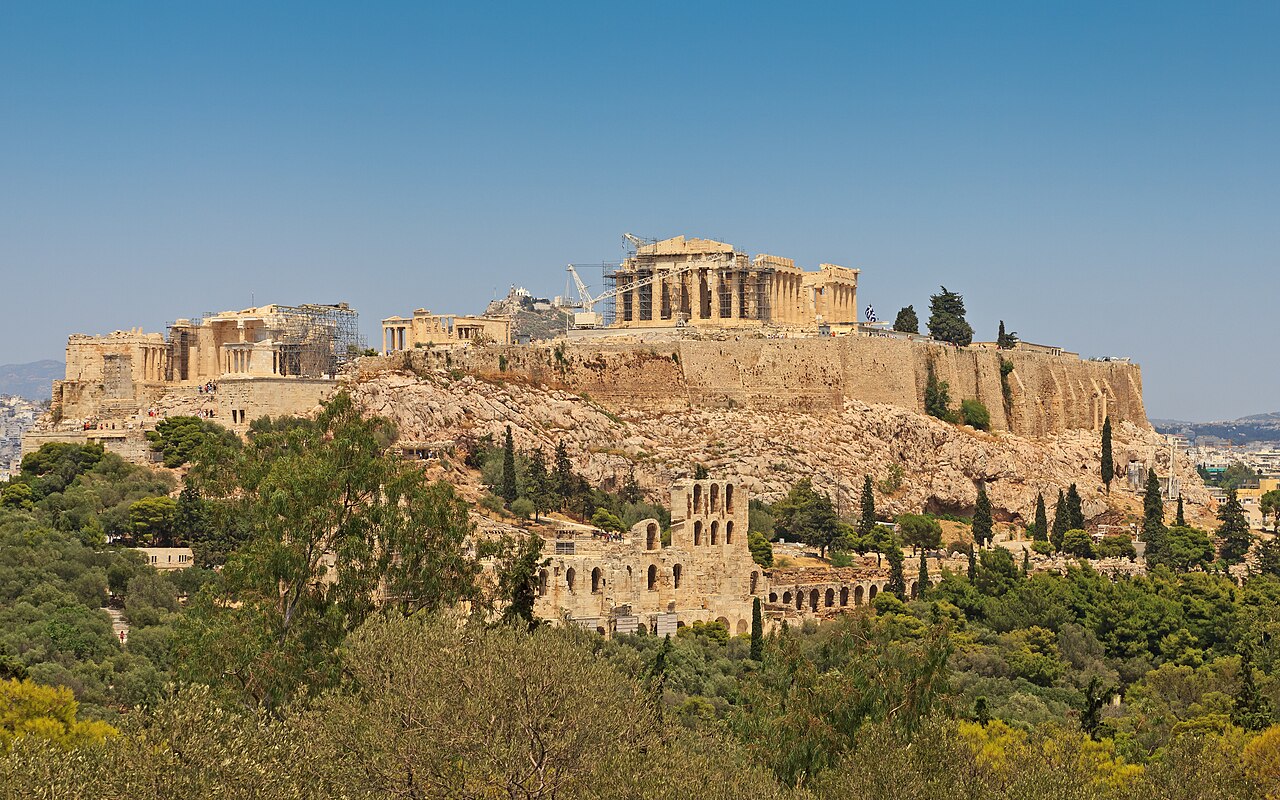
The Acropolis of Athens (Ancient Greek: ἡ Ἀκρόπολις τῶν Ἀθηνῶν, romanized: hē Akropolis tōn Athēnōn; Modern Greek: Ακρόπολη Αθηνών, romanized: Akrópoli Athinón) is an ancient citadel located on a rocky outcrop above the city of Athens, Greece, and contains the remains of several ancient buildings of great architectural and historical significance, the most famous being the Parthenon. The word Acropolis is from Greek ἄκρον (akron) 'highest point, extremity' and πόλις (polis) 'city'. The term acropolis is generic and there are many other acropoleis in Greece. During ancient times the Acropolis of Athens was also more properly known as Cecropia (Κεκροπία), after the legendary serpent-man Cecrops, the supposed first Athenian king.
While there is evidence that the hill was inhabited as early as the 4th millennium BC, it was Pericles (c. 495–429 BC) in the fifth century BC who coordinated the construction of the buildings whose present remains are the site's most important ones, including the Parthenon, the Propylaea, the Erechtheion and the Temple of Athena Nike. The Parthenon and the other buildings were seriously damaged during the 1687 siege by the Venetians during the Morean War when gunpowder being stored by the Turkish rulers in the Parthenon was hit by a Venetian bombardment and exploded.
Text adapted from “Acropolis of Athens” on Wikipedia, CC BY-SA 4.0.
Acropolis of Athens ranks #5 of 9,035 worldwide in the atlas's castle fame ranking, and #2 of the 133 mapped in Greece. Founded c. 500 BC, it is older than 99% of the atlas's dated landmarks, one of 11 atlas entries founded in the 5th century BC. Its Wikipedia articles were opened 164,313 times in the last 60 days, more than 99% of the atlas. Wikidata records about 4,560,000 visitors in 2024. 5 more atlas landmarks stand within 25 km. The nearest day-trip guide is Athens, 1 km away. See how Greece compares in the castle statistics.
View on the interactive castle map →