 Japan · 17th century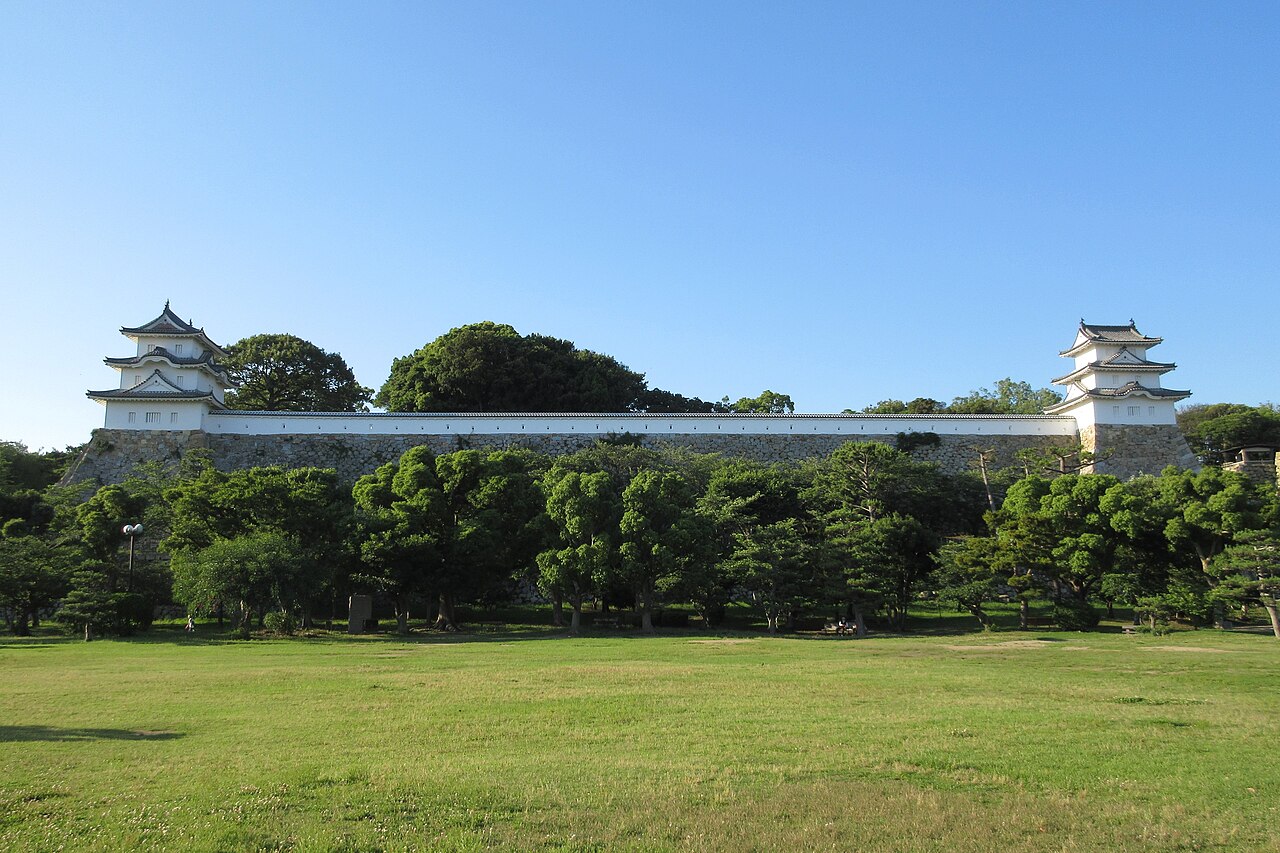
Akashi Castle (明石城, Akashi-jō) is an Edo period Japanese castle located in the city of Akashi, Hyōgo Prefecture, Japan. It was also known as Kiharu Castle (喜春城, Kiharu-jō) or Kinkō Castle (錦江城, Kinkō-jō). Its ruins have been protected as a National Historic Site since 1957.
Akashi Castle is located on Mount Akamatsu, a hill in central Akashi, to the north of Akashi Station. The site was the location of a burial mound which was believed to have been the grave of the Nara period poet Kakinomoto no Hitomaro. The location dominates the San'yōdō highway connecting the Kinai region with western Japan and also the main route north to Tanba and Tango Provinces. It is also very near the coast of the Seto Inland Sea, overlooking the narrows to Awaji island. Considered by the Tokugawa shogunate to be a backup to Himeji Castle, it was the final line of defences for the Kansai region against any attack from the west.
The construction of the castle was by order of Shogun Tokugawa Hidetada from 1617 to 1619, who had assigned Ogasawara Tadazane to the area as daimyō of the newly created 100,000 koku Akashi Domain. Ogasawara Tadazane's father Ogasawara Hidemasa had married a granddaughter of Tokugawa Ieyasu and was daimyō of Matsumoto Domain. He was killed in action at the Siege of Osaka. It is claimed without clear documentary evidence that Miyamoto Musashi assisted in building the castle as a "Construction Supervisor", as it is recorded that he was in the service of Ogasawara Tadazane at the time.
The castle only took one year to complete, which was relatively fast for the time period. This was done so quickly as a result of the 1615 decree mandating castle per clan, so many castles in the area were dismantled and some materials and buildings were recycled for the construction of Akashi Castle. This included wood from Miki Castle, Takasago Castle, Edayoshi Castle, and Funage Castle and a number of buildings from Fushimi Castle and Funage Castle including yagura towers. Although no tenshu main tower was ever built, Akashi Castle became a large castle with 20 yagura and 27 gates. The Inner bailey had four three-story corner yagura, two of which have survived to the present.
The Ogawasawa clan were transferred to Kokura Domain in 1632, and afterwards the castle was ruled by a succession of fudai daimyō or shimpan clans.
Text adapted from “Akashi Castle” on Wikipedia, CC BY-SA 4.0.
Akashi Castle ranks #1,301 of 9,079 worldwide in the atlas's castle fame ranking, and #63 of the 296 mapped in Japan. Founded 1617, it is older than 30% of the atlas's dated landmarks — one of 721 atlas entries founded in the 17th century. Its Wikipedia articles were opened 4,044 times in the last 60 days, more than 83% of the atlas. 1 more atlas landmarks stand within 25 km. The nearest day-trip guide is Kobe, 19 km away. It is one of the 69 landmarks on the atlas's regional map of Kansai. See how Japan compares in the castle statistics.
View on the interactive castle map →