 Germany · 12th century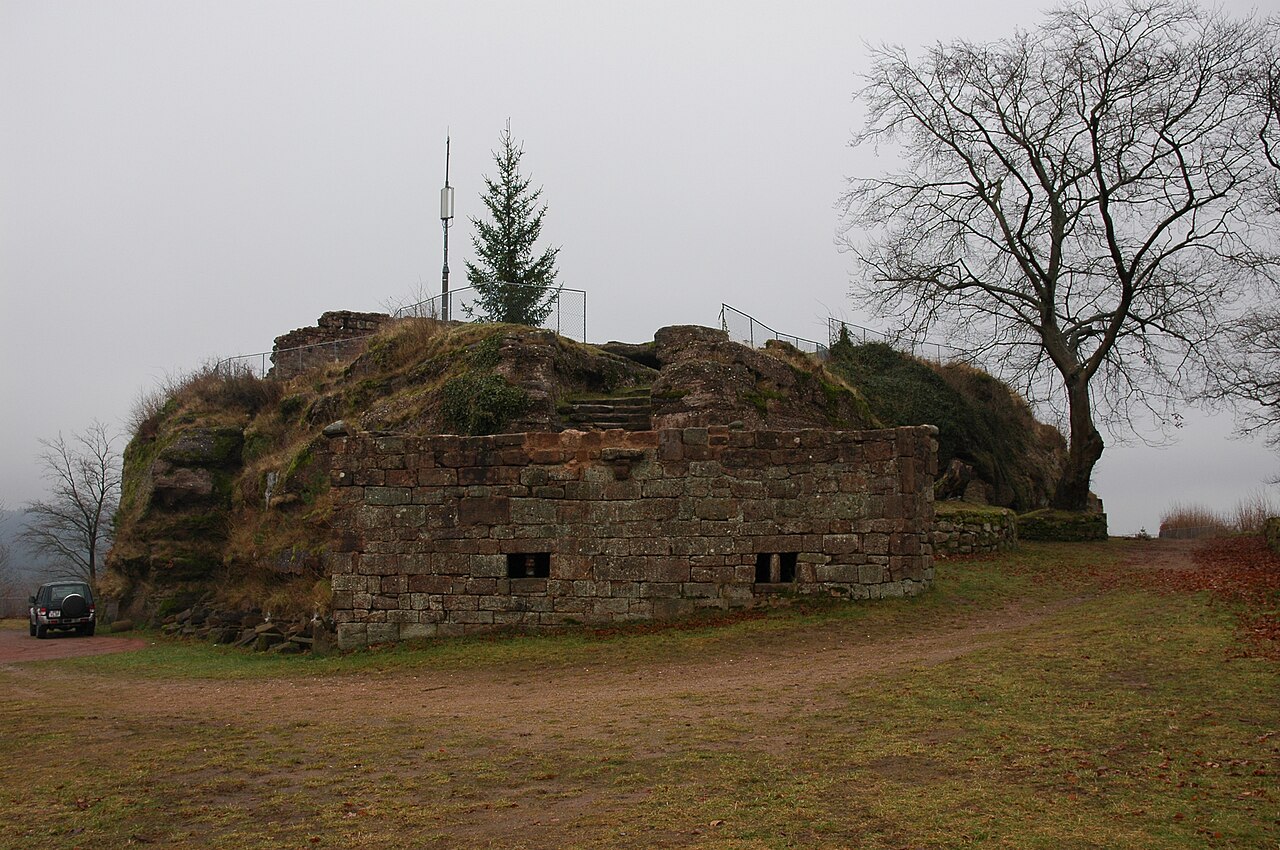
Lemberg Castle (German: Burg Lemberg) is a medieval castle on the territory of Lemberg in the county of Südwestpfalz in the German state of Rhineland-Palatinate.
The hill castle stands on the Schlossberg hill at an elevation of 458 metres and houses a castle information centre for the Palatinate and North Vosges regions and a castle café owned by the Palatine Forest Club. Its exposed location means there are extensive views over Lemberg and the surrounding wooded hills of the Wasgau region.
In 1198 the abbot of Hornbach Abbey granted two hills, the Gutinberc and the Ruprehtisberc, to Henry I, Count of Zweibrücken. On these hills the count built the castles of Lemberg and Ruppertstein. The construction period was probably around 1200, but the first documented record of the Castrum Lewenberc dates to 1230. Today, all that survives on the Schlossberg hill are some wall remains and the foundation of a chapel. The chapel was mentioned in 1502, but coins and shards of pottery found on the site indicate that it goes back to the second half of the 13th century.
The first known castellan (Burgmann) was Gozo of Lemberg, who is recorded in 1269.
In 1333 the castle went to Count Simon I, son of Eberhardt of Zweibrücken-Bitsch. From 1535 to 1541, his successor, Count James of Zweibrücken-Bitsch resided at the castle and remodeled it into a Renaissance schloss. Following his death in 1570 an inheritance dispute arose, which the Lehnsherr of the castle, Duke Charles of Lorraine ended by occupying the castle with his own troops in 1572. In 1606 he agreed with Count John Reinhard I of Hanau-Lichtenberg, that James' grandson would receive the Lemberg estate, whilst Charles II would hold the lordship of Bitche.
The castle and village were occupied and plundered in 1634 and 1635 during the Thirty Years' War. In 1636 the castle was razed and then only rebuilt in makeshift fashion.
In 1688 Louis XIV of France sparked the War of the Palatine Succession. He acted on the authority of his sister-in-law, Liselotte of the Palatinate. The background was his plans for expansion, which were opposed by an alliance of the German emperor, the imperial princes, Spain and England. In view of their superiority, Louis XIV, ordered that the Palatinate was to be burned. French troops probably slighted the castle in October 1689; even the bergfried was demolished.
Text adapted from “Lemberg Castle” on Wikipedia, CC BY-SA 4.0.
Castle Lemberg ranks #6,964 of 9,079 worldwide in the atlas's castle fame ranking, and #623 of the 711 mapped in Germany. Founded c. 1200, it is older than 75% of the atlas's dated landmarks — one of 756 atlas entries founded in the 12th century. 29 more atlas landmarks stand within 25 km. The nearest day-trip guide is Kaiserslautern, 31 km away. See how Germany compares in the castle statistics.
View on the interactive castle map →