 Italy · 11th century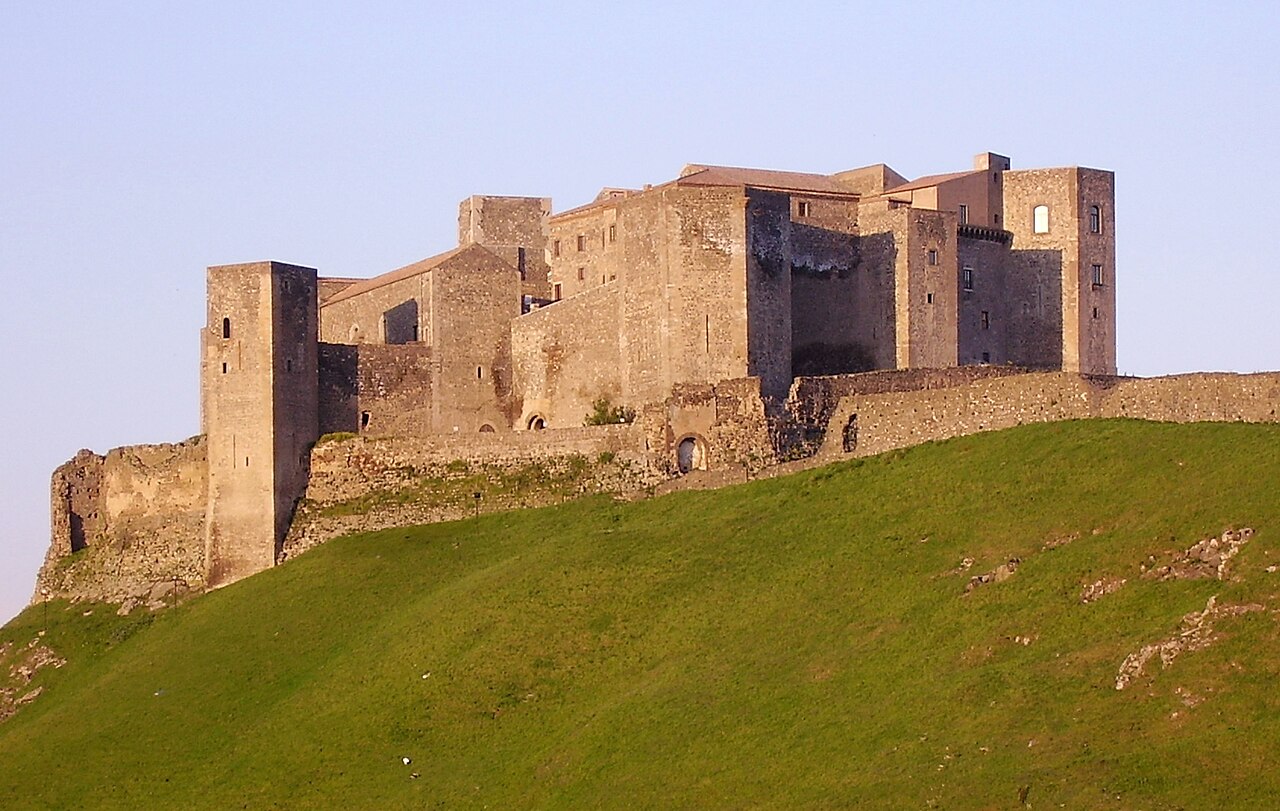
The Castle of Melfi in Basilicata is a monument owned by the Italian State and one of the most important medieval castles in Southern Italy. Its construction, at least the components still visible, dates back to the Norman conquest and has undergone significant changes over time, especially under the House of Anjou and the Crown of Aragon.
The castle was built in the late 11th century by the Normans in a strategic location that serves as a gateway between Campania and Apulia. Its placement was essential to defend itself from external attacks and as a refuge for Norman allies. The structure was a place of several "historic" events during the Norman period.
In Melfi, the residential seat of the County of Apulia (Contea di Puglia), there were five ecumenical councils, organized by five different Popes between 1059 and 1137. In the summer of 1059, Pope Nicholas II stayed at the fortress: on 24 June he concluded an agreement with Count Robert Guiscard and Prince Richard I of Capua, in preparation of the First Council of Melfi, which he celebrated there from 3 to 25 August finally recognizing the Norman conquests by the Concordat of Melfi. The Pope named Robert Guiscard Duke of Apulia and Calabria and the town of Melfi on that occasion was promoted to the capital of his duchy. Guiscard had exiled his first wife Alberada of Buonalbergo, to marry the Lombard princess Sikelgaita of Salerno.
Further synods were held at the castle: Pope Alexander II from 1 August 1067 chaired the Second Council of Melfi, received the Lombard prince Gisulf II of Salerno as well as Robert Guiscard and his younger brother Roger I. The Third Council of Melfi, convened in 1089 by Pope Urban II, dealt with church legislation and the relation to the Greek Church, in 1101 Paschal II called the Fourth Council of Melfi IV and finally Innocent II in 1137 celebrated the Fifth Council of Melfi, last of the series. Also in 1130 Antipope Anacletus II, who established the Norman Kingdom of Sicily, organized a Council of Melfi, which however was not recognized by the Church.
Upon the arrival of the Hohenstaufen dynasty in 1194, Emperor Frederick II gave great importance to the Castle of Melfi, and ordered several modifications.
Text adapted from “Castle of Melfi” on Wikipedia, CC BY-SA 4.0.
Castle of Melfi ranks #1,513 of 9,079 worldwide in the atlas's castle fame ranking, and #112 of the 560 mapped in Italy. Founded c. 1075, it is older than 87% of the atlas's dated landmarks — one of 436 atlas entries founded in the 11th century. Its Wikipedia articles were opened 2,151 times in the last 60 days, more than 71% of the atlas. 2 more atlas landmarks stand within 25 km. See how Italy compares in the castle statistics.
View on the interactive castle map →