 England · 11th century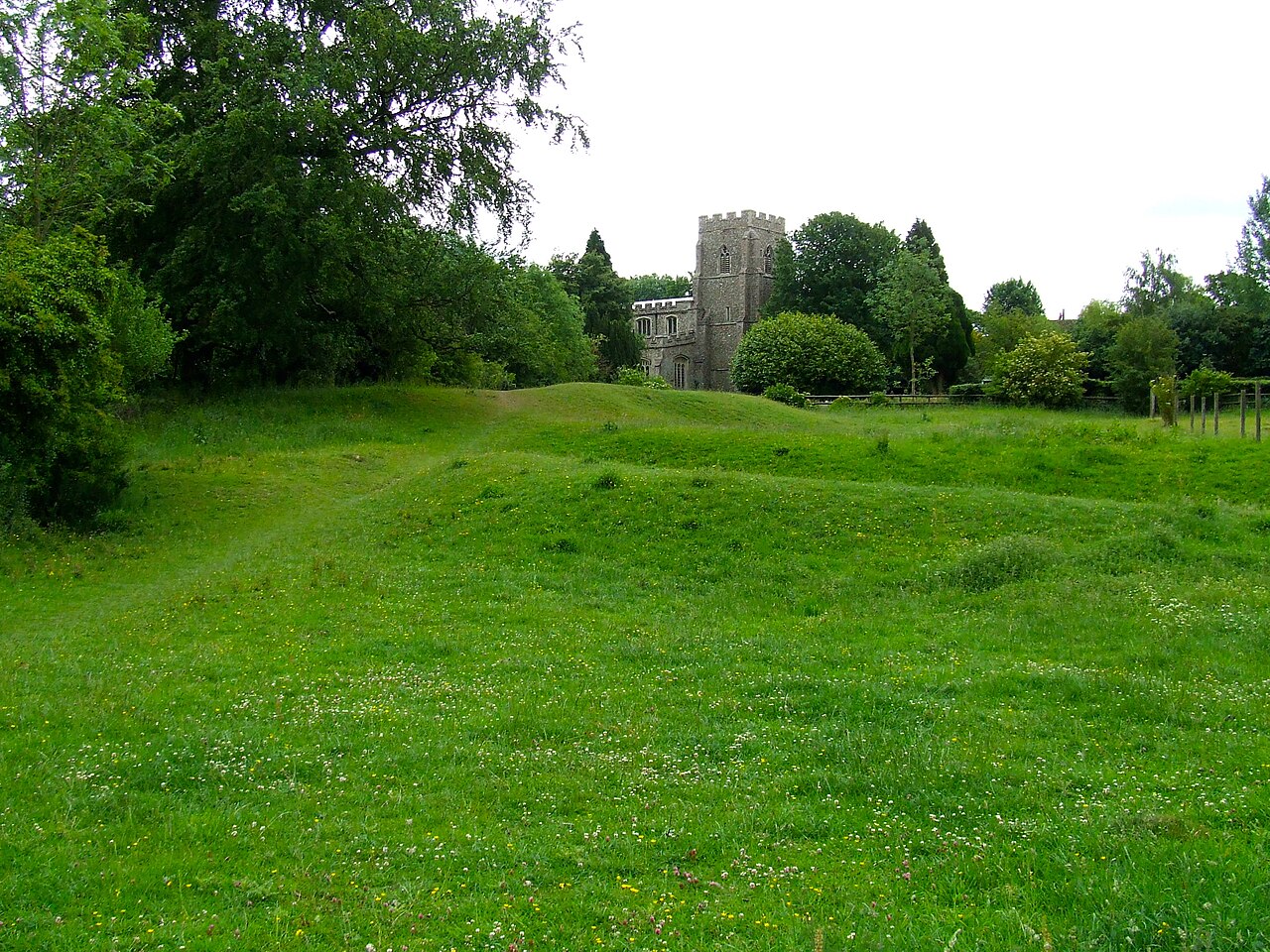
Clavering Castle remains are situated in the small parish village of Clavering in the county of Essex, England, 50m north of the church of St Mary and St Clement on the southern bank of the River Stort, some 10 kilometres (6.2 mi) north of Bishop's Stortford (grid reference TL471320).
The site of this castle is unusual in that the ringworks and earthworks that remain have been identified as predating the Norman Conquest, and Clavering Castle was built no later than 1052.
Ringworks are medieval fortifications built and occupied from late Anglo-Saxon times to the later 12th century. A ringwork was a small defended area which contained buildings surrounded or partially surrounded by a large ditch and a bank topped with a timber palisade or, more unusually, a stone wall. Occasionally a more lightly defended embanked enclosure, the bailey, adjoined the ringwork. Ringworks acted as strongholds for military operations and defended aristocratic or major settlements. They are rare, and there are only 200 recorded examples, fewer than 60 have baileys. Clavering Castle is one of a limited number and very restricted range of Anglo-Saxon and Norman fortifications and the ringworks are of particular significance for investigating the period.
A series of earth banks, channels and pond bays have not been dated but are believed to be associated with a former mill. These earthworks extend for 200m to the west of the castle along the banks of the River Stort.
The River Stort flows around the north side of the site and has been diverted to feed the moat. Archaeological excavations have established that there was a pre-Conquest settlement and the later Norman castle.
The first known Lord of Clavering mentioned in the Domesday Book of 1086 was Robert FitzWimarc, an image of whom is believed to appear on the Bayeux Tapestry, at Edward the Confessor's deathbed. ‘Robert’s Castle’ mentioned in Domesday is thought to refer to Clavering Castle. FitzWimarc was a Frenchman and was one of Edward the Confessor's closest aides; he has a school named after him in Rayleigh, Essex. The site at Clavering is identified as one of the castles to which the French party at Edward the Confessor's court fled in 1052.
Text adapted from “Clavering Castle” on Wikipedia, CC BY-SA 4.0.
Clavering Castle ranks #5,603 of 9,079 worldwide in the atlas's castle fame ranking, and #332 of the 360 mapped in England. Founded c. 1052, it is older than 89% of the atlas's dated landmarks — one of 436 atlas entries founded in the 11th century. 2 more atlas landmarks stand within 25 km. The nearest day-trip guide is Cambridge (England), 27 km away. See how England compares in the castle statistics.
View on the interactive castle map →