Castle
Dalkey Castle
🇮🇪 Ireland · 14th century
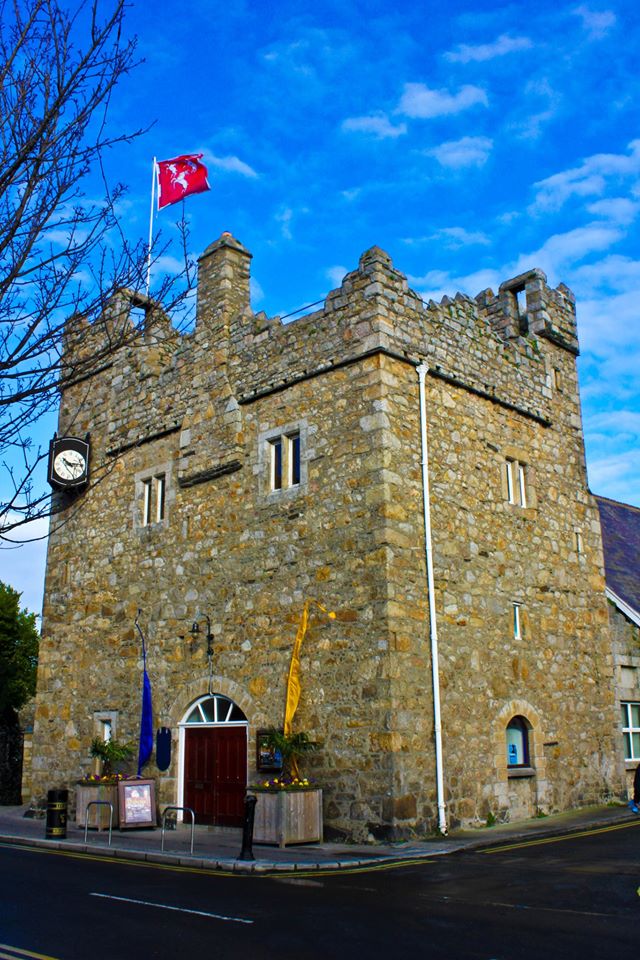
Dalkey Castle (Irish: Caisleán Deilginis), formerly known as Goat Castle, is a medieval structure in Castle Street, Dalkey, Dublin, Ireland. The complex currently accommodates the Dalkey Heritage Centre, which is in the castle itself, and Dalkey Town Hall, which is formed by a single storey extension behind the original building.
The building was commissioned by local merchants as a fortified warehouse to protect goods being transported to and from central Dublin. It was designed in the typical Norman style, built in rubble masonry and was completed in around 1390. The merchants built a total of seven castles, of which the only other surviving example is Archbold's Castle. The design involved a three-storey structure facing onto Castle Street. It was fenestrated by lancet windows and featured machicolation and castellation on all sides. Internally, the principal rooms were a chamber with a vaulted ceiling on the ground floor, and two further large spaces on the first and second floors.
The castle was acquired by the Chevers family in the 17th century and became known as Goat Castle (Chevre being French for goat). Walter Chevers lived there until he died in 1678. It was subsequently owned by the Allen family until it passed to Sir William Mayne in the mid-18th century.
After significant population growth, largely associated with its development as a residential suburb of Dublin, the township of Dalkey appointed town commissioners in 1863. The new town commissioners acquired the castle and used the first floor space as a council chamber from 1869. In around 1890, the town commissioners decided to erect an extension to accommodate public meetings: a new single-storey building was constructed, extending back for six bays along White's Villas. It was accessed through the ground floor of the castle and became known as "Dalkey Town Hall". In 1899, the town commissioners were replaced by an urban district council, with the first floor space in the castle becoming the meeting place of the new council. However, the castle ceased to be the local seat of government in 1930, when Dalkey became part of the borough of Dún Laoghaire.
The town hall became an important venue for public meetings: the Irish republican and leader of Fianna Fáil, Éamon de Valera, gave a speech at a political rally in the town hall in the 1930s.
Text adapted from “Dalkey Castle” on Wikipedia, CC BY-SA 4.0.
Dalkey Castle ranks #6,978 of 8,134 worldwide in the atlas's castle fame ranking, and #161 of the 173 mapped in Ireland. Founded c. 1390, it is older than 55% of the atlas's dated landmarks — one of 604 atlas entries founded in the 14th century. 17 more atlas landmarks stand within 25 km. The nearest day-trip guide is Dublin, 13 km away. See how Ireland compares in the castle statistics.
View on the interactive castle map →Frequently asked questions
Where is Dalkey Castle?
Dalkey Castle stands in Ireland, at 53.2779°, -6.1055°.
When was Dalkey Castle built?
The atlas dates its founding to c. 1390. Earlier structures may have stood on the site; this is the earliest documented founding year.
How famous is Dalkey Castle?
In this atlas's fame ranking: #6,978 of 8,134 worldwide, and #161 in Ireland. Fame here combines how many Wikipedia language editions cover a landmark with how many people read them.
What is the nearest castle to Dalkey Castle?
James Joyce Tower and Museum, about 1 km away.
More castles in Ireland
- Castle Otway Ireland · 18th century
- Barmeath Castle Ireland · 15th century
- Castlelost Castle Ireland
- Ballycowan Castle Ireland · 16th century
More castles
- Castle of Asmesnal Spain
- Tistad Castle Sweden
- Castle of Moeche Spain · 15th century
- Castle of Zalatambor Spain