 Italy · 1st century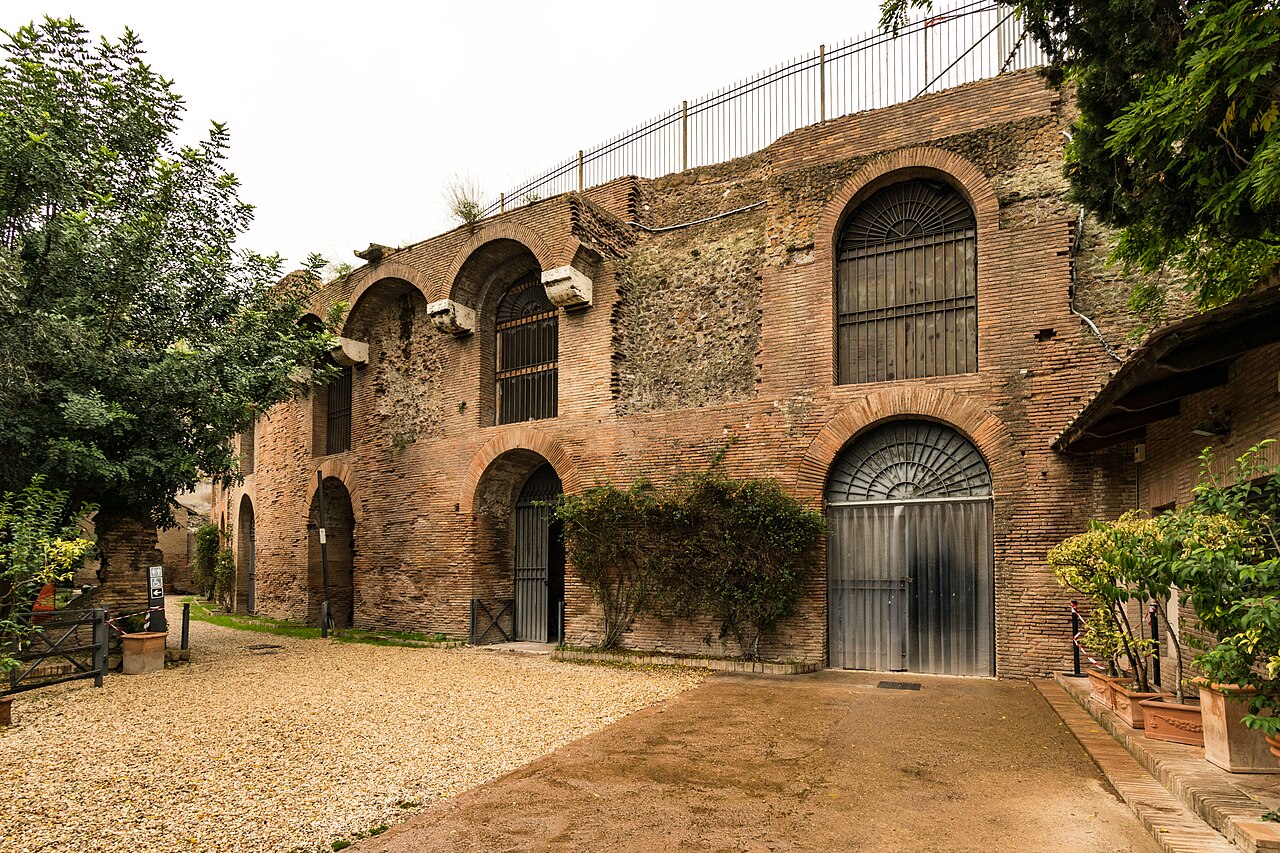
The Domus Aurea (Latin, "Golden House") was a vast landscaped complex built by the Emperor Nero largely on the Oppian Hill in the heart of ancient Rome after the great fire in 64 AD had destroyed a large part of the city.
It replaced and extended his Domus Transitoria that he had built as his first palace complex on the site.
Construction began after the great fire of 64 and was nearly completed before Nero's death in 68, a remarkably short time for such an enormous project. Nero took great interest in every detail of the project, according to Tacitus, and oversaw the engineer-architects, Celer and Severus, who were also responsible for the attempted navigable canal with which Nero hoped to link Misenum with Lake Avernus.
Emperor Otho and possibly Titus allotted money to finish at least the structure on the Oppian Hill; this continued to be inhabited, notably by emperor Vitellius in 69 but only after falling ill, until it was destroyed in a fire under Trajan in 104.
A symbol of decadence that caused severe embarrassment to Nero's successors, the Domus Aurea was stripped of its marble, jewels, and ivory within a decade. Although the Oppian villa continued to be inhabited for some years, soon after Nero's death other parts of the palace and grounds, encompassing 2.6 square kilometres (1 sq mi), were filled with earth and built over: the Baths of Titus were already being built on part of the site, probably the private baths, in 79 AD. On the site of the lake, in the middle of the palace grounds, Vespasian built the Flavian Amphitheatre, which could be flooded at will, with the Colossus of Nero beside it. The Baths of Trajan, and the Temple of Venus and Roma were also built on the site. Within 40 years, the palace was obliterated. Paradoxically, this ensured the wall paintings' survival by protecting them from moisture.
When a young Roman inadvertently fell through a cleft in the Esquiline hillside at the end of the 15th century, he found himself in a strange cave or grotto filled with painted figures. Soon the young artists of Rome were having themselves let down on boards knotted to ropes to see for themselves. The Fourth Style frescoes that were uncovered then have faded now, but the effect of these freshly rediscovered grotesque decorations (Italian: grotteschi) was electrifying in the early Renaissance, which was just arriving in Rome.
Text adapted from “Domus Aurea” on Wikipedia, CC BY-SA 4.0.
Domus Aurea ranks #119 of 9,079 worldwide in the atlas's castle fame ranking, and #11 of the 560 mapped in Italy. Founded 64, it is older than 98% of the atlas's dated landmarks — one of 33 atlas entries founded in the 1st century. Its Wikipedia articles were opened 34,534 times in the last 60 days, more than 99% of the atlas. Wikidata records about 61,000 visitors in 2022. 65 more atlas landmarks stand within 25 km. The nearest day-trip guide is Rome, 1 km away. See how Italy compares in the castle statistics.
View on the interactive castle map →