 Italy · 1st century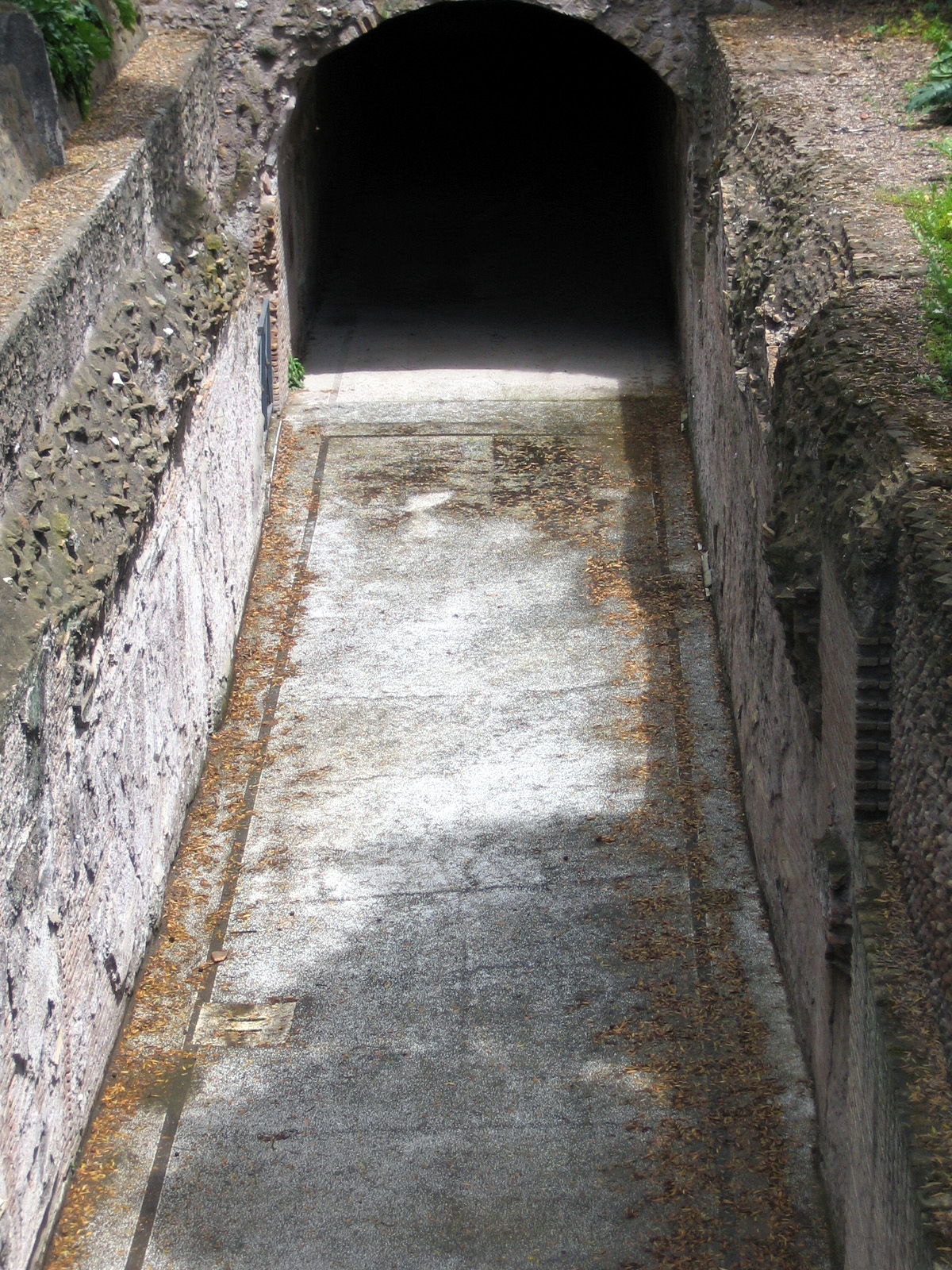
The Domus Transitoria (House of Passage) was Roman emperor Nero's (r. 54 – 68) first palace damaged or destroyed by the Great Fire of Rome in 64 AD, and then extended by his Domus Aurea (or Golden House).
The "domus" estate was intended to connect the Palatine palace with all of the imperial estates that had been acquired in various ways, including the Gardens of Maecenas, Horti Lamiani, Horti Lolliani, etc.
According to Suetonius (Nero 31.1): "He built a palace extending all the way from the Palatine to the Esquiline, which at first he called the Domus Transitoria, but when it was burned down shortly after its completion and rebuilt, the Golden House". It was probably built from AD 60.
One of the main buildings is thought to be on the western side of the Oppian Hill under the Baths of Trajan.
The brick walls of the palace were originally covered with marble at the bottom, while the upper parts were frescoed. A portico fronted the domus along the south side. Almost all of the columns, floors and marble walls were removed when Trajan built his baths (in 104 AD).
The house was built around a big peristyle with porticos on three sides, while the fourth on the north consisted of a cryptoporticus which supported the rear embankment. At the centre, occupied now by a series of long barrel vaults to support the overlying Trajanic baths are the remains of a fountain; on the eastern part is a large nymphaeum that opens to the courtyard.
An elaborate nympheum was unfortunately divided in two by a later wall of Trajan. Surrounded by a portico of four columns it was equipped with a cascading fountain on the bottom, whose water was conveyed into a central basin. On the walls of the grotto was a mosaic of which a few traces remain within a frame of shells. The lower part of the walls were originally covered in marble.
The decoration of the vault, 10 m (33 ft) high, is preserved only in part where four corner medallions and a central octagon were inserted, the latter partly preserved representing the Polyphemus scene.
Five metres below Hadrian's Temple of Venus and Roma a sumptuous rotunda belonging to the palace was discovered in 1828, cut through by foundations of the Domus Aurea.
Text adapted from “Domus Transitoria” on Wikipedia, CC BY-SA 4.0.
Domus Transitoria ranks #1,615 of 9,079 worldwide in the atlas's castle fame ranking, and #120 of the 560 mapped in Italy. Founded 60, it is older than 98% of the atlas's dated landmarks — one of 33 atlas entries founded in the 1st century. Its Wikipedia articles were opened 2,935 times in the last 60 days, more than 77% of the atlas. 65 more atlas landmarks stand within 25 km. The nearest day-trip guide is Rome, 1 km away. See how Italy compares in the castle statistics.
View on the interactive castle map →