 Armenia · 8th century BC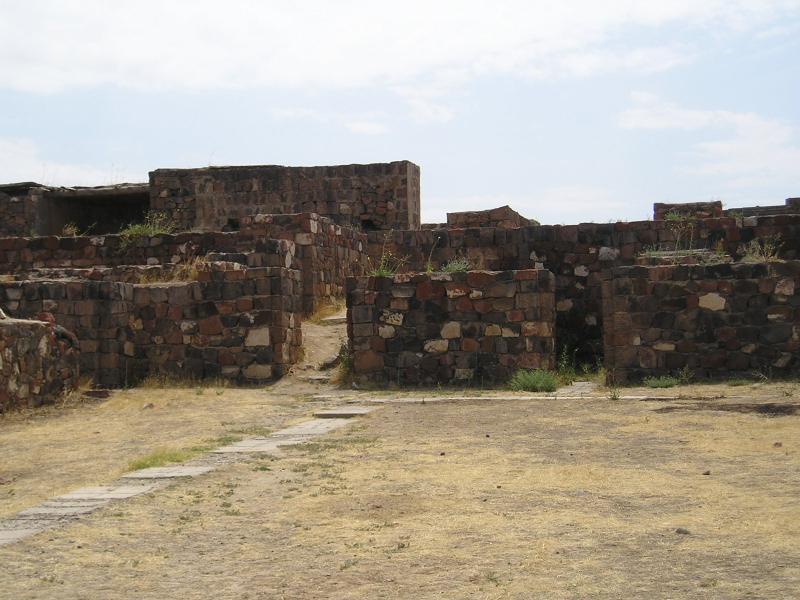
Erebuni Fortress (Armenian: Էրեբունի ամրոց, romanized: Erebuni amrots') is an Urartian fortified city, located in Yerevan, Armenia. It is 1,017 metres (3,337 ft) above sea level. It was one of several fortresses built along the northern Urartian border and was one of the most important political, economic and cultural centers of the vast kingdom. The name Yerevan itself is derived from Erebuni.
On an inscription found at Karmir Blur, the Urartian verb erebu-ni is used in the sense of "to seize, pillage, steal, or kidnap" followed by a changing direct object. Scholars have conjectured that the word, as an unchanging direct object, may also mean "to take" or "to capture" and thus believe that the Erebuni at the time of its founding meant "capture", "conquest", or "victory."
Erebuni was founded by Urartian king Argishti I (r. c. 785–753 BC) in 782 BC. It was built on top of a hill called Arin Berd overlooking the Aras River Valley to serve as a military stronghold to protect the kingdom's northern borders. It has been described as being "designed as a great administrative and religious centre, a fully royal capital." According to Margarit Israelyan, Argishti began the construction of Erebuni after conquering the territories north of Yerevan and west of Lake Sevan, roughly corresponding to where the town of Abovyan is currently located. Accordingly, the prisoners he captured in these campaigns, both men and women, were used to help build his town.
In the autumn of 1950, an archaeological expedition led by Konstantine Hovhannisyan discovered an inscription at Arin Berd dedicated to the city's founding which was carved during Argishti's reign. Two other identical inscriptions have been found at the citadel of Erebuni. The inscription reads:
By the greatness of the God Khaldi, Argishti, son of Menua, built this mighty stronghold and proclaimed it Erebuni for the glory of Biainili (Urartu) and to instill fear among the king's enemies. Argishti says: The land was a desert, before the great works I accomplished upon it. By the greatness of Khaldi, Argishti, son of Menua, is a mighty king, king of Biainili, and ruler of Tushpa."
Argishti left a similar inscription at the Urartian capital of Tushpa (current-day Van) as well, stating that he brought 6,600 prisoners of war from Khate and Tsupani to populate his new city.
Text adapted from “Erebuni Fortress” on Wikipedia, CC BY-SA 4.0.
Erebuni Fortress ranks #521 of 9,079 worldwide in the atlas's castle fame ranking, and #1 of the 27 mapped in Armenia. Founded 782 BC, it is older than 99% of the atlas's dated landmarks — one of 6 atlas entries founded in the 8th century BC. Its Wikipedia articles were opened 5,450 times in the last 60 days, more than 88% of the atlas. 5 more atlas landmarks stand within 25 km. The nearest day-trip guide is Yerevan, 5 km away. See how Armenia compares in the castle statistics.
View on the interactive castle map →