 England · 11th century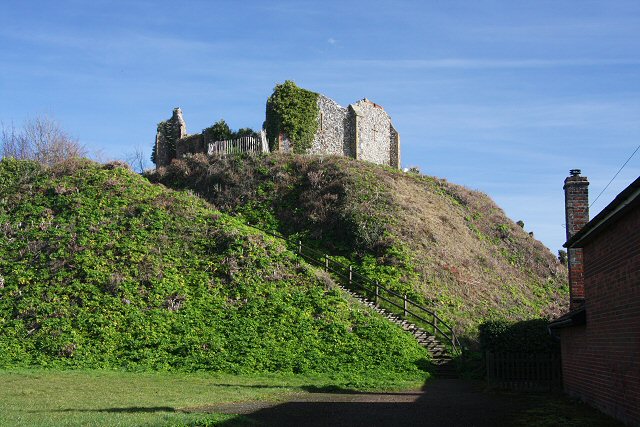
Eye Castle is a motte and bailey medieval castle with a prominent Victorian addition in the town of Eye, Suffolk. Built shortly after the Norman conquest of England in 1066, the castle was sacked and largely destroyed in 1265. Sir Edward Kerrison built a stone house on the motte in 1844: the house later decayed into ruin, becoming known as Kerrison's Folly in subsequent years.
Eye Castle is a motte and bailey castle, built during the reign of William I by William Malet, who died fighting Hereward the Wake in 1071. The Malet family also controlled the surrounding Honour of Eye, a significant collection of estates centring on the castle, and the park of Eye. The castle motte is 160 feet (49 m) in diameter and 40 feet (12 m) high, with the bailey approximately 400 by 250 feet (122 by 76 m) wide. The castle is unusual in being one of only two castles mentioned in the Domesday Book on 1086 as a source of income for their owners, due to the presence of a market within the castle bailey, from which the owner drew revenue; the castle's market competed with the Bishop of Norwich's market at Hoxne.
William Malet's son, Robert, was exiled and after his death at the Battle of Tinchebray in Normandy in 1106, Eye was confiscated by Henry I and became a royal castle for a period. Henry gave Eye to his favoured nephew, Stephen of Blois in 1113. Stephen succeeded to the English throne in 1135 and he gave the honour of Eye first to one of his lieutenants, William of Ypres and then later to Hervey Brito, his son-in-law. At some point during the 1140s, Stephen then transferred the lands to his second son, William. William was still young at the time, and it appears that until he came of age these lands were initially managed by Stephen's trusted Royal Steward, William Martel.
Meanwhile, the civil war known as the Anarchy had broken out between Stephen and the Empress Matilda between 1138 and 1154; much of the fighting occurred in East Anglia, where the powerful Bigod family, headed by Hugh Bigod, attempted to expand their autonomy and influence. Eye Castle did not play a major role in the war as, despite some skirmishing occurring in the region, most of the campaigning was conducted to the west.
After coming to power in 1154, Henry II attempted to re-establish royal influence across the region.
Text adapted from “Eye Castle” on Wikipedia, CC BY-SA 4.0.
Eye Castle ranks #4,884 of 9,079 worldwide in the atlas's castle fame ranking, and #305 of the 360 mapped in England. Founded 1066, it is older than 88% of the atlas's dated landmarks — one of 436 atlas entries founded in the 11th century. 3 more atlas landmarks stand within 25 km. The nearest day-trip guide is Colchester, 51 km away. See how England compares in the castle statistics.
View on the interactive castle map →