Castle
Bungay Castle
ENG England · 11th century
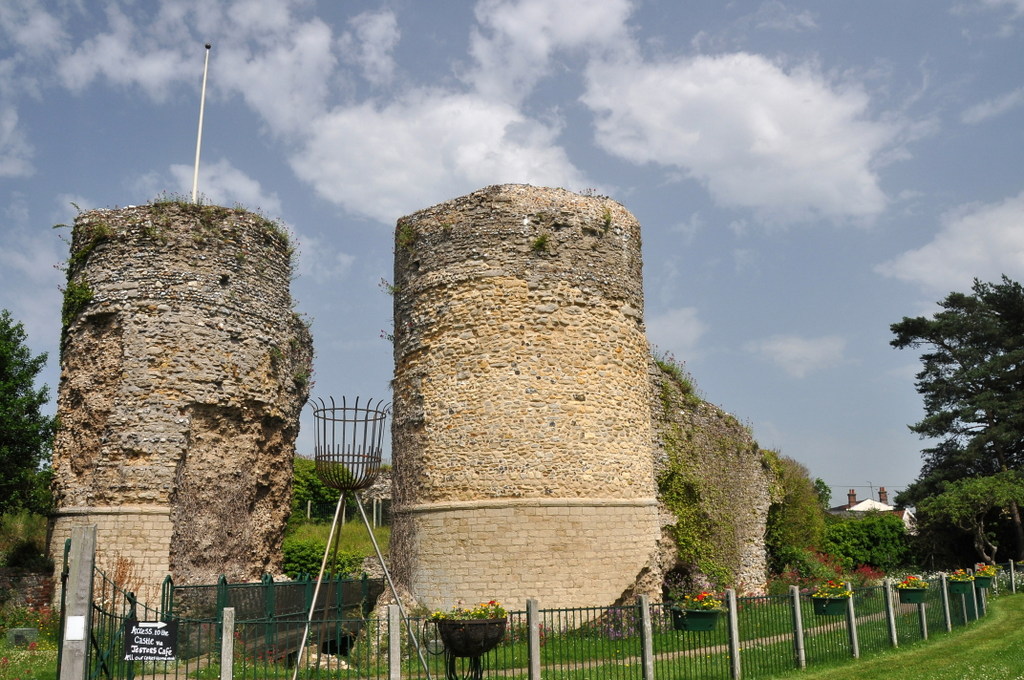
Bungay Castle is a Grade I listed building in the town of Bungay, Suffolk.
The site was originally a Norman castle built by Roger Bigod in about 1100 to take advantage of the natural protection provided by a curve in the River Waveney. Roger's son Hugh was a prominent player in the civil war period known as the Anarchy (1138–1154), and his loyalty was called into question during the early years of the reign of Henry II. Henry confiscated Bungay but in 1164 he returned it to Bigod, who built a large square Norman keep on the site in 1165. It is not recorded how much it cost to build the keep, but the archaeologist Hugh Braun, who led the excavations at the castle in the 1930s, estimated that it would have cost around £1,400 (equivalent to £4,402,254 in 2025).
Bigod was on the losing side in the revolt of 1173–1174, and Bungay was besieged, mined and ultimately slighted by royal forces. According to the historian Sidney Painter, it was one of at least 21 castles demolished on Henry II's instructions.
The site was subsequently restored yet again to the Bigod family and was further developed in 1294 by Roger Bigod, 5th Earl of Norfolk, who probably built the massive gate towers on the site. He fell out with Edward I and after his death the castle reverted to the Crown, falling into disrepair and ruin. In 1310, King Edward II granted sustenance to his two younger half-brothers, Thomas of Brotherton and Edmund of Kent, from Bigod's lands which included Bungay. In 1312, Thomas of Brotherton came into the vacated earldom of Norfolk and Bungay Castle which then passed to his daughter Alice Montagu at his death in 1338.
Alice had married Edward Montagu, younger brother of William, 1st Earl of Salisbury and it was at Bungay Castle he and two of his retainers beat her so violently, Alice died in January 1352. It stayed in the hands of Edward Montagu until his death in 1361. In1483 it was re-acquired by the Dukes of Norfolk, who retained ownership until the 20th century, except for a short period in the late 18th century. In 1766 the site was sold to Robert Mickleborough, who quarried the keep and curtain walls for road-building materials. Later, in the early 1790s, it was purchased by Daniel Bonhôte, a local solicitor, but was sold back to the Dukes of Norfolk in about 1800.
Text adapted from “Bungay Castle” on Wikipedia, CC BY-SA 4.0.
Bungay Castle ranks #2,604 of 8,134 worldwide in the atlas's castle fame ranking, and #174 of the 333 mapped in England. Founded c. 1100, it is older than 86% of the atlas's dated landmarks — one of 325 atlas entries founded in the 11th century. Its Wikipedia articles were opened 1,597 times in the last 60 days, more than 61% of the atlas. 6 more atlas landmarks stand within 25 km. The nearest day-trip guide is Colchester, 73 km away. See how England compares in the castle statistics.
View on the interactive castle map →Frequently asked questions
Where is Bungay Castle?
Bungay Castle stands in England, at 52.45597°, 1.436°.
When was Bungay Castle built?
The atlas dates its founding to c. 1100. Earlier structures may have stood on the site; this is the earliest documented founding year.
How famous is Bungay Castle?
In this atlas's fame ranking: #2,604 of 8,134 worldwide, and #174 in England. Fame here combines how many Wikipedia language editions cover a landmark with how many people read them.
What is the nearest castle to Bungay Castle?
Mettingham Castle, about 3 km away.
More castles in England
- Newgate England
- Cadbury Castle England
- Little Solsbury Hill England
- Buckden Towers England · 12th century
More castles
- Portumna Castle Ireland · 17th century
- Årsta Castle Sweden · 17th century
- Bytča Castle Slovakia
- Château d'Aguilar France · 12th century