 England · 12th century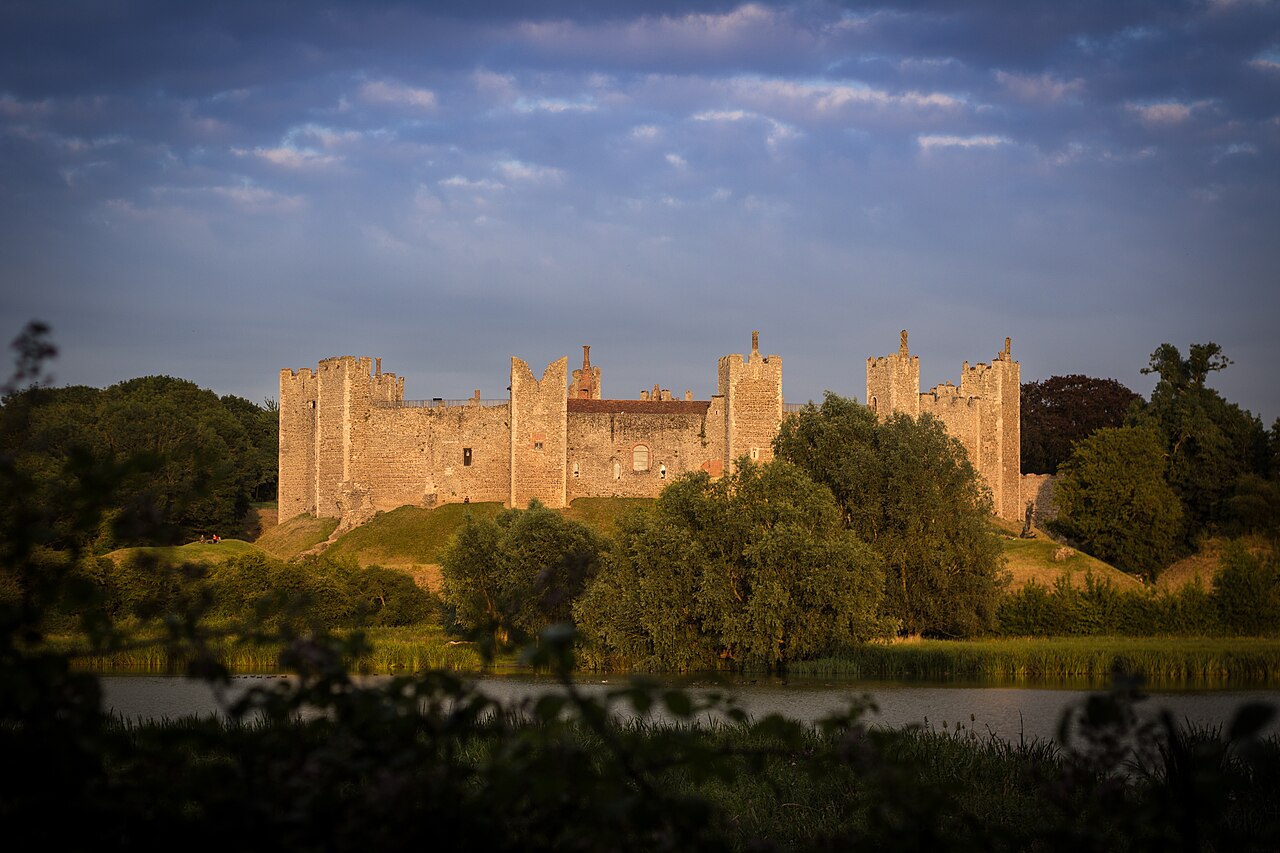
Framlingham Castle is a castle in the market town of Framlingham, Suffolk, England. An early motte and bailey or ringwork Norman castle was built on the Framlingham site by 1148, but this was destroyed (slighted) by Henry II of England in the aftermath of the Revolt of 1173–1174. Its replacement, constructed by Roger Bigod, the Earl of Norfolk, was unusual for the time in having no central keep, but instead using a curtain wall with thirteen mural towers to defend the centre of the castle. Despite this, the castle was successfully taken by King John in 1216 after a short siege. By the end of the 13th century, Framlingham had become a luxurious home, surrounded by extensive parkland used for hunting.
During the 15th and 16th centuries Framlingham was at the heart of the estates of the powerful Mowbray and Howard families. Two artificial meres were built around the castle, which was expanded in fashionable brick. With a large, wealthy household to maintain, the castle purchased supplies from across England and brought in luxury goods from international markets. Extensive pleasure gardens were built within the castle and older parts redesigned to allow visitors to enjoy the resulting views. By the end of the 16th century, however, the castle fell into disrepair and after the final Howard owner, Theophilus, entered into financial difficulties the castle and the surrounding estates were sold off.
In 1636, Framlingham Castle was given to Pembroke College, Cambridge, as a philanthropic gesture, and remained in its ownership for some three hundred years. In the 17th century, the internal buildings were taken down to make way for the construction of a poor law workhouse within the castle; it was used in this way until 1839, when the facility was closed; the castle was then used as a drill hall and as a county court.
Text adapted from “Framlingham Castle” on Wikipedia, CC BY-SA 4.0.
Framlingham Castle ranks #739 of 9,079 worldwide in the atlas's castle fame ranking, and #54 of the 360 mapped in England. Founded 1148, it is older than 83% of the atlas's dated landmarks — one of 756 atlas entries founded in the 12th century. Its Wikipedia articles were opened 7,456 times in the last 60 days, more than 91% of the atlas. 3 more atlas landmarks stand within 25 km. The nearest day-trip guide is Colchester, 48 km away. See how England compares in the castle statistics.
View on the interactive castle map →