 Canada · 18th century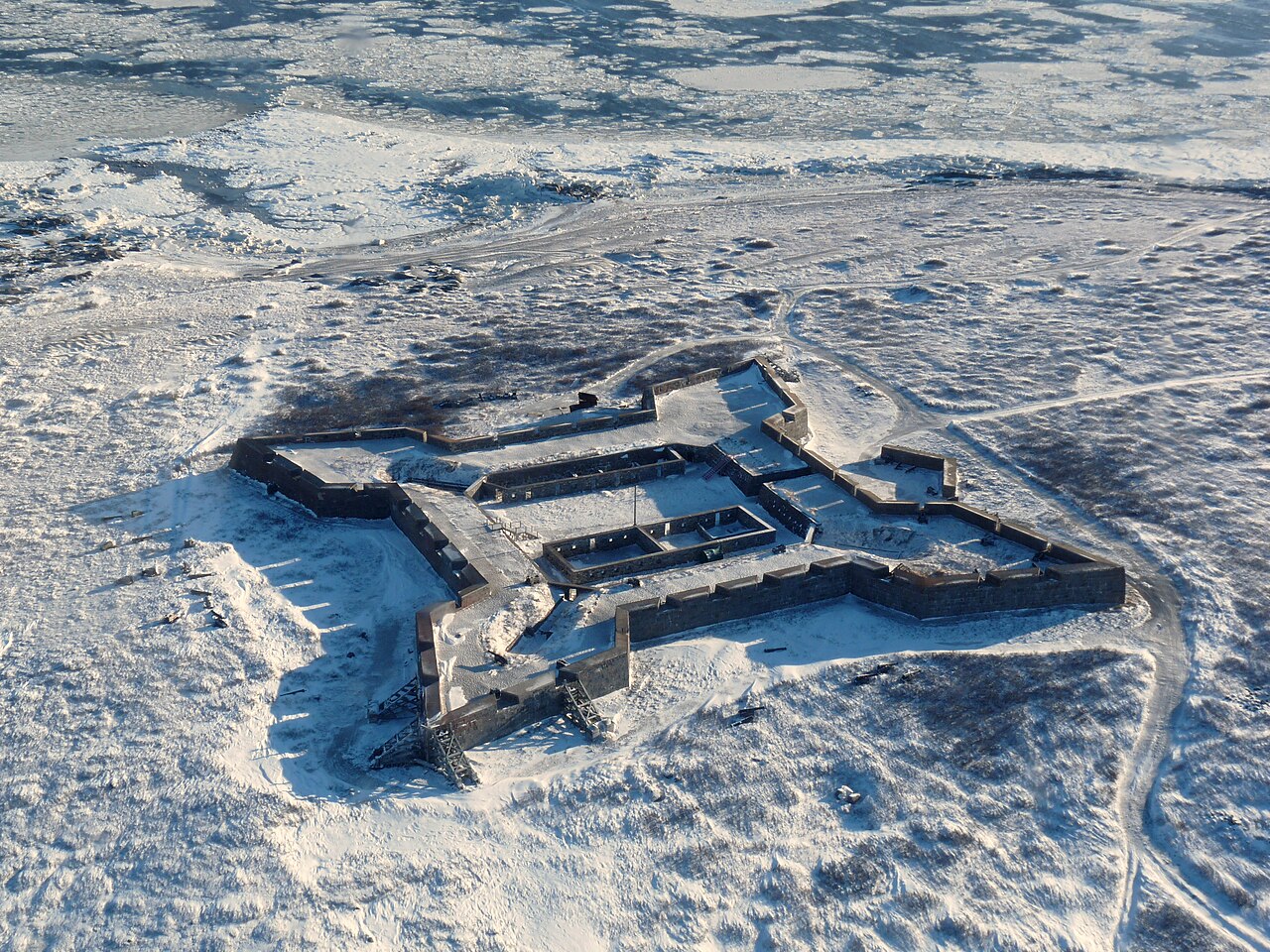
Prince of Wales Fort is a historic bastion fort on Hudson Bay across the Churchill River from Churchill, Manitoba, Canada. It is the oldest building in the country west of Ontario, and the northernmost fort in North America. It is a National Historic Site in the national park system.
The European history of this area starts with Henry Hudson sailing into Hudson Bay in 1610. The area was recognized as important in the fur trade and of potential importance for other discoveries. The fort is built in a star shape.
This fort began as a log fort built in 1717 by James Knight of the Hudson's Bay Company (HBC) and was originally called the Churchill River Post. In 1719, the post was renamed Prince of Wales Fort. It was located on the west bank of the Churchill River to protect and control the HBC's interests in the fur trade.
The original wooden fort was replaced by a massive stone fort, probably to abide by the Royal Charter which required that Rupert's Land should be fortified.
Construction of this fort was started in 1731 near what was then called Eskimo Point. It was in the form of a square, with sides 90 m (300 ft) long and walls 6 m (20 ft) tall and 9 m (30 ft) thick at the base.
It had forty-two cannon mounted on the walls. The cannon were massive, some weighing as much as 2,500 kg (5,500 lb), built to fire nine, eighteen and 24-pound balls. There was also a battery across the river on Cape Merry meant to hold six more cannon.
In the 1780s, the French government launched a Hudson Bay expedition to damage HBC activities in that bay. Three French warships of the expedition, led by Jean-François de La Pérouse, captured the Prince of Wales Fort in 1782. The fort was manned by only 39 (non-military) men at the time, and the fort's governor, Samuel Hearne, recognised the numerical and military imbalance and surrendered without a single shot being fired. The French partially destroyed the fort, but its mostly-intact ruins survive to this day.
The fort returned to the HBC in 1783. Thereafter, its importance waned with the decline in the fur trade although the post was refounded a little way up the river.
The remains of these buildings still stand in the Fort, although none of them are intact, with roofs long since deteroriated.
Text adapted from “Prince of Wales Fort” on Wikipedia, CC BY-SA 4.0.
Prince of Wales Fort ranks #2,262 of 9,035 worldwide in the atlas's castle fame ranking, and #9 of the 26 mapped in Canada. Founded 1717, it is older than 20% of the atlas's dated landmarks, one of 685 atlas entries founded in the 18th century. Its Wikipedia articles were opened 2,869 times in the last 60 days, more than 77% of the atlas. See how Canada compares in the castle statistics.
View on the interactive castle map →