 Canada · 17th century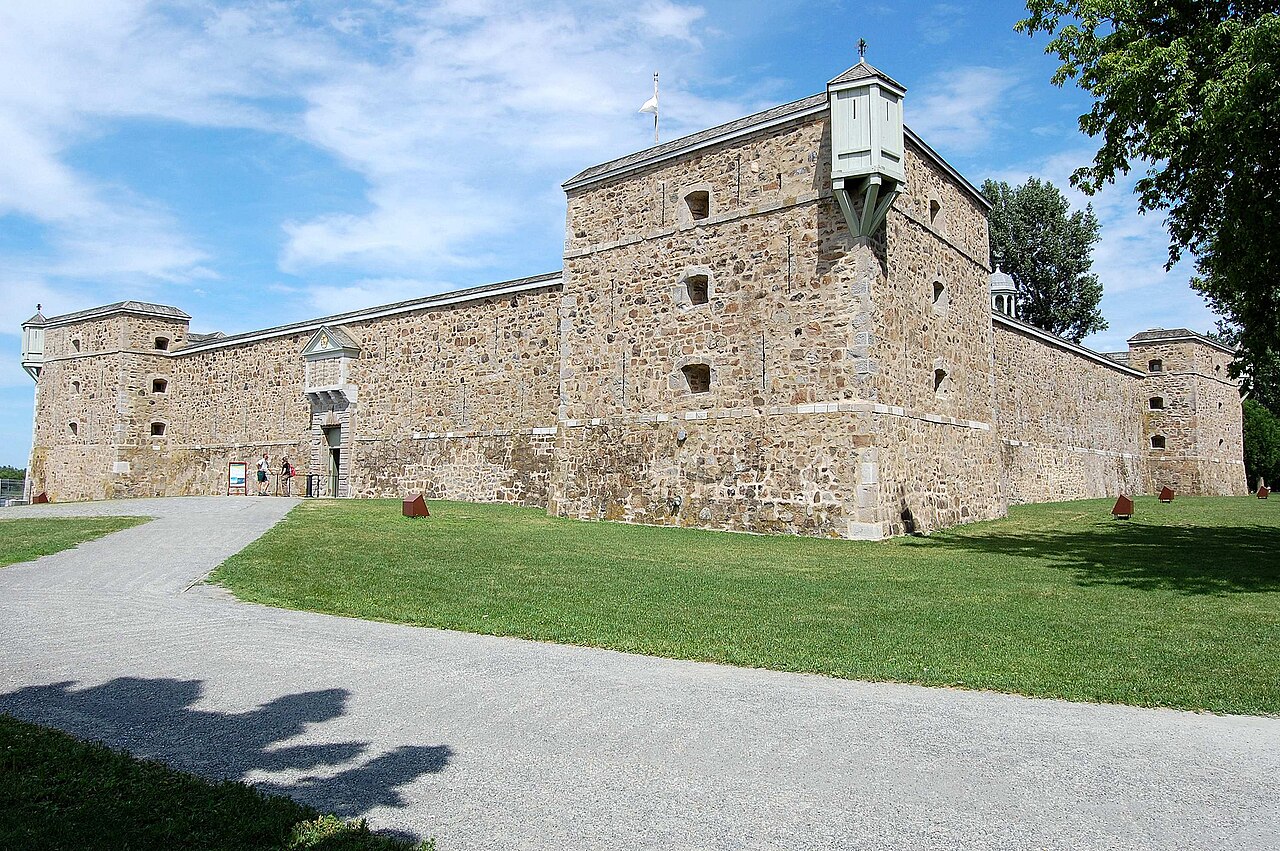
Fort Chambly is a historic fort in La Vallée-du-Richelieu Regional County Municipality, Quebec. It is designated as a National Historic Site of Canada. Fort Chambly was formerly known as Fort St. Louis. It was part of a series of five fortifications built along the Richelieu River to protect travellers on the river from the Iroquois. The region is informally known as la Vallée-des-Forts.
Fort Chambly at the foot of the Chambly rapids on the Richelieu River in Quebec, Canada, was built by the French in 1711. It was the last of three forts to be built on the same site. The first — then called Fort Saint Louis — was constructed in 1665 by captain Jacques de Chambly, to protect New France from Iroquois attacks.
After minor repairs, the fort was burned by the Indians in 1702, but was reconstructed the same year. By then it was already known as Fort Chambly. However, with the Great Peace of Montreal in 1701, the war between the French and Iroquois was over. Also at this time the War of the Spanish Succession broke out, and boiled over into the colonies of France and England. Thus, to defend against a more powerful European attack, including the threat of cannon fire, Governor Philippe de Rigaud Vaudreuil ordered that the fort be rebuilt in stone in 1709. The engineer responsible for the design and construction of the new fort was Josué Boisberthelot de Beaucours. He also oversaw major improvements carried out on the fort between 1718 and 1720, modifications he felt would greatly increase the fort's defenses.
For many years Fort Chambly was the main footing of the defensive chain of fortifications along the Richelieu River, which was the easiest invasion route into New France. However, with the construction of Fort Saint-Frédéric (1731) and Fort Saint-Jean (1748) further south, Fort Chambly lost most of its defensive purpose and so was converted into a warehouse and rally-point for soldiers, although the fort was never abandoned. With the Seven Years' War, Fort Chambly was re-fortified and reoccupied, although it failed to stop the British from approaching Montreal and Quebec City.
The substantial stone structure which still stands today was lost to the British in August 1760 in the Montreal Campaign during the French and Indian War.
Text adapted from “Fort Chambly” on Wikipedia, CC BY-SA 4.0.
Fort Chambly ranks #2,709 of 9,035 worldwide in the atlas's castle fame ranking, and #13 of the 26 mapped in Canada. Founded 1665, it is older than 24% of the atlas's dated landmarks, one of 708 atlas entries founded in the 17th century. Its Wikipedia articles were opened 2,479 times in the last 60 days, more than 74% of the atlas. See how Canada compares in the castle statistics.
View on the interactive castle map →