Fortress
Fortress of Saint James of Sesimbra
🇵🇹 Portugal · 17th century
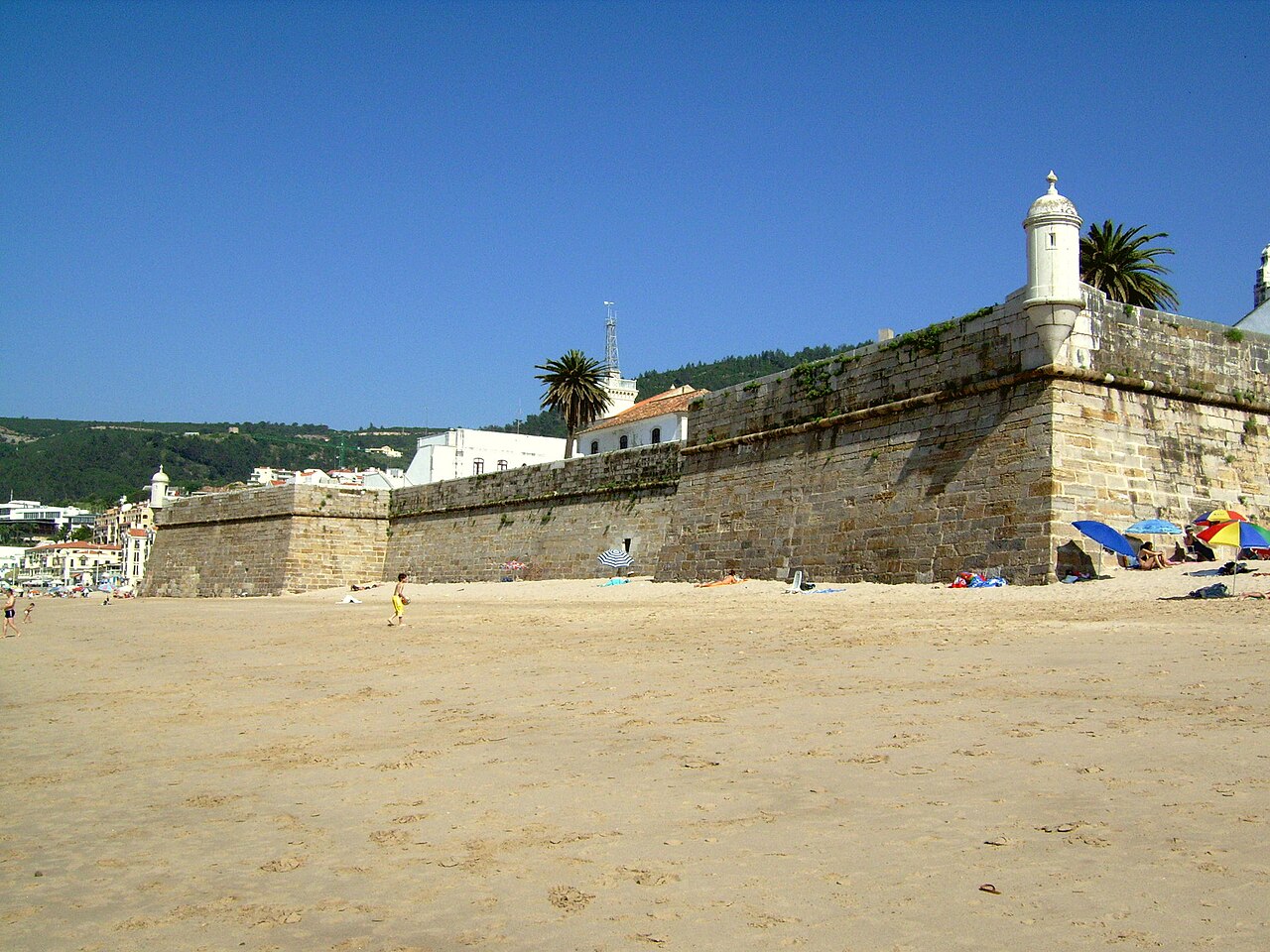
The Fortress of Saint James of Sesimbra (also known as the Fortress of Santiago) is a fortress located in the parish of Santiago in the coastal town and municipality of Sesimbra, in the Setúbal District of Portugal. It was built between 1642 and 1648 on the site of an earlier 16th-century Manueline fort.
During the Anglo-Spanish War (1585-1604), the Battle of Sesimbra Bay between two English naval forces and a Spanish fleet took place on June 3, 1602. The English managed to sink two Spanish vessels, forcing the Spaniards to withdraw to the fishing village of Sesimbra, where they attacked the existing fort and caused heavy damage.
The present fort was constructed when King John IV ordered the strengthening of Portugal’s Atlantic defences in the face of attacks by the Spanish navy during the Restoration War (1640-68). In many cases this involved restructuring earlier forts and increasing their firepower. The king appointed João de Cosmander, a Dutch Jesuit military engineer, to supervise construction of the new fortress on the site of the earlier fort built by King Manuel I, with the intention that it would be capable of protecting the fishing harbour of Sesimbra from piracy and from Spanish attacks. Cosmander also worked on the Castle of Campo Maior, the Castle of Belver, and the Castle of Elvas, all major forts in Portugal.
The fort, which is oriented east-west along the beach, has a very solid structure with an austere appearance. It was developed with a polygonal star-shaped plan, with a rectangular central body and bastions, with cylindrical bartizans. The interior area was divided to make space for the residence of the Governor, the garrison barracks, cisterns, a warehouse and a chapel dedicated to Saint James. The north side of the fortress, facing the village, presents a less military appearance. The round arch gate is topped with a coat of arms with the national shield and inscription indicating the date of inauguration, 1648.
In 1712, King John V decided to install the Military Government of the region in the fortress. At that time the fort also served as a summer residence for the "Boys of Palhavã", the infant bastard sons of the king.
Text adapted from “Fortress of Saint James of Sesimbra” on Wikipedia, CC BY-SA 4.0.
Fortress of Saint James of Sesimbra ranks #6,395 of 8,134 worldwide in the atlas's castle fame ranking, and #132 of the 205 mapped in Portugal. Founded 1642, it is older than 28% of the atlas's dated landmarks — one of 626 atlas entries founded in the 17th century. 7 more atlas landmarks stand within 25 km. The nearest day-trip guide is Lisbon, 30 km away. See how Portugal compares in the castle statistics.
View on the interactive castle map →Frequently asked questions
Where is Fortress of Saint James of Sesimbra?
Fortress of Saint James of Sesimbra stands in Portugal, at 38.44289°, -9.10114°.
When was Fortress of Saint James of Sesimbra built?
The atlas dates its founding to 1642. Earlier structures may have stood on the site; this is the earliest documented founding year.
How famous is Fortress of Saint James of Sesimbra?
In this atlas's fame ranking: #6,395 of 8,134 worldwide, and #132 in Portugal. Fame here combines how many Wikipedia language editions cover a landmark with how many people read them.
What is the nearest castle to Fortress of Saint James of Sesimbra?
Castelo de Sesimbra, about 1 km away.
More castles in Portugal
- Fort of Santiago do Outão Portugal · 16th century
- Fort of São Sebastião de Caparica Portugal
- Forte de São Sebastião (Castro Marim) Portugal · 17th century
- Fortificações da Praça de Valença do Minho Portugal
More fortresses
- Borj Masouda Tunisia
- Borj Ennar Tunisia
- Forte do Castelo de Belém Brazil · 17th century
- Fort of São João do Arade Portugal · 16th century