 Greece · 14th century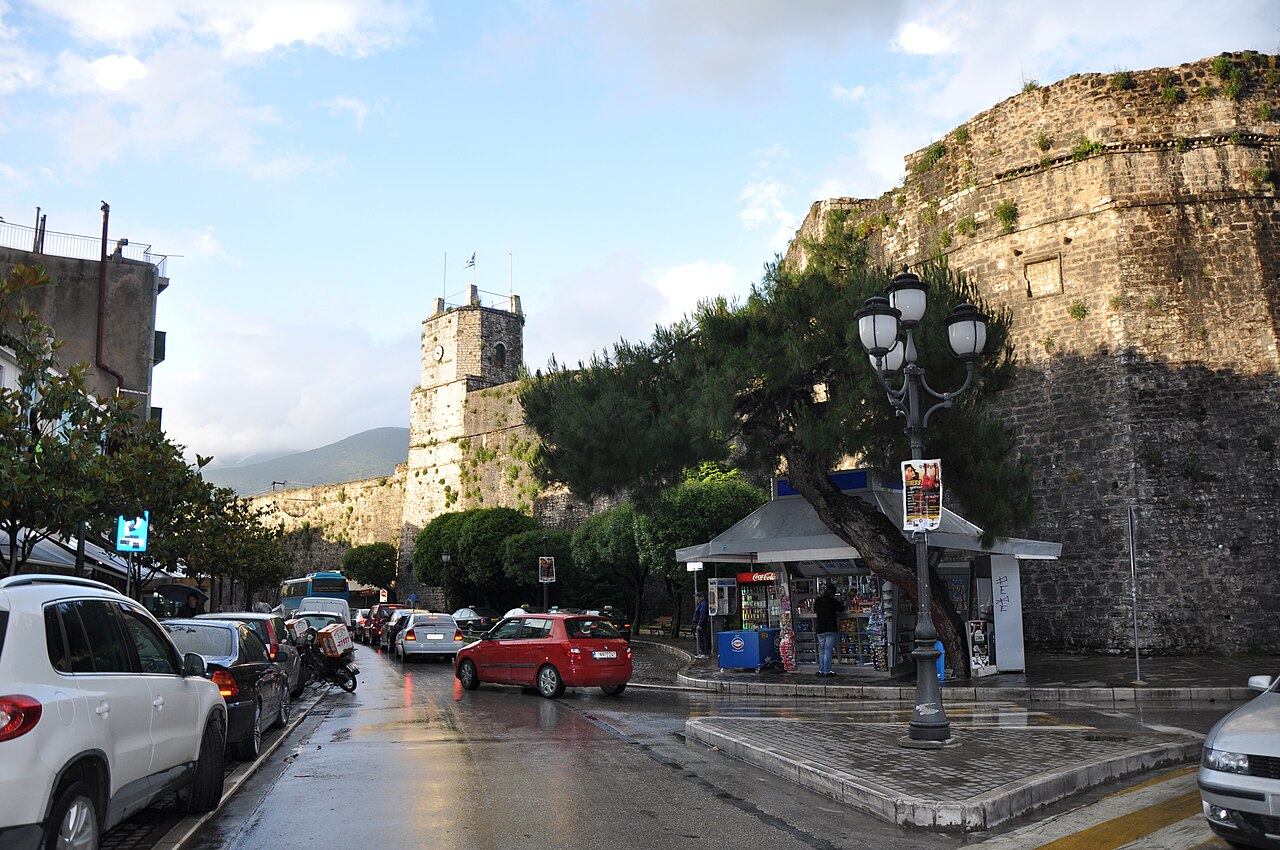
The Ioannina Castle (Greek: Κάστρο Ιωαννίνων) is the fortified old town of the city of Ioannina in northwestern Greece. The present fortification dates largely to the reconstruction under Ali Pasha in the late Ottoman period, but incorporates also pre-existing Byzantine elements.
Ioannina is first definitely mentioned in a 1020 decree by the Byzantine emperor Basil II, but it clearly existed for several centuries before. Traditionally, the foundation and first fortification of the city have been placed in the 6th century, when the historian Procopius (De Aedificiis, IV.1.39–42) records the construction of a new, "well-fortified" city by the Byzantine emperor Justinian I (r. 527–565) for the inhabitants of ancient Euroia. This view is not supported, however, by any concrete archaeological evidence. Early 21st-century excavations furthermore have brought to light fortifications dating to the Hellenistic period (4th–3rd centuries BC), the course of which was largely followed by later reconstructions of the fortress in the Byzantine and Ottoman periods.
The identification of the site with one of the known ancient cities of Epirus has not yet been possible. The Greek archaeologist K. Tsoures dated the Byzantine city walls and the northeastern citadel to the 10th century. Additions in the late 11th century, including the southeastern citadel, are traditionally ascribed to the short-lived occupation of the city by the Normans under the leadership of Bohemond of Taranto.
After the fall of the Byzantine Empire to the Fourth Crusade in 1204, the town's history was turbulent: it became part of the Byzantine Greek successor state of Epirus, fell to the restored Byzantine Empire under the Palaiologos dynasty in 1319, and was captured by the Serbian ruler Stefan Dushan in 1346. The Florentine adventurer Esau de' Buondelmonti captured the city from its Serbian rulers in 1385, to be followed by the Tocco family, rulers of Cephalonia and Zakynthos, from 1411 until the capture of the city by the Ottoman Empire on 9 October 1430. In the years immediately after 1204, the city walls and the northeastern citadel were reconstructed, while further reconstruction was undertaken in 1367–84 under Thomas Preljubović.
Text adapted from “Ioannina Castle” on Wikipedia, CC BY-SA 4.0.
Ioannina Castle ranks #1,408 of 9,079 worldwide in the atlas's castle fame ranking, and #30 of the 134 mapped in Greece. Founded 1378, it is older than 53% of the atlas's dated landmarks — one of 755 atlas entries founded in the 14th century. Its Wikipedia articles were opened 3,428 times in the last 60 days, more than 80% of the atlas. The nearest day-trip guide is Ioannina, 1 km away. See how Greece compares in the castle statistics.
View on the interactive castle map →