 Greece · 19th century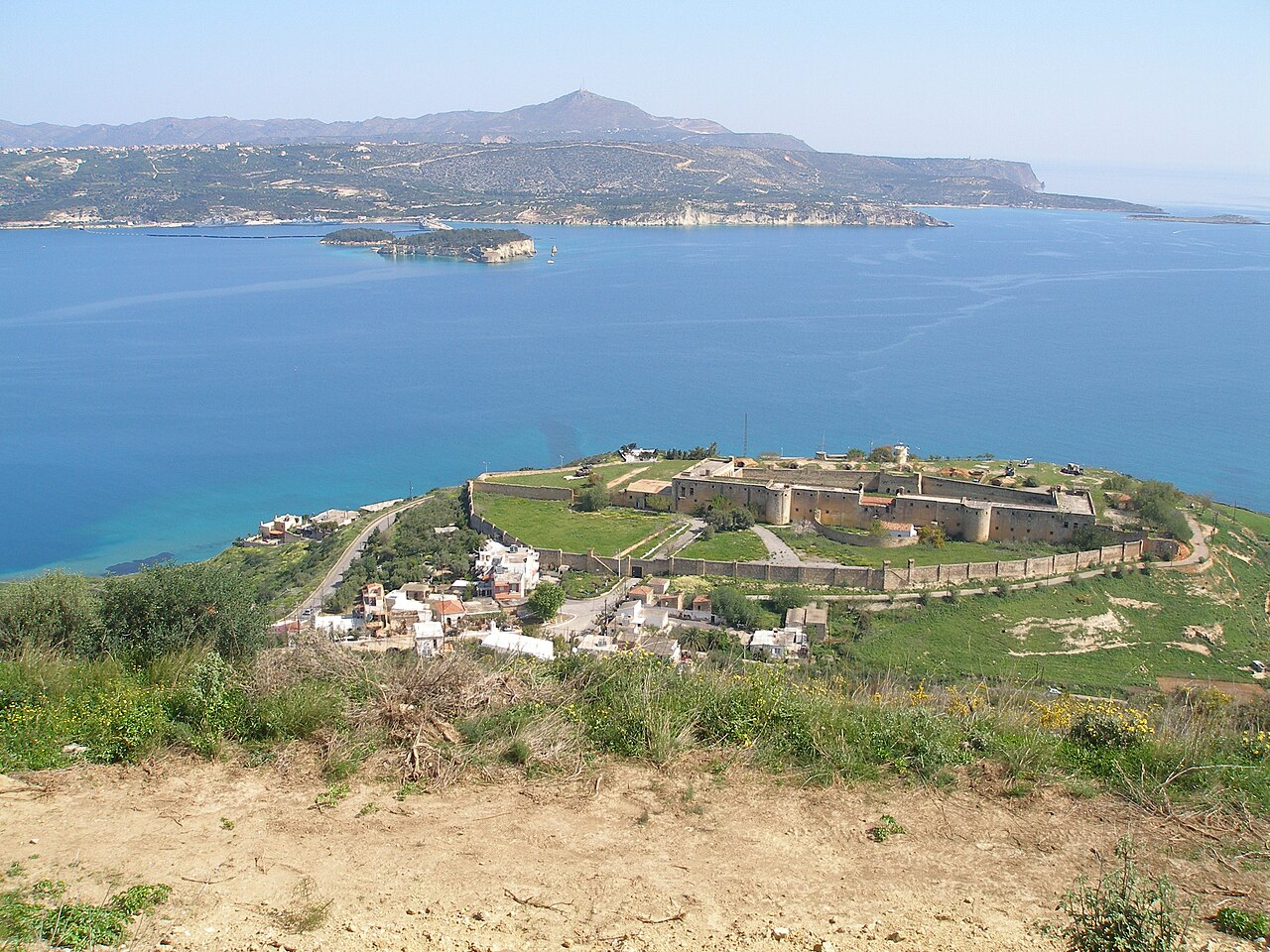
The Izzeddin Fortress (Greek: Φρούριο Ιτζεδδίν; Izzeddin means "Glory of the Faith") is an Ottoman fortress in Souda Bay, Crete, near the village of Kalami, best known for its role as a prison for political prisoners in 20th-century Greece.
The fortress was established by the then Ottoman governor of the island, Rauf Pasha, in 1872, and named after the son of Sultan Abdulaziz. Already under the Cretan State (1898–1913) it was used as a prison, and continued so when Crete passed under Greek rule, until 1950. It was particularly notorious as a site of imprisonment for political prisoners, especially during the dictatorship of Theodoros Pangalos (1925–26) and the Greek Civil War. Its occupants included Eleftherios Venizelos in 1903 and the deposed dictator Theodoros Pangalos in 1926–28. After 1950 it passed under the jurisdiction of the Hellenic Navy. Today it is a protected landmark and a site for cultural events.
Text adapted from “Izzeddin Fortress” on Wikipedia, CC BY-SA 4.0.
Izzeddin Fortress ranks #3,419 of 9,079 worldwide in the atlas's castle fame ranking, and #51 of the 134 mapped in Greece. Founded 1872, it is older than 6% of the atlas's dated landmarks — one of 717 atlas entries founded in the 19th century. Its Wikipedia articles were opened 1,010 times in the last 60 days, more than 51% of the atlas. 3 more atlas landmarks stand within 25 km. See how Greece compares in the castle statistics.
View on the interactive castle map →