 Sweden · 12th century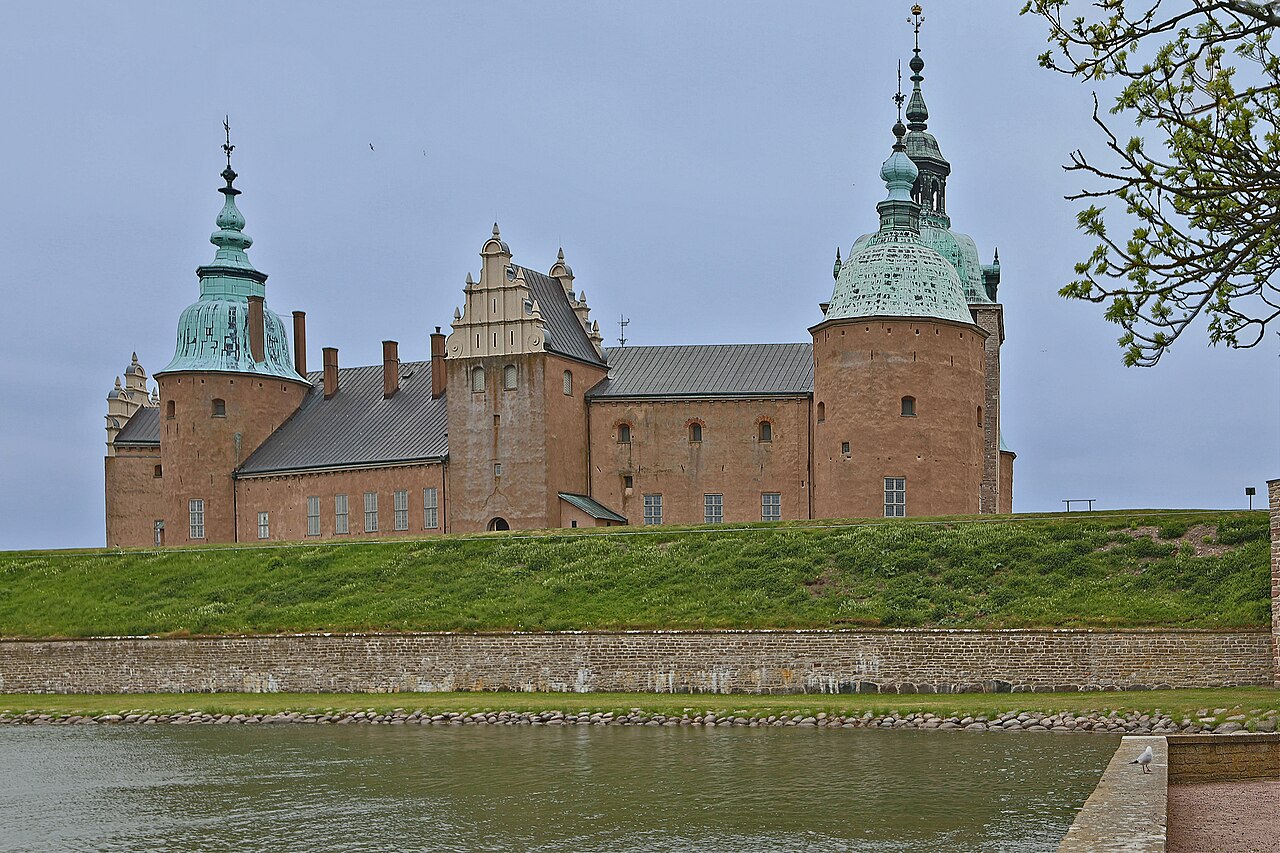
Kalmar Castle (Swedish: Kalmar slott) is a castle in the city Kalmar in the province of Småland in Sweden.
During the twelfth century a round defensive tower was built on Kalmarsund and a harbour constructed. At the end of the thirteenth century King Magnus Ladulås had a new fortress built with a curtain wall, round corner towers and two square gatehouses surrounding the original tower. Located near the site of Kalmar's medieval harbor, it has played a crucial part in Swedish history since its initial construction as a fortified tower in the 12th century.
One of the most significant political events in Scandinavia took place at Kalmar Castle in 1397, where the Kalmar Union was formed - a union of Denmark, Norway and Sweden (including Finland), organized by Queen Margaret I of Denmark. During the Swedish rebellion against Denmark in 1520, the fortress was commanded by Anna Eriksdotter (Bielke), who at the death of her spouse, Johan Månsson Natt och Dag, in the middle of the rebellion, took control over his fiefs and defended Kalmar against Denmark.The fortress was improved during the 16th century under the direction of King Gustav I and his sons King Eric XIV and Johan III who turned the medieval fortress into a castle fit for a renaissance king.
Upon ascending the throne, King Johan III of Sweden initiated an extensive reconstruction program for the castle, beginning almost immediately after his coronation. In 1574, the architect Domenicus Pahr commenced the renovation work. As part of the project, all towers, except for three—the southeastern, northeastern, and "Kuretornet"—were modified to achieve a uniform height, with their roofs covered in lead. Additionally, all windows were reshaped into squares, and the original roofing was replaced with a gable roof covered in clay. The king also ordered the facade to be painted white and the roof red. Following the completion of the castle's exterior, an interior renovation commenced in 1587, two years after Johan III's visit to the castle.
Several rooms were remodeled, including "Gamla kungamaket" (the old throne room), "Rutsalen" (the chequer hall), and "Grå salen" (the grey hall). The "Nya kungamaket" (the new throne hall) was renovated to its present-day interior, incorporating decorative elements such as 2,200 gold-painted leaves.
Text adapted from “Kalmar Castle” on Wikipedia, CC BY-SA 4.0.
Kalmar Castle ranks #541 of 9,079 worldwide in the atlas's castle fame ranking, and #10 of the 209 mapped in Sweden. Founded c. 1200, it is older than 75% of the atlas's dated landmarks — one of 756 atlas entries founded in the 12th century. Its Wikipedia articles were opened 5,951 times in the last 60 days, more than 89% of the atlas. 6 more atlas landmarks stand within 25 km. See how Sweden compares in the castle statistics.
View on the interactive castle map →