 Japan · 7th century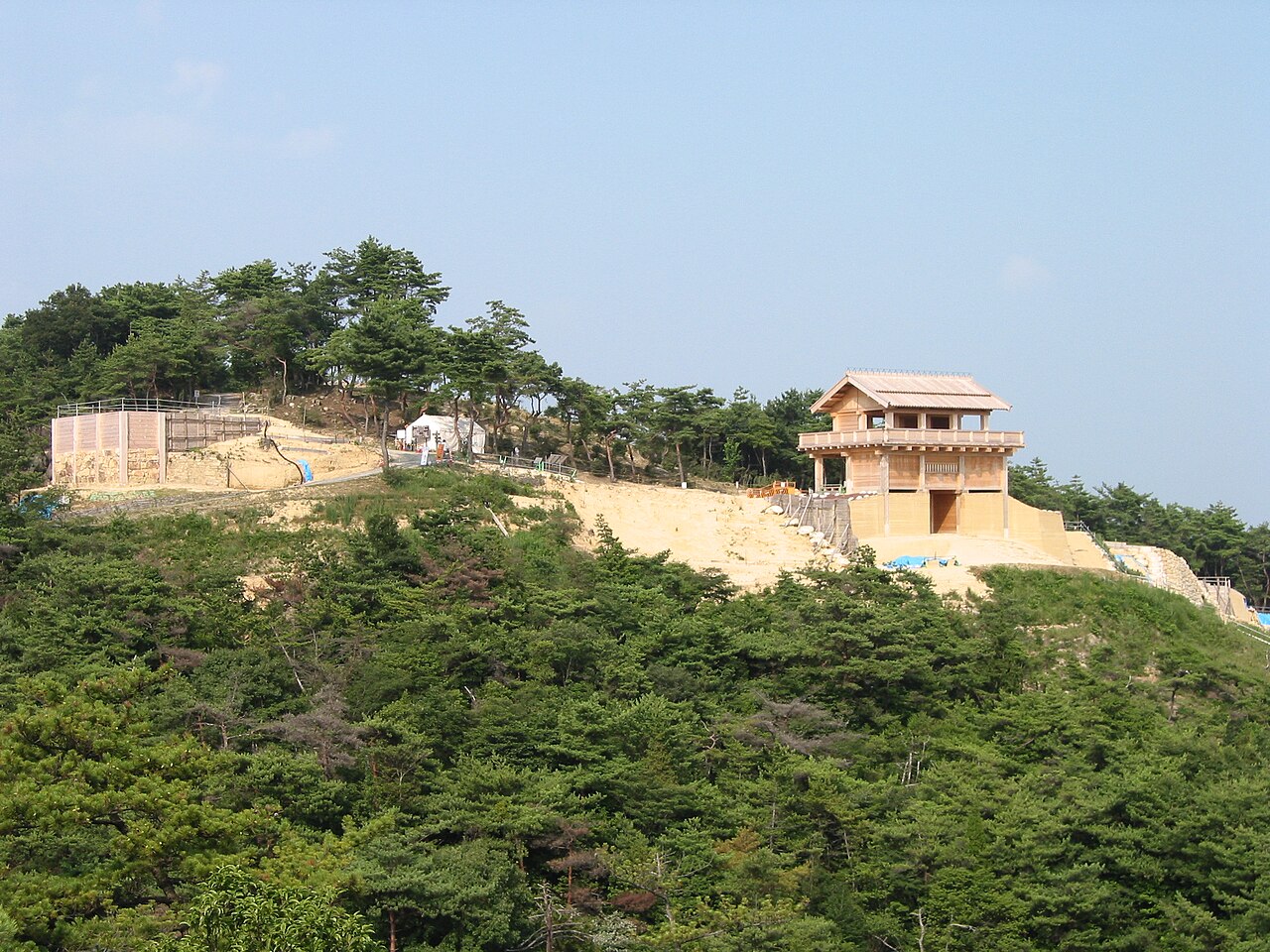
Kino Castle (鬼ノ城, Kino-jō) was an ancient kōgoishi type castle located in the city of Sōja, Okayama Prefecture, Japan. Its ruins have been protected as a National Historic Site since 1986. Portions of the castle were reconstructed in the early 2000s.
The castle's name literally means "demon castle" (ki is another reading for the character for oni); according to a traditional fable, a demon named Onra or Ura once ruled Kibi Province from the castle. The castle is the basis of the myth that is associated with the folklore hero, Momotarō. The legendary story of Kibitsuhiko-no-mikoto and Ura explains that the Prince Ura of Kudara used to live in Ki-no-jo (castle of the devil) and was a cause of trouble for the people living in the village. The emperor's government sent Kibitsuhiko-no-mikoto (Momotarō) to defeat Ura. However, "Ki means "castle in the ancient language of Baekje, and was later simply assigned the kanji character for "demon". "Ki-no-jō" is a name that combines the two words for "castle".
After the defeat of the combined Baekje and Yamato Japan forces, at the hands of the Silla and Tang China alliance at the Battle of Hakusukinoe in 663, the Yamato court feared an invasion from either or both Tang or Silla. In response, Emperor Tenji ordered the construction of a huge network of shore fortifications throughout the rest of the 600s, often with the assistance of Baekje engineers, generals and artisans. Unaware of the outbreak of the Silla-Tang War (670–76), the Japanese would continue to build fortifications until 701, after finding out that Silla was no longer friendly with Tang. According to the Nihonshoki, twelve Korean-style mountain fortifications were built in western Japan at this time, and it is believed that Kino Castle was one of them.
The identification of particular sites with the fortresses constructed at this time remains a subject of debate, and most fortifications of this period are classified under the wider term kōgoishi (神籠石).
Kino Castle is not mentioned in any historical documents, and the year of its construction is unknown, but archaeological excavations show that it was built in the latter half of the 7th century. The caste is situated at the southern end of the Kibi plateau and encompasses the summit of a mountain near the center of ancient Kibi Province.
Text adapted from “Kino Castle” on Wikipedia, CC BY-SA 4.0.
Ki Castle ranks #2,273 of 9,035 worldwide in the atlas's castle fame ranking, and #137 of the 295 mapped in Japan. Founded c. 700, it is older than 96% of the atlas's dated landmarks, one of 39 atlas entries founded in the 7th century. Its Wikipedia articles were opened 4,291 times in the last 60 days, more than 84% of the atlas. 4 more atlas landmarks stand within 25 km. The nearest day-trip guide is Okayama, 16 km away. See how Japan compares in the castle statistics.
View on the interactive castle map →