 Germany · 14th century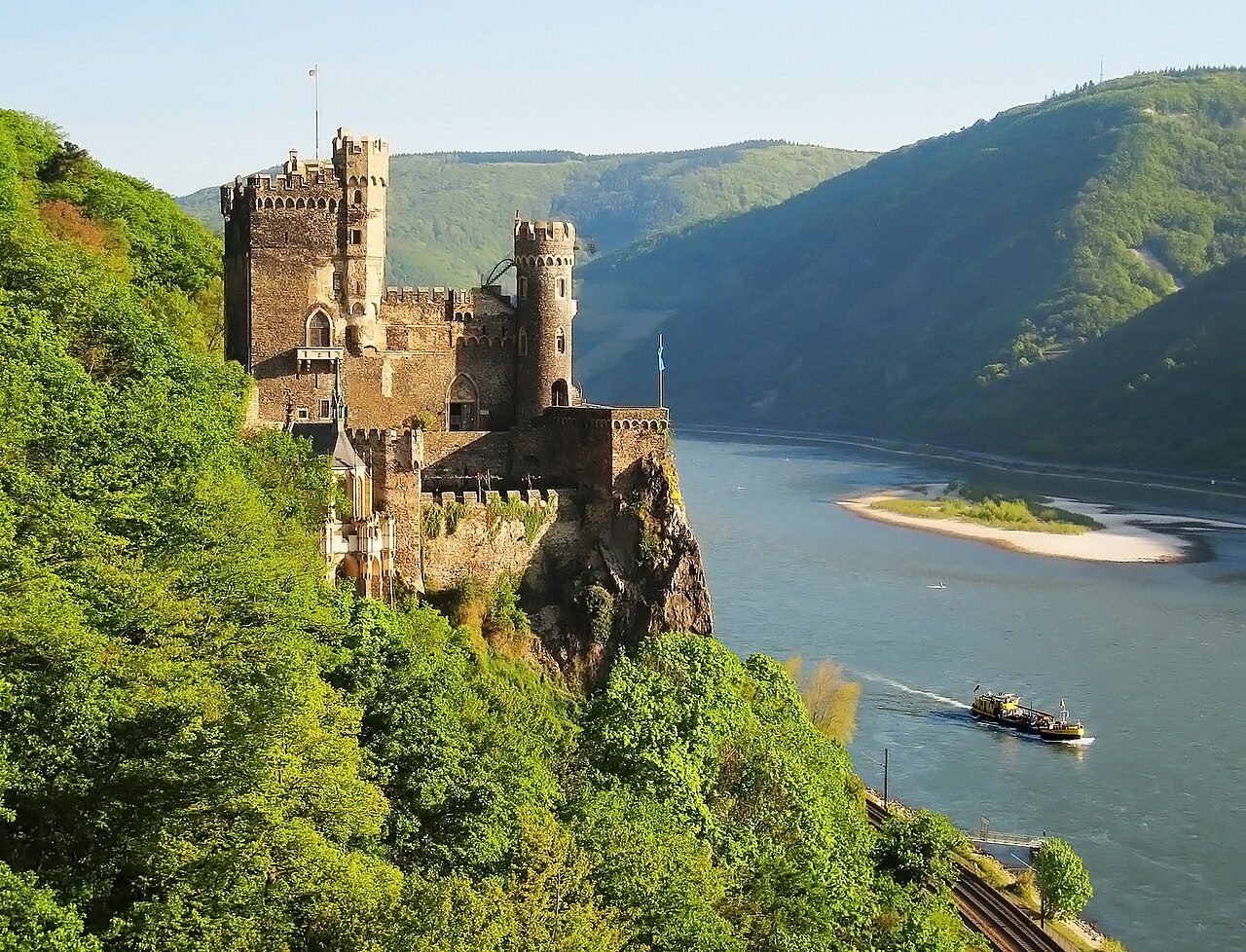
Rheinstein Castle (German: Burg Rheinstein) is a castle near the town of Trechtingshausen in Rhineland-Palatinate, Germany.
The castle was constructed in about 1316/1317. Rheinstein Castle was important for its strategic location. By 1344, the castle was in decline. By the time of the Palatine War of Succession, the castle was very dilapidated. During the romantic period in the 19th century, Prince Frederick of Prussia (1794–1863) bought the castle and it was rebuilt.
Burg Rheinstein possesses a working drawbridge and portcullis, which are typical of medieval castle architecture and defences. The castle is open to the public. Just past the gift shop near the entrance is an opening on the left to the courtyard, which has views of the Rhine. Rheinstein's courtyard is known as the Burgundy Garden after the Burgundy grape vine growing there. The vine, which is approximately 500 years old, still produces grapes.
From the garden, steps lead down to the castle chapel. In the centre of the Gothic altar piece of the chapel there is a woodcarving depicting Jesus at the Last Supper. Between the rock and chapel, additional steps lead down to the royal crypt of Prince Frederick William Louis's family.
Heading upwards to the Burgundy Garden, another set of steps lead to the main part of the castle. The largest and most impressive room at Rheinstein Castle is located at the top of the stairway to the left once inside the castle. Known as the Rittersaal or Knight's Hall, it includes beautiful stained glass windows, as well as three-dimensional paintings.
Rheinstein houses a cafe and gift shop offering miniature handmade wooden treasure chests, as well as traditional items including postcards and guidebooks for purchase.
From the 14th–17th centuries, the castle was granted as a fief by the archbishops of Mainz. Its owners and feudal lords included: 1323 – Matthias, Count of Bucheck, Archbishop of Mainz 1348 – Kuno II von Falkenstein, Archbishop of Mainz 1409 – John of Nassau enfeoffed the Geheimrat, Johann von Selheim, with Königstein. Sometimes the archbishops of Mainz stayed here in their secular role as electors of the Holy Roman Empire.
1459 – Diether von Isenburg, Elector and Archbishop of Mainz, enfeoffed the castle and the village of Assmannshausen (which is near the castle on the opposite bank of Rhine) to the cathedral student (Domscholasten) Volpert.
Text adapted from “Rheinstein Castle” on Wikipedia, CC BY-SA 4.0.
Rheinstein Castle ranks #1,159 of 9,079 worldwide in the atlas's castle fame ranking, and #93 of the 711 mapped in Germany. Founded 1316, it is older than 60% of the atlas's dated landmarks — one of 755 atlas entries founded in the 14th century. Its Wikipedia articles were opened 5,087 times in the last 60 days, more than 87% of the atlas. 24 more atlas landmarks stand within 25 km. The nearest day-trip guide is Wiesbaden, 29 km away. It is one of the 39 landmarks on the atlas's regional map of the Middle Rhine. It is stop 6 of 32 on the Rhine castle route, Bingen to Koblenz. See how Germany compares in the castle statistics.
View on the interactive castle map →