 England · 11th century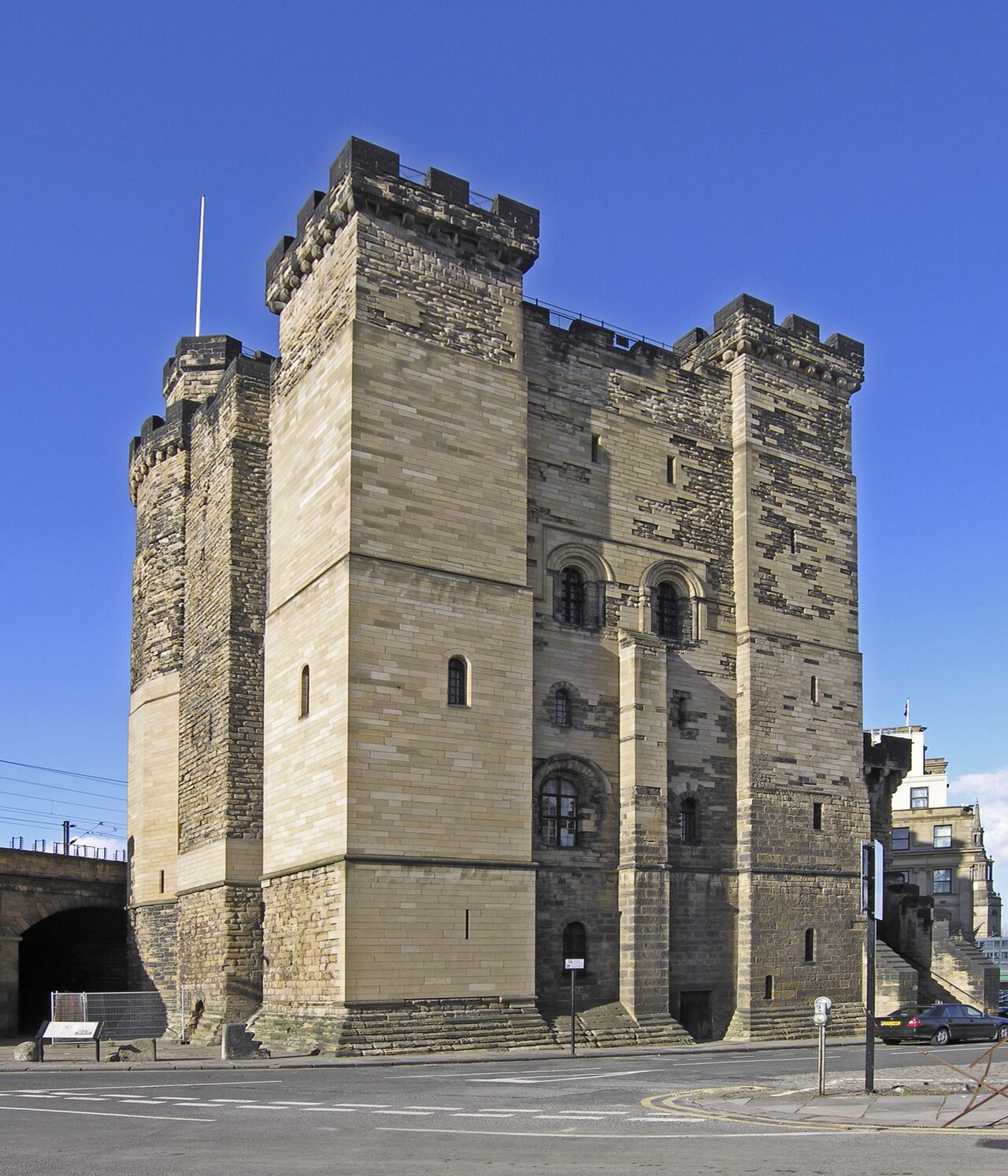
The Castle, Newcastle, or Newcastle Castle is a medieval fortification in Newcastle upon Tyne, England, built on the site of the fortress that gave the City of Newcastle its name. The most prominent remaining structures on the site are the Castle Keep (the castle's main fortified stone tower, pictured below right), and the Black Gate, its fortified gatehouse.
Use of the site for defensive purposes dates from Roman times, when it housed a fort and settlement called Pons Aelius (meaning 'bridge of (Publius) Aelius (Hadrianus)' – the Roman emperor Hadrian) – guarding a bridge over the River Tyne. Robert Curthose, eldest son of William the Conqueror, in 1080 built a wooden motte-and-bailey-style castle on the site of the Roman fort. Curthose built this 'New Castle upon Tyne' after he returned south from a campaign against Malcolm III of Scotland. Henry II built the stone Castle Keep between 1172 and 1177 on the site of Curthose's castle. Henry III added the Black Gate between 1247 and 1250. Nothing remains above ground of the Roman fort or the original motte-and-bailey castle. The Keep is a Grade I listed building, and a scheduled monument.
The Castle Keep and Black Gate pre-date the construction of the Newcastle town wall, construction of which started around 1265, and did not include it. The site of the keep is in the centre of Newcastle and lies to the east of Newcastle station. The 75-foot (23 m) gap between the keep and the gatehouse is almost entirely filled by the railway viaduct that carries the East Coast Main Line from Newcastle to Scotland.
The keep and Black Gate are now managed by the Old Newcastle Project under the Heart of the City Partnership as one combined visitor attraction, "Newcastle Castle".
Text adapted from “The Castle, Newcastle” on Wikipedia, CC BY-SA 4.0.
Newcastle upon Tyne Castle ranks #976 of 9,079 worldwide in the atlas's castle fame ranking, and #69 of the 360 mapped in England. Founded 1080, it is older than 87% of the atlas's dated landmarks — one of 436 atlas entries founded in the 11th century. Its Wikipedia articles were opened 5,562 times in the last 60 days, more than 88% of the atlas. 16 more atlas landmarks stand within 25 km. The nearest day-trip guide is Newcastle upon Tyne, 1 km away. It is stop 4 of 18 on the Northumberland castle coast, Newcastle upon Tyne to Berwick-upon-Tweed. See how England compares in the castle statistics.
View on the interactive castle map →