 Japan · 16th century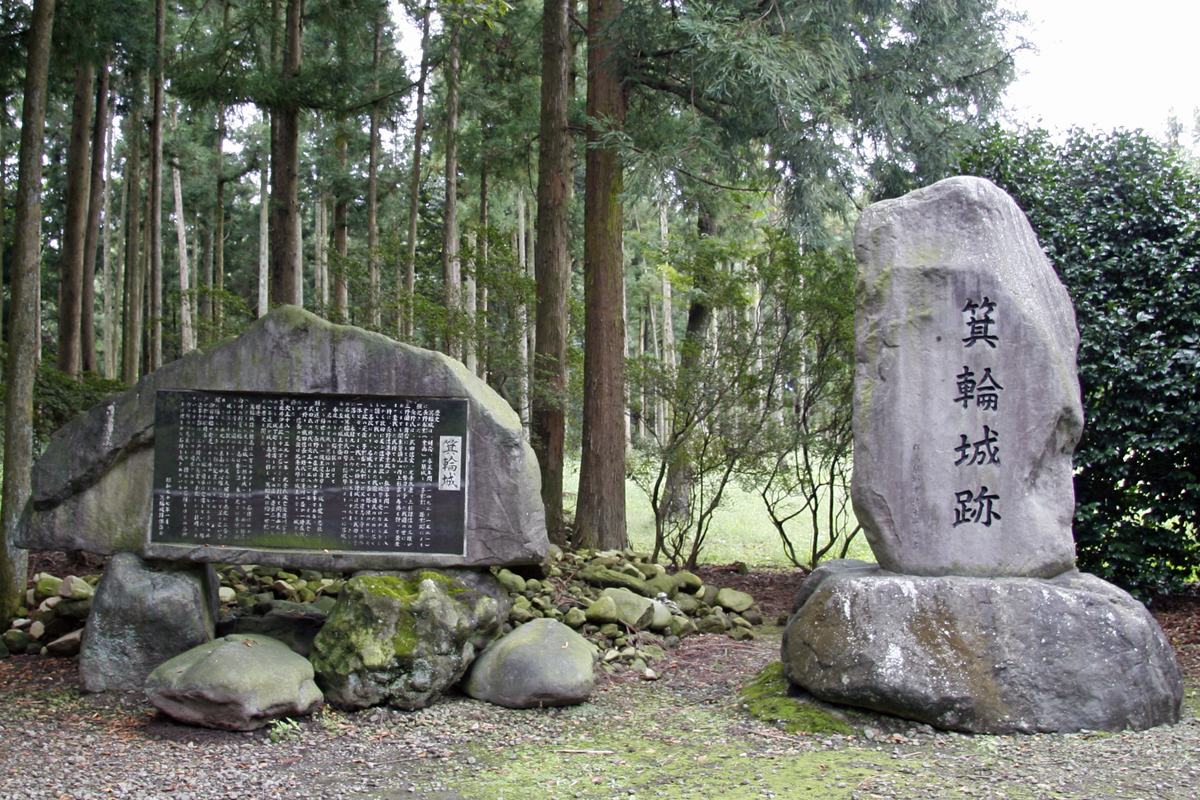
Minowa Castle (箕輪城, Minowa-jō) was a "hirayama"-style castle located in the Misato neighborhood of the city of Takasaki, Gunma Prefecture, Japan. The ruins have been protected by the central government as a National Historic Site since 1987.
Minowa Castle is located on a 30-meter high hill at the end of long ridge which extends from Mount Haruna southwest towards former Misato town in the northwestern part of Takasaki. This area was located on the Nakasendō highway towards Shinano Province to the west and also on the Mikuni Kaidō towards Echigo Province to the north. The castle, protected on one side by a deep valley created by the Shirakawa River and on its long, narrow hill, commanded both strategic roads.
The castle extends over an area 1200 meters long by 400 meters wide orientated north and southward, having two small ridges at its south end. Roughly the castle consists of three concentric layers of enclosures. The main gate of the castle originally existed at southwestern edge of the hill, but later a huge masugata-style gate was built next to the river.
During the Muromachi period, this area was governed by the Nagano clan, who claimed descent from Ariwara no Narihira, the famed Heian period nobleman and poet. By the Muromachi period, the Nagano clan were minor warlords controlling western Kōzuke Province and built Minowa castle as their residence in 1512. In 1545, Uesugi Norimasa, the Kantō Kanrei and nominal overlord of the Nagano clan, was severely defeated by the forces of Hōjō Ujiyasu at the 1546 Battle of Kawagoe. His forces were also defeated by Takeda Shingen the following year. With the weakening of the Uesugi, Nagano Narimasa (1491–1561) switched allegiance to the Hōjō.
In 1560, the Uesugi clan under the leadership of Uesugi Kenshin attempted to re-take Kōzuke and the Nagano clan switched allegiance back to the Uesugi. Takeda Shingen then attacked the Uesugi in support of the Hōjō, and the Nagano at Minowa Castle were their primary targets. When Nagano Narimasa died in 1561, he stated in his will that his son Nagano Narimori should continue the fight against Takeda Shingen to the last man if necessary. Narimori continued to resist the Takeda for the next five years, but gradually lost the support of his surrounding neighbors and allies.
Text adapted from “Minowa Castle” on Wikipedia, CC BY-SA 4.0.
Minowa Castle ranks #1,696 of 9,035 worldwide in the atlas's castle fame ranking, and #104 of the 295 mapped in Japan. Founded 1512, it is older than 42% of the atlas's dated landmarks, one of 886 atlas entries founded in the 16th century. Its Wikipedia articles were opened 4,866 times in the last 60 days, more than 86% of the atlas. 3 more atlas landmarks stand within 25 km. See how Japan compares in the castle statistics.
View on the interactive castle map →