 Russia · 11th century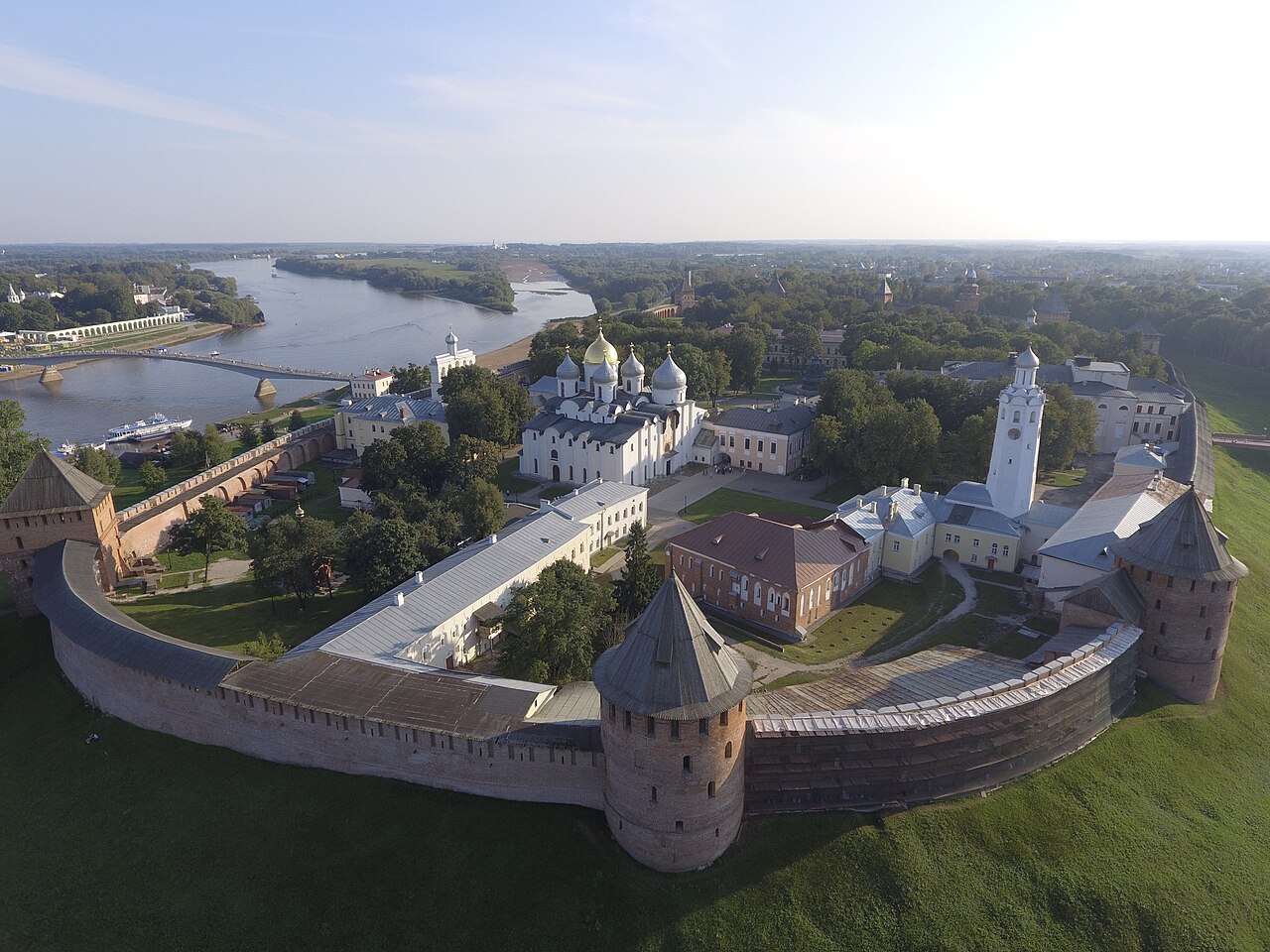
The Novgorod Detinets (Russian: Новгородский детинец, romanized: Novgorodskiy detinets), also known as the Novgorod Kremlin (Russian: Новгородский кремль, romanized: Novgorodskiy kreml'), is a fortified complex (detinets) in Veliky Novgorod, Russia. It stands on the left bank of the Volkhov River about two miles north of where it empties out of Lake Ilmen.
The compound was originally the site of a pagan burial ground upon which the first bishop of Novgorod, Ioakim Korsunianin, built the Cathedral of Holy Wisdom upon his arrival in the area in 989 or so. Thus the compound was and remained largely an ecclesiastical site, although many Novgorodian boyars built their houses in the southern part of the Detinets.
The first reference of the fortification on the site dates to 1044, with additional construction taking place in 1116. These were probably earthen embankments topped by a wooden palisade, although stone towers and walls were built in 1302. Archbishop Vasily Kalika (1330-1352) rebuilt the stone wall along the eastern side of the Detinets in 1331-1335. The rest was completed in stone only in 1400. Under the rule of Archbishop Evfimy II (1429-1458), a council hall for the nobility council and a clocktower were built in the episcopal compound in 1433 and 1436 respectively. The council hall, now called the Episcopal Chamber or the Chamber of Facets due to its elaborate Gothic vaults, is one of the easternmost examples of Brick Gothic. In 1437, part of Vasily's walls collapsed into the Volkhov River and were rebuilt by Evfimy II, too.
The fortress was rebuilt between 1484 and 1490 by Muscovite builders in the wake of Grand Prince Ivan III's conquest of the city in 1478; a third of it was paid for by the Novgorodian archbishop Gennady, a Muscovite appointee (1484-1504). It is a large oval 545 metres long and 240 metres wide with nine surviving towers (three additional towers have not survived). The tallest tower, the Kokui tower, is capped by a silver dome. It was built in the 18th century, and its name is of Swedish origin. Today it is possible to enter this tower and climb to the top. The walls are 1,487 metres in circumference.
The main buildings in the Detinets are the Cathedral of Holy Wisdom and the archiepiscopal/metropolitan compound in the northwestern corner.
Text adapted from “Novgorod Detinets” on Wikipedia, CC BY-SA 4.0.
Novgorod Kremlin ranks #677 of 9,079 worldwide in the atlas's castle fame ranking, and #29 of the 146 mapped in Russia. Founded 1044, it is older than 91% of the atlas's dated landmarks — one of 436 atlas entries founded in the 11th century. Its Wikipedia articles were opened 7,964 times in the last 60 days, more than 92% of the atlas. See how Russia compares in the castle statistics.
View on the interactive castle map →