 England · 11th century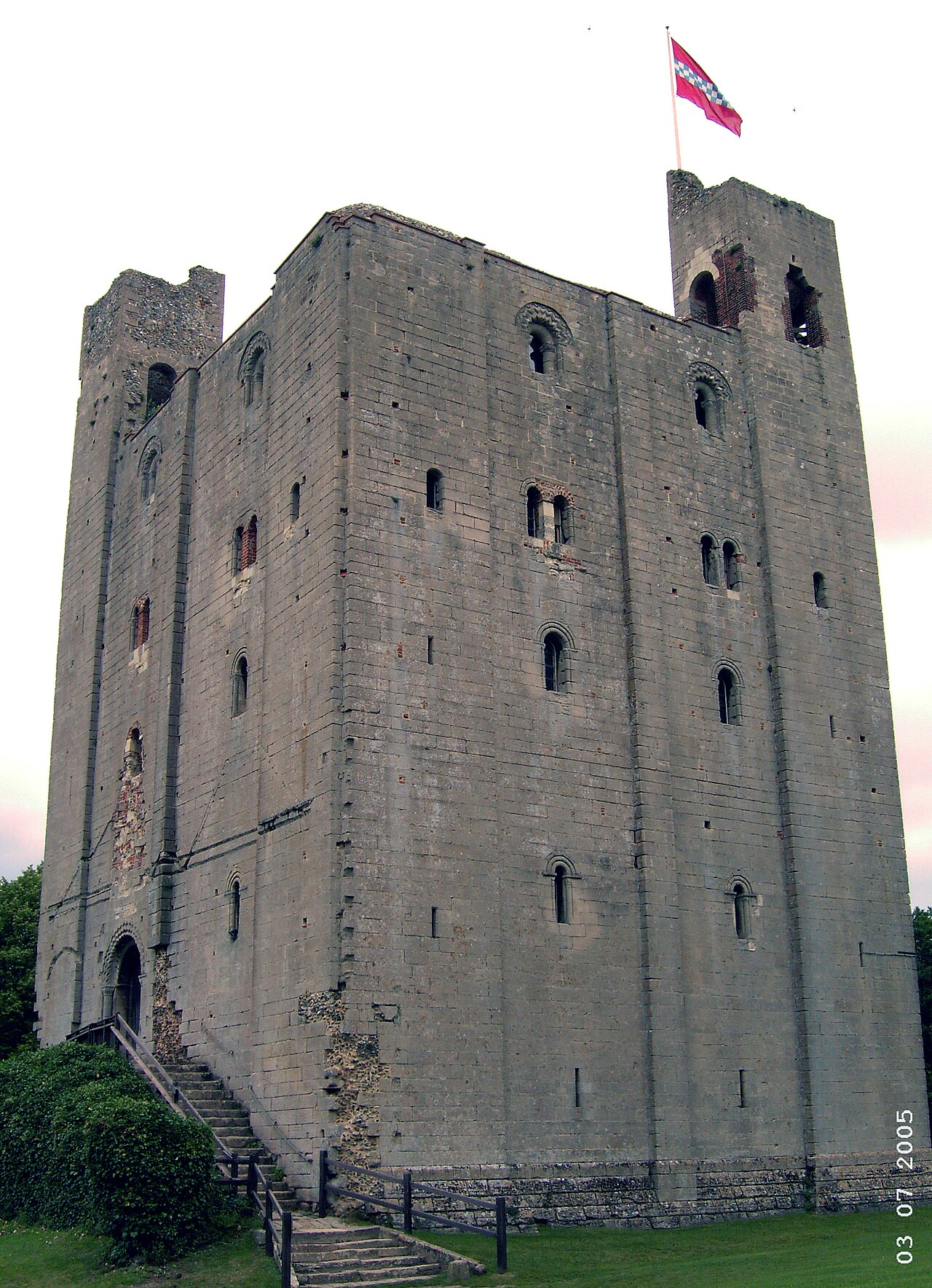
Hedingham Castle, in the village of Castle Hedingham, Essex, is arguably the best preserved Norman keep in England. The castle fortifications and outbuildings were built around 1100, and the keep around 1140. However, the keep is the only major medieval structure that has survived, albeit less two turrets. It is a Grade I listed building and a scheduled monument. The keep is open to the public.
The manor of Hedingham was awarded to Aubrey de Vere I by William the Conqueror by 1086. The castle was constructed by the de Veres in the late 11th and early 12th centuries, and the keep in the 1130s and 1140s. To accommodate the existing castle, a large ditch was cut through a natural spur westward into the Colne Valley in order to form a ringwork and inner bailey; an outer bailey extended south further into the valley and what is now the modern village of Castle Hedingham. The stone keep is the only mediaeval structure to survive, and is in an excellent state of preservation.
The keep is nearly square, a common shape for Norman keeps. The east and west sides are 53 ft (16 m) long and the north–south sides about 58 ft (18 m). The main part of the keep stands more than 70 ft (21 m) tall, and the turrets rise an additional 15 to 25 ft (4.6 to 7.6 m) above the parapets, commanding the countryside around it from its elevated position atop the ringwork. The walls are about 11 ft (3.4 m) thick at the base and average 10 ft (3.0 m) thick at the top. They are constructed from flint rubble bound with lime mortar, but, very unusually for an Essex castle, are faced with ashlar stone transported from a quarry in Barnack, Northamptonshire.
The keep has five floors including the Great or Banqueting Hall with a large fireplace and a central arch extending two storeys. The top floor may have been added around the 15th century, replacing a pyramid-shaped roof. This is a recent theory, however, and many older sources have noted the similar plans of Hedingham Castle and Rochester Castle, which was begun about 1126 and has four floors and four turrets.
Changes were made in subsequent years, particularly during the Tudor period. Two of the original four corner turrets are missing. Their demise is owing to the ambitious building plans of Henry VII, which required vast amounts of stone.
Text adapted from “Hedingham Castle” on Wikipedia, CC BY-SA 4.0.
Hedingham Castle ranks #1,221 of 9,079 worldwide in the atlas's castle fame ranking, and #81 of the 360 mapped in England. Founded c. 1100, it is older than 85% of the atlas's dated landmarks — one of 436 atlas entries founded in the 11th century. Its Wikipedia articles were opened 4,585 times in the last 60 days, more than 85% of the atlas. 4 more atlas landmarks stand within 25 km. The nearest day-trip guide is Colchester, 24 km away. See how England compares in the castle statistics.
View on the interactive castle map →