Castle
Fujian Tulou
🇨🇳 China · 12th century
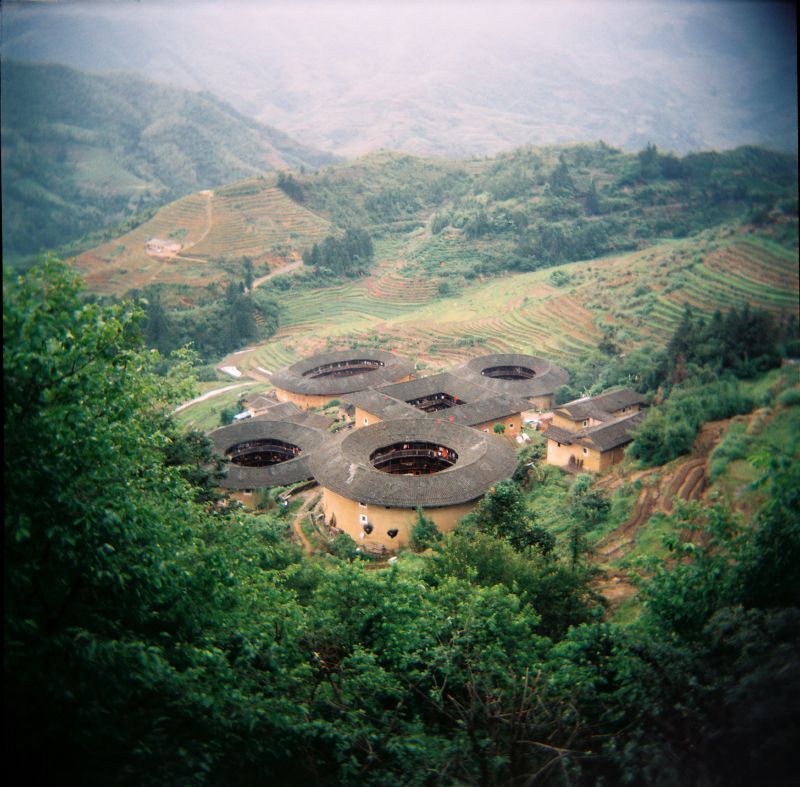
The Fujian tulou (simplified Chinese: 福建土楼; traditional Chinese: 福建土樓; pinyin: Fújiàn tǔlóu; lit. 'Fujian earthen buildings') are Chinese rural dwellings unique to the Hakka in the mountainous areas in southeastern Fujian, China. They were mostly built between the 12th and the 20th centuries.
A tulou is usually a large, enclosed and fortified earth building, most commonly rectangular or circular in configuration, with very thick load-bearing rammed earth walls between three and five stories high and housing up to 800 people. Smaller interior buildings are often enclosed by these huge peripheral walls which can contain halls, storehouses, wells and living areas, the whole structure resembling a small fortified city.
The fortified outer structures are formed by compacting earth, mixed with stone, bamboo, wood and other readily available materials to form walls up to 6 feet (1.8 m) thick. Branches, strips of wood and bamboo chips are often laid in the wall as additional reinforcement. The result is a well-lit, well-ventilated, windproof and earthquake-proof building that is warm in winter and cool in summer. Tulous usually have only one main gate, guarded by 4–5-inch-thick (100–130 mm) wooden doors reinforced with an outer shell of iron plate. The top level of these earth buildings has gun holes for defensive purposes.
Most of the tulou (with the exception of the Dadi tulou cluster in Hua'an county) are found in a relatively small geographical area, straddling the boundary between the Yongding, Nanjing, and Pinghe counties of Fujian province. Some of tulous are also found in neighboring Guangdong province such as in eastern Dabu County of Meizhou. These are administered as a single tourist site (known as the Nanjing Tulou Scenic Area) with its entrance in Shuyang township (Nanjing County, Zhangzhou).
Text adapted from “Fujian tulou” on Wikipedia, CC BY-SA 4.0.
Fujian Tulou ranks #252 of 8,134 worldwide in the atlas's castle fame ranking, and #7 of the 119 mapped in China. Founded c. 1150, it is older than 81% of the atlas's dated landmarks — one of 564 atlas entries founded in the 12th century. Its Wikipedia articles were opened 12,823 times in the last 60 days, more than 95% of the atlas. 3 more atlas landmarks stand within 25 km. See how China compares in the castle statistics.
View on the interactive castle map →Frequently asked questions
Where is Fujian Tulou?
Fujian Tulou stands in China, at 24.6587°, 116.975°.
When was Fujian Tulou built?
The atlas dates its founding to c. 1150. Earlier structures may have stood on the site; this is the earliest documented founding year.
Is Fujian Tulou a UNESCO World Heritage Site?
Yes — Fujian Tulou is inscribed as a UNESCO World Heritage Site, per its Wikidata entry.
How famous is Fujian Tulou?
In this atlas's fame ranking: #252 of 8,134 worldwide, and #7 in China. Fame here combines how many Wikipedia language editions cover a landmark with how many people read them.
What is the nearest castle to Fujian Tulou?
Zhenchenglou, about 1 km away.
More castles in China
- Norbulingka China · 18th century
- Badaling China · 16th century
- Old Summer Palace China · 19th century
- Gaochang China · 1st century BC
More castles
- Predjama Castle Slovenia · 13th century
- Konopiště Castle Czech Republic · 13th century
- Elmina Castle Ghana · 15th century
- Ambras Castle Austria · 16th century