Fortress
Zhonghua Gate
🇨🇳 China · 14th century
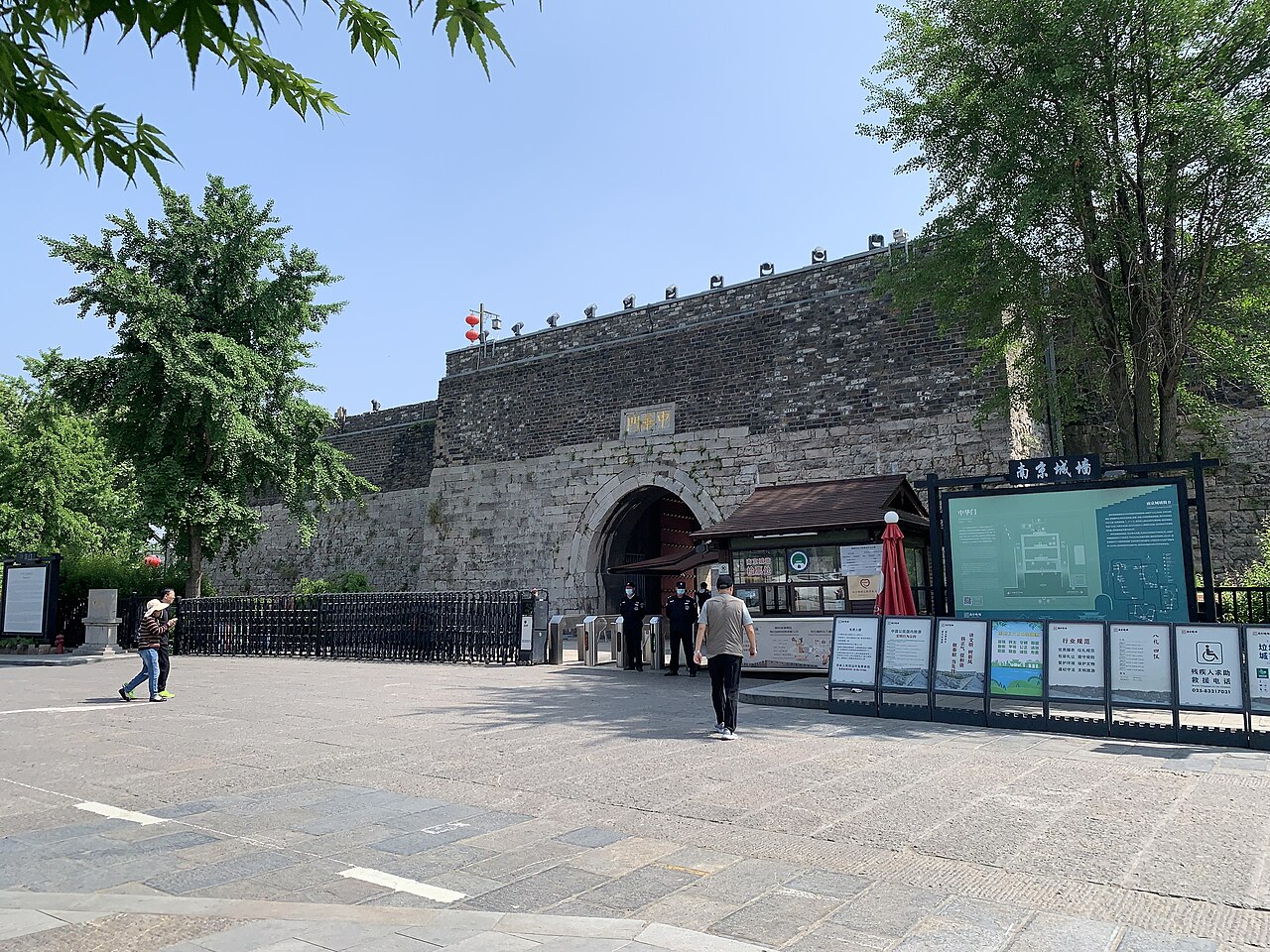
The Zhonghua Gate (traditional Chinese: 中華門; simplified Chinese: 中华门; pinyin: Zhōnghuámén) is a gate and defensive complex on the city wall of Nanjing, China. This is the southern gate of Nanjing city. It is renowned as the city gate with one of the most complex and well preserved structures in the world.
The city wall of Nanjing was built from 1360 to 1386 under the founder of the Ming dynasty, the Hongwu Emperor Zhu Yuanzhang. In 1368, Zhu Yuanzhang was crowned Emperor, and made Nanjing his capital. The southern and eastern sections of the old city wall from the Tang dynasty were incorporated into the new wall. The northern and eastern sections were built afresh. The city wall was 33.676 kilometres long. It was 14–21 m high; 14.5m thick at its base, and 4.9m thick at the top. Thirteen gates were built into the wall, and the enclosed area was the largest of any walled city in China.
The gate today known as Zhonghua Gate was then known as Jubao Gate (traditional Chinese: 聚寶門; simplified Chinese: 聚宝门; pinyin: Jùbǎo Mén; lit. 'Gathering Treasure Gate'). It was built on the site of the south gate of the capital city of the Southern Tang dynasty. It was the largest among the thirteen gates of Nanjing. In 1931, after the Republic of China government established Nanjing as its capital, the gate was renamed to Zhonghua Gate. In one sense, this reflects the triumph of the southern factions led by Chiang Kai-shek over the northern factions of the Beiyang government in Beijing, who had named the southern (main) gate of Beijing "Gate of China" to signify its status as "gate of the nation".
The gate was made of huge strip stones 0.8 – 1.39 m long, 0.7 m wide and 0.26-0.35 thick and large Chinese brick 0.4 m long 0.2 m wide and 0.1 m thick.
Its dimensions were 118.5 m from east to west, and 128 m from south to north. The ramparts were 20.45 m high. The total area enclosed was 15,168 square meters. Three barbicans were connected by four arched gates, each of which was equipped with a Qianjinzha (traditional Chinese: 千金閘; simplified Chinese: 千金闸; pinyin: Qiānjīn Zhá; lit. 'very heavy gate') which could be opened up and down, as well as a pair of wooden doors. The Toudaomen (traditional Chinese: 頭道門; simplified Chinese: 头道门; pinyin: Tóudào Mén; lit. 'first gate') consisted of 3 steps.
At the top step, there used to be a wooden building to defend against the enemy.
Text adapted from “Zhonghua Gate, Nanjing” on Wikipedia, CC BY-SA 4.0.
Zhonghua Gate ranks #2,654 of 8,134 worldwide in the atlas's castle fame ranking, and #47 of the 119 mapped in China. Founded 1360, it is older than 56% of the atlas's dated landmarks — one of 604 atlas entries founded in the 14th century. Its Wikipedia articles were opened 1,989 times in the last 60 days, more than 67% of the atlas. 6 more atlas landmarks stand within 25 km. The nearest day-trip guide is Nanjing, 5 km away. See how China compares in the castle statistics.
View on the interactive castle map →Frequently asked questions
Where is Zhonghua Gate?
Zhonghua Gate stands in China, at 32.01469°, 118.77649°.
When was Zhonghua Gate built?
The atlas dates its founding to 1360. Earlier structures may have stood on the site; this is the earliest documented founding year.
How famous is Zhonghua Gate?
In this atlas's fame ranking: #2,654 of 8,134 worldwide, and #47 in China. Fame here combines how many Wikipedia language editions cover a landmark with how many people read them.
What is the nearest castle to Zhonghua Gate?
City Wall of Nanjing, about 1 km away.
More castles in China
- Jiankou China · 14th century
- Mandarin's House China · 19th century
- Fan Lau Fort China · 18th century
- Zhenhai Tower China · 14th century
More fortresses
- Puerta del Puente Spain · 16th century
- Puerta Nueva de Bisagra Spain · 16th century
- City walls of Córdoba Spain · 3rd century BC
- Door of Palmas Spain