Fortaleza
Gingee Fort
🇮🇳 India · siglo XI
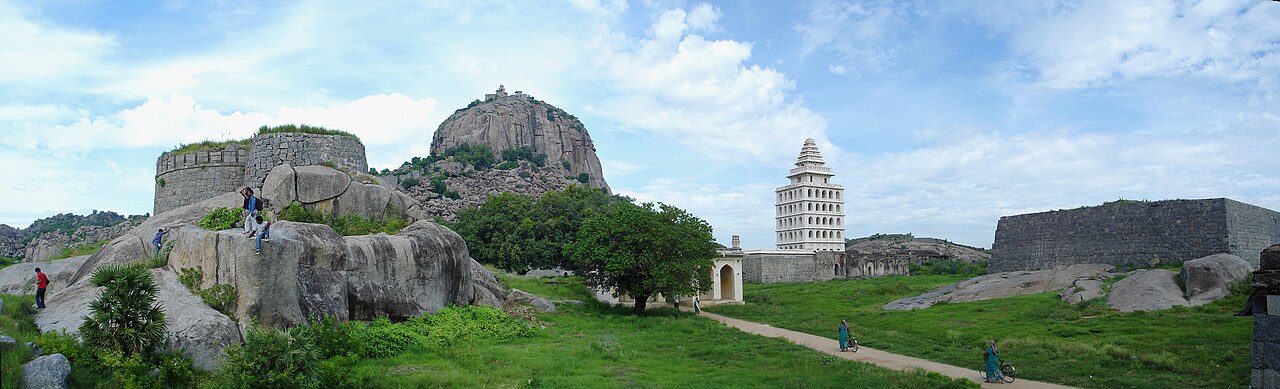
El fuerte de Gingee o fuerte de Senji (también conocido como Chenji, Chanchi, Jinji o Senchi), en Tamil Nadu, India, es uno de los fuertes que se conservan en dicho estado. Se le conoce popularmente como la Gran Muralla del sur de la India. Se encuentra en el distrito de Villupuram, a 160 kilómetros (99 mi) de la capital estatal, Chennai, y cerca del territorio de la Unión de Puducherry. Está clasificado como la «fortaleza más inexpugnable de la India», y los británicos lo llamaron «la Troya de Oriente».
Mencionado originalmente como territorio de un jefe kadava con el título de Senjiyar Kon en el Moovarula de Ottakoothar, hacia el año 1123 d. C. El fuerte fue construido originalmente por Ananda kon hacia el siglo XI d. C. El fuerte fue construido como plaza estratégica para repeler a los ejércitos invasores. Según un relato, el fuerte fue fortificado aún más durante los siglos XV y XVI. El fuerte fue conquistado para el Swarajya por el subedar Harji Rajemahadik en nombre de los marathas bajo el liderazgo de Shivaji en 1677 d. C. Posteriormente fue conquistado por los sultanes de Bijapur, los mogoles, los nawabs carnáticos, los franceses y finalmente los británicos en 1761. El fuerte está estrechamente asociado con Raja Tej Singh, quien se rebeló sin éxito contra el nawab de Arcot y finalmente perdió la vida en una batalla.
El complejo del fuerte de Gingee se asienta sobre tres colinas: Krishnagiri al norte, Rajagiri o Anandagiri al oeste, y Chakilidurg al sureste. Las tres colinas conforman en conjunto un complejo fortificado, cada una con su propia ciudadela independiente y autosuficiente. Las murallas del fuerte se extienden 13 km (8,1 mi), y las tres colinas están unidas por murallas que encierran un área de 11 kilómetros cuadrados (4,2 mi²). Fue construido a una altura de 800 pies (240 m) y protegido por un foso de 80 pies (24 m) de ancho.
Traducción automática de «Gingee Fort» en la Wikipedia en inglés, CC BY-SA 4.0.
Gingee Fort ocupa el puesto 963 de 8134 en el mundo en la clasificación de fama de este atlas y el n.º 35 de los 179 que el atlas cartografía en la India. Su fundación, hacia ca. 1050, es anterior a la del 90% de los monumentos datados del atlas — uno de los 325 monumentos del atlas fundados en el siglo XI. Sus artículos de Wikipedia se abrieron 10.893 veces en los últimos 60 días, más que el 93% del atlas. Compara el dato en las estadísticas de castillos.
Ver en el mapa interactivo de castillos →Preguntas frecuentes
¿Dónde está Gingee Fort?
La fortaleza se encuentra en la India, en las coordenadas 12.25083°, 79.39583°.
¿De qué año data Gingee Fort?
El atlas fija su fundación en ca. 1050. Pudieron existir construcciones anteriores en el mismo lugar; este es el año documentado más antiguo.
¿Es Gingee Fort Patrimonio de la Humanidad?
Sí: según Wikidata forma parte de un sitio del Patrimonio de la Humanidad de la UNESCO.
¿Qué puesto ocupa Gingee Fort en la clasificación por fama?
En la clasificación por fama de este atlas: n.º 963 de 8134 en el mundo, y n.º 35 en la India. La fama combina en cuántas ediciones de Wikipedia aparece un monumento y cuánta gente las lee.
¿Qué castillo está más cerca de Gingee Fort?
Fort St. David, a unos 70 km.
Más castillos en la India
- Khānderi Island India
- Harishchandragad India
- Kangla Fort India
- Bekal Fort India · siglo XVII
Más fortalezas
- Acronauplia Grecia
- Fuerte Frontenac Canadá · siglo XVII
- Fortaleza de Sagres Portugal · siglo XV
- Fort Amsterdam (Ghana) Ghana · siglo XVII