 India · 11th century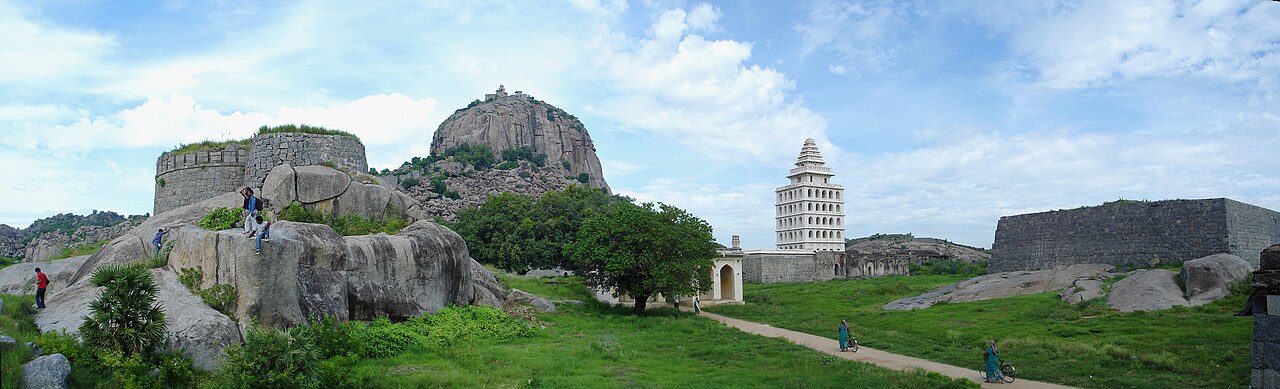
Gingee Fort or Senji Fort (also known as Chenji, Chanchi, Jinji or Senchi) in Tamil Nadu, India is one of the surviving forts in Tamil Nadu, India. It is popularly known as Great Wall of South India. It lies in Villupuram District, 160 kilometres (99 mi) from the state capital, Chennai, and is close to the Union Territory of Puducherry. It is ranked as the "most impregnable fortress in India", and was called the "Troy of the East" by the British.
Originally mentioned as the territory of a Kadava chieftain titled Senjiyar Kon in Ottakoothar's Moovarula around 1123 AD. The fort was originally built by Ananda kon around 11th century AD. The fort was built as a strategic place of fending off any invading armies. As per one account, the fort was further fortified during the 15–16th century. The fort was won for Swarajya by Subedar Harji Rajemahadik for the Marathas under the leadership of Shivaji in 1677 AD. It was then conquered by the Bijapur sultans, the Moghuls, the Carnatic Nawabs, the French and finally the British in 1761. The fort is closely associated with Raja Tej Singh, who unsuccessfully revolted against the Nawab of Arcot and eventually lost his life in a battle.
The Gingee Fort complex is on three hillocks: Krishnagiri to the north, Rajagiri or Anandagiri to the west and Chakilidurg to the southeast. The three hills together constitute a fort complex, each having a separate and self-contained citadel. The fort walls are 13 km (8.1 mi) and the three hills are connected by walls enclosing an area of 11 square kilometres (4.2 mi2). It was built at a height of 800 feet (240 m) and protected by an 80 feet (24 m) wide moat. The complex has a seven-storeyed Kalyana Mahal(marriage hall)which has a pyramidical shikhara or summit on top, granaries, prison cells, and a temple dedicated to its presiding goddess called Chenjiamman.
Text adapted from “Gingee Fort” on Wikipedia, CC BY-SA 4.0.
Gingee Fort ranks #940 of 9,079 worldwide in the atlas's castle fame ranking, and #34 of the 224 mapped in India. Founded c. 1050, it is older than 89% of the atlas's dated landmarks — one of 436 atlas entries founded in the 11th century. Its Wikipedia articles were opened 10,893 times in the last 60 days, more than 94% of the atlas. See how India compares in the castle statistics.
View on the interactive castle map →