Vesting
Gingee Fort
🇮🇳 India · 11e eeuw
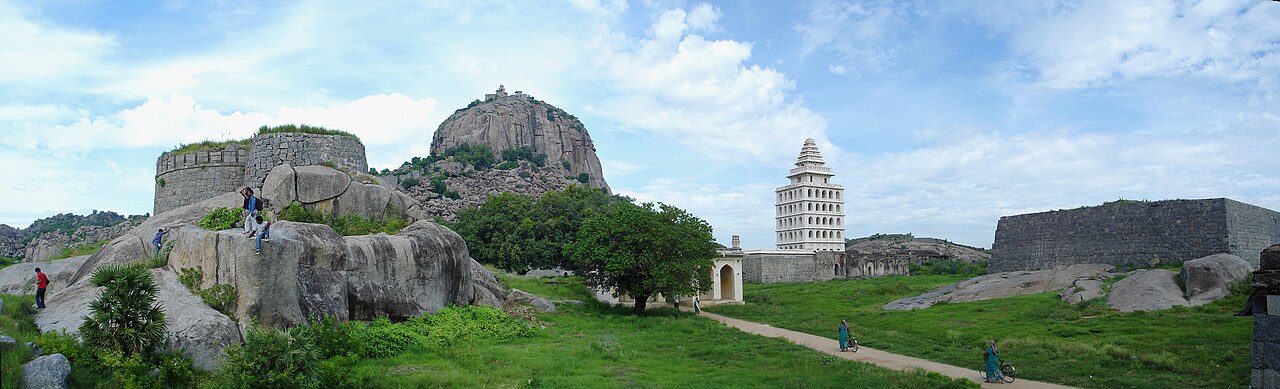
Gingee Fort of Senji Fort (ook bekend als Chenji, Chanchi, Jinji of Senchi) in Tamil Nadu, India, is een van de bewaard gebleven forten in Tamil Nadu, India. Het staat algemeen bekend als de Grote Muur van Zuid-India. Het ligt in het district Villupuram, 160 kilometer (99 mijl) van de deelstaathoofdstad Chennai, en dicht bij het unieterritorium Puducherry. Het wordt beschouwd als de "meest onneembare vesting van India" en werd door de Britten "het Troje van het Oosten" genoemd.
Oorspronkelijk vermeld als het gebied van een Kadava-hoofdman met de titel Senjiyar Kon in Ottakoothars Moovarula rond 1123 n.Chr. Het fort werd oorspronkelijk rond de 11e eeuw n.Chr. gebouwd door Ananda kon. Het fort werd gebouwd als een strategische plek om binnenvallende legers af te weren. Volgens één relaas werd het fort in de 15e-16e eeuw verder versterkt. Het fort werd in 1677 n.Chr. voor Swarajya gewonnen door Subedar Harji Rajemahadik voor de Maratha's onder leiding van Shivaji. Het werd daarna veroverd door de sultans van Bijapur, de Mogols, de nawabs van Carnatic, de Fransen en ten slotte in 1761 door de Britten. Het fort is nauw verbonden met Raja Tej Singh, die tevergeefs in opstand kwam tegen de nawab van Arcot en uiteindelijk het leven liet in een veldslag.
Het fortcomplex van Gingee ligt op drie heuvels: Krishnagiri in het noorden, Rajagiri of Anandagiri in het westen en Chakilidurg in het zuidoosten. De drie heuvels vormen samen een fortcomplex, elk met een afzonderlijke en zelfvoorzienende citadel. De fortmuren zijn 13 km (8,1 mijl) lang en de drie heuvels zijn verbonden door muren die een gebied van 11 vierkante kilometer (4,2 mi2) omsluiten. Het werd gebouwd op een hoogte van 800 voet (240 m) en beschermd door een 80 voet (24 m) brede gracht.
Machinaal vertaald uit “Gingee Fort” op de Engelstalige Wikipedia, CC BY-SA 4.0.
Gingee Fort staat op plaats 963 van 8.134 in de bekendheidsranglijst van deze atlas en op plaats 35 van de 179 die de atlas in India in kaart brengt. Gebouwd in ca. 1050, en daarmee ouder dan 90% van de gedateerde bouwwerken in de atlas — een van de 325 bouwwerken in de atlas die uit de 11e eeuw stammen. De Wikipedia-artikelen erover werden de afgelopen 60 dagen 10.893 keer geopend, meer dan 93% van de atlas. Zie hoe dat zich verhoudt in de kastelenstatistiek.
Bekijk op de interactieve kastelenkaart →Veelgestelde vragen
Waar ligt Gingee Fort?
Gingee Fort ligt in India, op 12.25083°, 79.39583°.
Wanneer werd Gingee Fort gebouwd?
De atlas dateert de stichting op ca. 1050. Er kunnen eerdere bouwwerken hebben gestaan; dit is het oudste gedocumenteerde bouwjaar.
Is Gingee Fort UNESCO-werelderfgoed?
Ja — volgens Wikidata maakt het deel uit van een UNESCO-werelderfgoedsite.
Hoe bekend is Gingee Fort?
In de bekendheidsranglijst van deze atlas: plaats 963 van 8.134 wereldwijd, plaats 35 in India. Bekendheid combineert het aantal Wikipedia-taalversies met het aantal lezers.
Welk kasteel ligt het dichtst bij Gingee Fort?
Fort St. David, ongeveer 70 km verderop.
Meer kastelen in India
- Khānderi Island India
- Harishchandragad India
- Kangla Fort India
- Bekal Fort India · 17e eeuw
Meer vestingen
- Acronauplia Griekenland
- Fort Frontenac Canada · 17e eeuw
- Fortaleza de Sagres Portugal · 15e eeuw
- Fort Amsterdam (Ghana) Ghana · 17e eeuw