 Spain · 13th century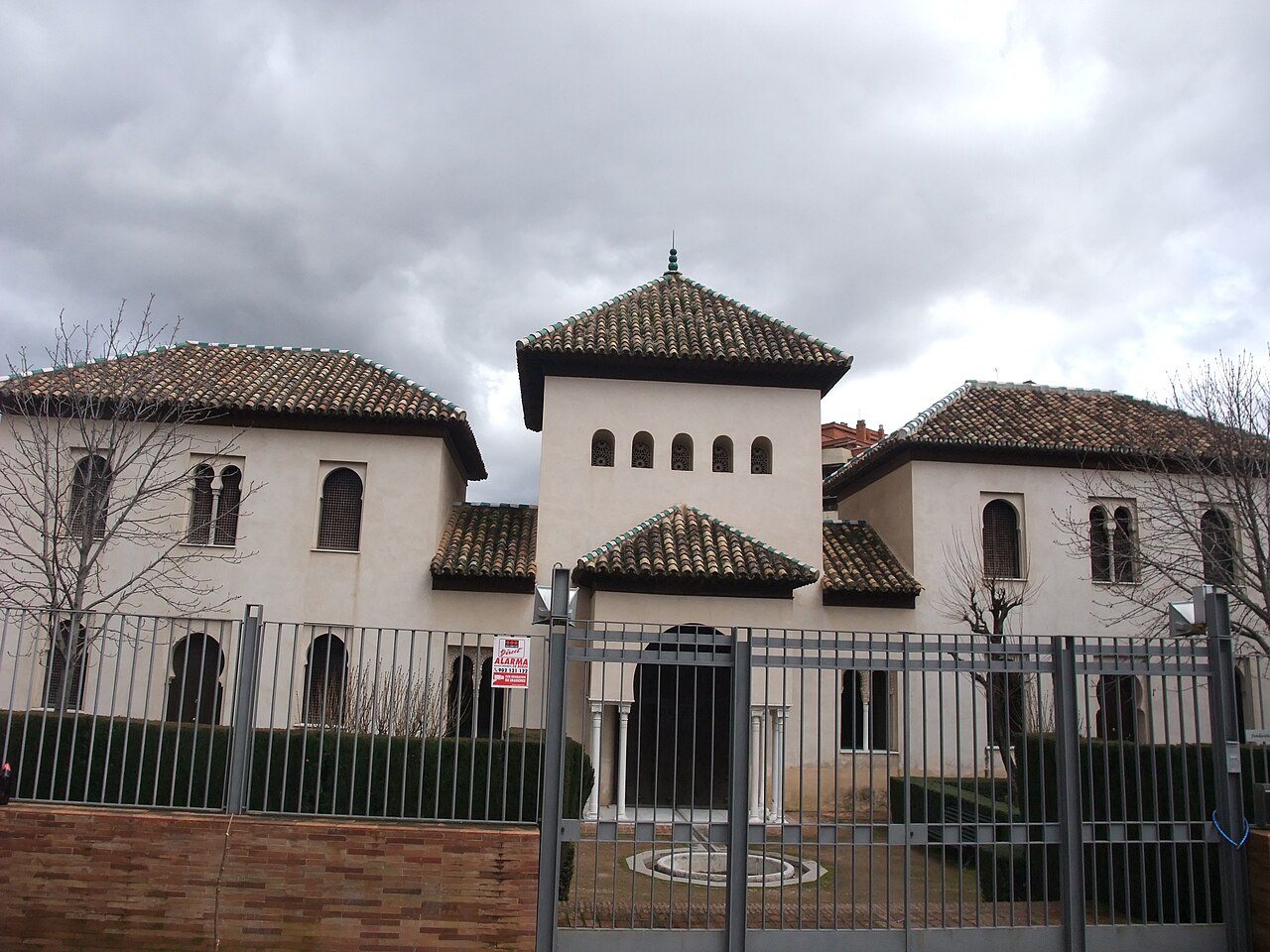
The Alcázar Genil is a Muslim-era palace in the city of Granada, Spain. It was originally called al-Qasr al-Sayyid ("the palace of the lord") and is located beside the River Genil outside the city walls. Today, only a pavilion of the palace is preserved. It currently houses the Francisco Ayala Foundation.
It was first built in 1218 or 1219 by Sayyid Ishaq ibn Yusuf, a member of the Almohad dynasty. The palace, built along the south shore of the Genil River, was located outside the city walls. It served as an almunia (from Arabic al-munya, meaning "farm"), a country villa that was used both as a private retreat for its elite owners as well as a farming estate with agricultural functions. A small ribat (religious retreat for Sufis) was also built nearby at the same time, consisting of a simple square hall covered by a sixteen-sided cupola with groin-vault squinches, with a sloped roof on the outside. This was later converted into a Christian hermitage and is now known as the Ermita de San Sebastián ("Hermitage of Saint Sebastian") or the rábita ("ribat").
In 1237, Muhammad I of the Nasrid dynasty took over Granada and the palace came under the new dynasty's possession. Muhammad I's grandson, Muhammad III (r. 1302–1309) temporarily lived here after he was dethroned, before he moved to Almuñécar. The decoration of the palace dates from the reign of Isma'il I (r. 1314–1325) or of Yusuf I (r. 1333–1354). It's possible that the current structure was also rebuilt at that time.
In 1892 the Spanish architect Rafael Contreras expanded the building by adding two wings on either side and a small porch on the front. The building was restored again in the 1980s and in 1994 by Pedro Salmerón Escobar.
Originally, the palace stood next to a large pool measuring 121 by 28 metres (397 by 92 ft), which formed part of an extensive water supply network used for agricultural irrigation. The pool may have also been used for aquatic games and displays. The original layout of the building, consisting of a central square chamber in the form of a qubba, with rectangular side chambers opening onto it, is an early example of a type of interior space which became common in Nasrid architecture. Only the central chamber of the palace was entered from the outside, such that the building was a relatively introverted space rather than one that was open to the gardens around it.
Text adapted from “Alcázar Genil” on Wikipedia, CC BY-SA 4.0.
Alcázar Genil ranks #4,443 of 9,035 worldwide in the atlas's castle fame ranking, and #184 of the 606 mapped in Spain. Founded 1218, it is older than 74% of the atlas's dated landmarks, one of 1090 atlas entries founded in the 13th century. 11 more atlas landmarks stand within 25 km. The nearest day-trip guide is Granada, 1 km away. It is one of the 123 landmarks on the atlas's regional map of Andalusia. It is stop 13 of 30 on the Andalusian frontier castles, Cádiz to Córdoba. See how Spain compares in the castle statistics.
View on the interactive castle map →